As someone who lives in a “lifestyle town” (a term I only recently learned, connoting a place where people move for the quality of life), I love talking to other people about what they do when they’re not working. Some people work all the time. Some people’s hobbies are pretty standard: movies, eating out. Some people have really esoteric hobbies: Buddhist archery, or food sculpture. Here’s some advice from me: when you work in a fast-paced, deadline-driven, word-centered job, you need some non-work interests that are a) slow, and b) wordless. This will help preserve your sanity and avoid burnout. Both are important if you want to stick with freelancing for the foreseeable future!
Slow hobbies have really exploded in popularity, at least in the US. Slow hobbies–knitting, weaving, embroidery, crocheting and so on–are now kind of a hipster thing, instead of a granny thing. I’m an avid knitter, and when I would knit back in college in the 90s, knitting was largely seen as a nursing home pastime. Whereas now when I visit the fancy knitting store in Boulder, I’m sometimes the oldest person in there (at age 45), or the only one without purple highlights in my hair. Knitting has progressed from toilet paper covers to bikinis, and cell phone covers, and even craftivism, a newly-coined term for political activism through crafting. My daughter and I volunteer at our local animal shelter (another slow hobby!) with a woman who runs crafting retreats as a job. Her theory, which I’m inclined to believe, is that as the rest of life gets faster, people want to spend their free time doing something slower. For us translators, I definitely recommend it!
Here’s the thing: in our jobs, one of the main questions we deal with is, “How fast can this be done?” We get that message from clients. We wonder it about learning a new piece of software, or setting up a website. How fast can I finish this? The content management system Squarespace even uses the slogan, “Create your own website in minutes!” There’s lots of “in minutes” out there. By contrast, here’s a sock I just finished knitting. I’d estimate that it took me about 8 or 10 hours:
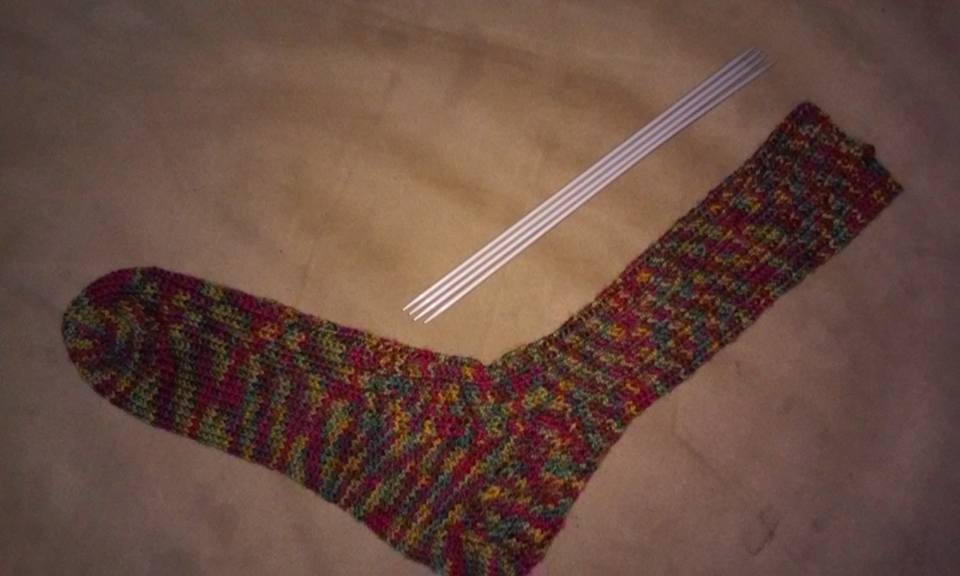
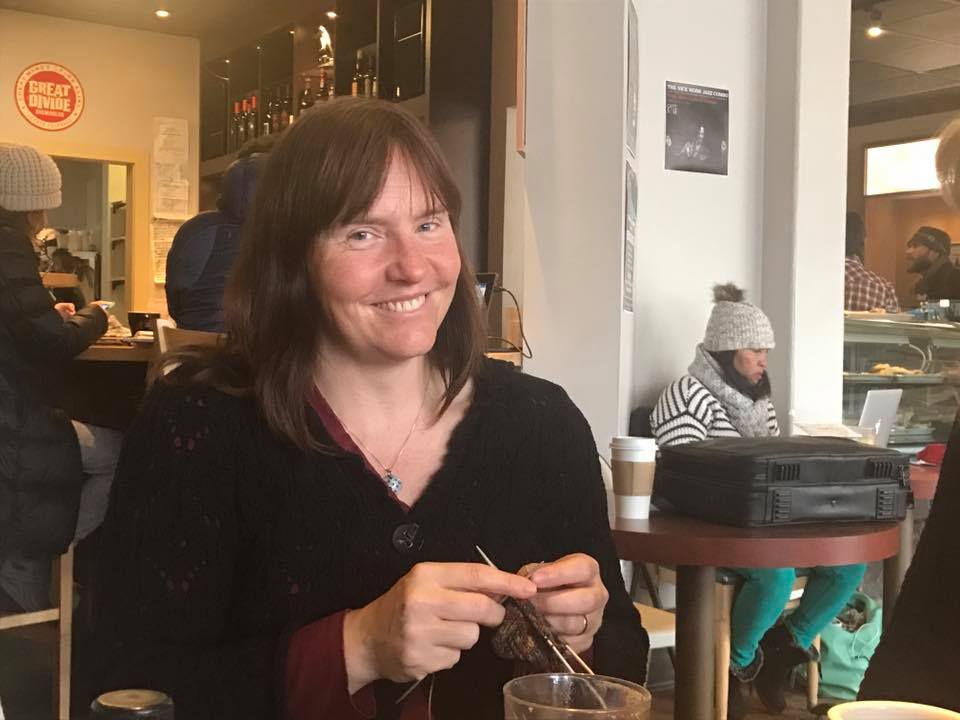
So, no “minutes” here: 8 or 10 hours of hanging out and knitting. Personally I find that knitting helps me relax and focus. By nature I’m an antsy, impatient person; I talk too fast, I read too fast, and I’m always eager to move on to the next thing. So when I get together with friends and want to just sit and talk (or even on conference calls), I often knit at the same time. Knitting has the added bonus of occupying your hands, so that you physically cannot check your phone or browse a mindless website. Like this (photo from Cris Silva at Colorado Translators Association coffee time!)
Playing the lute is an even slower hobby for me. After three years, I’m not the worst lute player you’ve ever heard, but I’ve barely (even with daily practice) progressed beyond what most people would consider the beginner level. On a good day, maybe advanced beginner. But slow progress is there. My rolled chords are starting to sound a little more like rolled chords than like arpeggios (string musicians will get that one!), and I play in a little group that brings me a lot of joy. And to me, the fact that learning to play an instrument is not an “in minutes” process is part of that joy: the joy of creating something that can’t be created in minutes, but rather takes hours/years of dedication to create.
And a word about wordless: at least for me, sometimes at the end of the day I’ve just had it with words. I love my job, but I rarely read an entire book unless we’re on vacation. I read the New Yorker in bed sometimes, but I also think it’s important to give your brain a break from words and use it in a different way. Music, sports, art, crafting, are all great ways to do that.
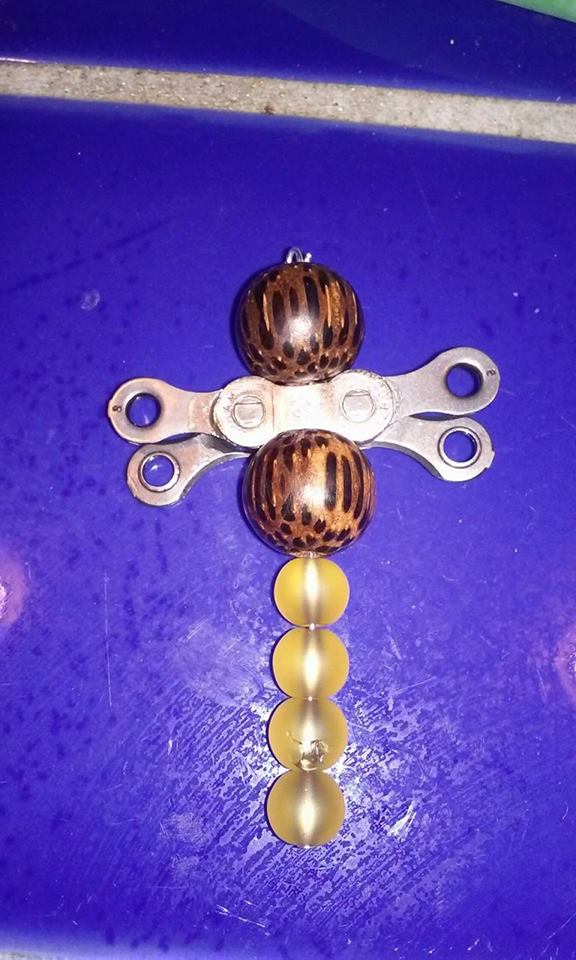
If you need some added inspiration, here’s a dragonfly pendant that my daughter and I crafted for her bike team Secret Santa. It’s strung on an eye pin, and the ‘wings’ are a link from a broken bike chain, combined with two wood beads for the head and body, and seaglass beads for the tail. Dab some super glue on the chain links so that they remain in flying position!
Corinne, this is an astute observation about the change of pace for our hobbies. Thank you for sharing it!
I certainly fit the wordless part, not sure about the slow one. I also like for my hobbies to be physical since translation is pretty sedentary, so I got involved in the Latin dancing community and joined a rec volleyball league. I find this provides my mind and body with a welcome break from routine and also enforces a hard stop to my work day.
Thanks, Maria! Yes, I love your point about physical activities. And that is so true that having other things scheduled is critical, so that your workday doesn’t creep into your non-work interests!
I see the notion of not reading books as a red flag. There is no way to be a good translator without reading constantly – in both your source language and your target language!
Interesting, thanks! I guess I would say that a) I read in French all day (for work), and I do actually read lots of blogs and web articles in English for research purposes, and b) I listen to lots of French podcasts to keep up my source language skills. But there’s definitely always more room for linguistic development!
That makes sense initially, but don’t forget that if you are translating you are *reading constantly* anyway. I much prefer to read in my target language, because I spend all ***ody day parsing German sentences and trying to unravel their thought-patterns. So I don’t really feel the need to do that in my free time too.
Thanks, Galina! Yes, that’s what I meant, but you said it much more eloquently!
Hi Corinne! Thought-provoking post for me, because I have a lot of word-based hobbies…writing, open mike nights and a major scrabble addiction (online and IRL). The “slow” aspect is especially illuminating, because you’re right, I’m definitely a “speed dial” kind of person. However, I do love a bit of secret crotcheting (which started off as a way of maximising time while watching films with my kids) so I am going to give myself permission for something “slow” in my life…congrats on the eight-hour sock! ; )
Thank you! I mean, I think the word hobbies aren’t the worst thing in the world (at least you *have* hobbies, right??) if they use your brain in a different way than translation does. But the crocheting sounds great too!
I agree wholeheartedly on both slowness and nonwordliness as hobby criteria. It’s interesting that the two you describe also combine time alone with time with others and even have a community aspect to them. I have way too many interests for my own good but my biggest hobby is my vegetable garden: it is physical, is productive, something I can do with my kids, and it gets me both literally outside but also takes me out of the navel-gazing inner world that I sometimes find myself sunk in while working a lot. And waiting days for seeds to germinate and then weeks or months for plants to grow is a serious exercise in slowness. I’ve made a couple of great friends through gardening who I order seeds with, trade jams and overabundant yields with, and even swap chickens with (really!). The fact that it is really hands-on and down-to-earth is a welcome antidote to the ethereal world of words, especially for jobs with clients you never meet or books you never actually hold. And sometimes it’s the time away, the time looking up that helps you regain the focus you needed or come up with the word that you couldn’t put your finger on. I’m curious to hear about other translators’ hobbies.
Thanks, Victoria! That sounds like a great antidote to translation (and good luck with the chicken-swapping!).
How timely – I’ve just taken up cross stitch after seeing some funny/geeky patterns online that I wanted to try out for myself. I agree, it’s great to do something that doesn’t require a screen or a deadline!
I tried knitting in the past but I wasn’t very good at it! Although, I keep seeing posts about “arm knitting” which looks kind of fun to try 😀
Thanks, Natalie! That sounds fun! And I do think that with the needle arts, it’s important to just go with what fits your personality. Cross stitch makes me nuts (all those little tiny crosses…aaaaah!), but I love knitting. Go figure. Have fun with it!
Hello Corinne,
Very true, you need a compensation for the long hours in front of the computer and the struggle for words. As I live in a very rural spot, my daily balancers are my two dogs who get me out of the house 3 times a day every day for abt. 2 hours with very few spoken words and a wide view to relax the eyes – perfect hobby!
Thanks, Helke! Yes, animals are such a great work/life balance tool too. Your walks sound perfect!
Dear Corinne,
Thank you for this post. I knit (not socks, because that’s not relaxing for me :-)) and I find that it both clears my head and leads me to new thoughts and thought patterns. And like Helke Heino, I appreciate the walks with my dog, away from computers and other electronic devices (although I do take my mobile phone with me …). I’d like to add a third hobby, which is baking. Also slow and very rewarding. As for reading books: It’s what I’ve always done since I started to read, but after a day filled with words, it’s not my recreational activity of choice. A while ago, I started to read more challenging books in the morning for about half an hour. It’s a luxury and I don’t always have time for it, but when I do it, I think I take more in than in the evening when I’m tired.
I agree about the dogs and gardening/allotments being great hobbies (if a dog can be described as a hobby – more of a lifestyle choice!). Cooking/baking is another favourite with me. I should probably describe myself as a lapsed knitter – I first started to knit at university as an antidote to all that reading (pre-digital age!) and knitted for years, especially when my children were young, but somehow have drifted away from it in recent years. I really should get back to it, as it’s very relaxing. Something else for the resolutions list!
Hi Corinne,
This post really resonated with me, and I totally agree about the need to have slow, non-wordy hobbies. My partner often tells me I should read more for pleasure (something I used to do a lot more before I became a translator), but somehow at the end of a long day of reading for work I don’t feel like it!
However, I sing with a choir which meets once a week and I have just taken up crocheting (a New Year’s Resolution!) – both of which I love. Baking is also another one of my favourite activities, but I tend to save that for weekends when I’ve got a bit more time on my hands.
Do you know if there’s a translators’ knitting/crocheting/cross stitch Facebook group? It seems like there are enough of us out there! 🙂
Thanks, Susie! Great examples. And it would be fun to start a translators’ crafting group…I’ll post pictures of the cat beds I made out of old sweaters 🙂
Hi Corrine. I think this is my first time commenting here! I guess I’m in the minority because my hobby is word-related. Other than watching movies and television series on Netflix or Iflix, my hobbies are reading and translating. Yes, translating! When I have some time on my hands (such as waiting at the doctor’s office), sometimes I translate something not work-related on my phone, such as short stories that I like. Creating the perfect sentence is just such a joy for me that I’m often drawn to it even when I don’t “have to” do it.
Interesting, thanks very much! That’s a neat example of translating things that are interesting, but that you wouldn’t translate for work. Thank you for braving your first comment 🙂
I grew up in Boulder in the 70s and 80s and even then it was a great place for pursuing all kinds of hobbies.
I don’t find that i want to avoid words so much as computers after a long day of translation work. I still love reading, but I will switch to audiobooks or fiction-oriented podcasts when I need to rest my eyes.
I run and highly recommend some sort of physical activity to maintain both body and brain as well as connect with the physical world. Playing instruments are another way I engage the non-verbal brain. Practicing occasionally, most of my instrument time is just noodling or sonic exploration.
In the last few years, I started playing tabletop games with people outside my family. This has been a good way to expand my non-work social network with a fun focus.
I used to be very involved in community volunteer activities, but they became too stressful for me to balance with work and family. They became just more work, but I need to find a way to keep my toes in.
This is great advice. I wish I had seen this a few weeks ago! I used to play saxophone in high school and in college, but I haven’t picked it up in years. Wordless and relaxing (and computer-less), but still intellectual, which seems like the perfect fit since I’m not an athlete by any means. I have to force myself to take walks and get exercise, so it’s not really very relaxing for me (everyone is different, of course), but music seems to hit all the right buttons. Great article!
Great, glad you enjoyed it Jonathan! Music really works for me; just seems to use your brain in a different way than words do.
I’ve been going for no words and no heavy use of hands, since they have been hurting a bit lately. My go to relaxation has been to go for a bike ride with my toddler boy, Bruno. It’s not only relaxing but healthy as well. We sit all day long. Exercising a bit is a must!