• Skip to main content

Training for Translators

Classes for translators and interpreters

  • Start here
  • Blog
  • Classes
    • Coaching for freelancers
    • Subscription
  • Books
    • Translate my books
    • Book Shop
  • About/Contact
    • Privacy Policy
  •  
  • Account

Work/life balance

Jun 06 2018
Corinne McKay

Freelancing with baby: the first year

This is a guest post by Rachel Sinn, a Spanish to English medical and pharmaceutical translator based in Colorado. I asked Rachel to write a post on her experiences managing her freelance business since giving birth to her first baby eight months ago. Specifically, Rachel has managed to juggle motherhood and freelancing while using little to no non-family child care. I get lots of requests from freelancing moms looking for real-life information, so I think you’ll enjoy this!

“So what are you guys going to do about child care?”

My friend smiled politely as my husband and I gave conflicting and somewhat vague accounts of our child care plans, because we hadn’t thought about it much. I was about five months pregnant. Later that night, that well-meaning question from a friend making small talk became a sleep-killing monster. What were we going to do about child care?

Of all the language-related trades, I chose translation at the tender age of 22 because I wanted to stay home with my future kids. At 30, with my first child kicking me on a daily basis, and with five years of translation work under my belt, I suddenly realized that it wasn’t going to be that easy. Cue several days weeks of panicked googling and calling around, only to encounter the dreaded daycare waitlist over and over again (30 months???).

After discouraging searches through hundreds of profiles on Care.com, endless daycare calls, and long talks, we decided to wing it. And I’m happy to say that I am still at home with my now eight-month-old daughter, and working close to full time. It has required a little creativity, and a reexamination of how we do life, but it’s possible and even enjoyable. Here are a few ideas if you’re looking to do the same.

Take a maternity leave
Childbirth is hard. Sleep deprivation is harder. As full-time employees, many women have the option to take 12 weeks of FMLA leave. I decided to give myself that amount of time as well. I notified all of my clients several months ahead of time, periodically reminded them nearer to the due date, and did so again the month of the due date. I also stopped taking projects with long deadlines the month of the due date. I took same day or next-day turnaround projects only (the opposite of what I did after my daughter was born!). I have two kinds of clients: giant translation agencies with hundreds of project managers and smaller, independent companies where I’ve been working with the same people for years. The former didn’t notice I was gone, and I had a good enough rapport with the latter that they happily congratulated me and told me to email them when I returned.

Ease back into it
When I decided I was ready to start working again, almost exactly three months later, I had to strategize how to do it. What worked for me was to “go back to work” for my best clients, a select few with whom I had a great relationship. You could call them my “A” clients. Great deadlines, interesting work, on-time payment, etc. Great deadlines were the key to the whole thing. I knew my schedule would be completely erratic for the foreseeable future (teething, sleep regressions, growth spurts, colds, the list goes on), which meant no same-day or next-day deadlines. I stuck with deadlines of two days or more at all times, and tried not to take more than one job at a time. I did this for about a month before going further. I’m happy to report that I was able to resume work with my “A” clients at about three months, and the rest around four to five months after my daughter was born. I didn’t lose a single client from going on maternity leave.

Rethink your schedule
My husband works full-time, so finding the time to get work done was tricky. I ended up translating during naps (an hour here, an hour there), and then in the evenings as well, when he or my mother-in-law could take the baby. I also ended up rearranging my workweek so that I worked over the weekend and took days off during the week. Far from being a handicap, this practice actually enabled me to take work other translators often refuse, thereby expanding my earning potential, and when I wanted to take the baby to story time at the library on a Wednesday morning, I didn’t feel like I was skipping out on work.

Beware the Mom-brain
Sleep deprivation is hard, and mom brain is real. You will put your phone in the fridge. You will find that your jeans have been inside out literally all day (how is that even possible?). I am fully aware that I might miss a deadline or make a serious error at any moment, simply because the baby was up five times the night before. I combat this problem by making the most of my productivity software. I set multiple reminders on my phone for each deadline (two days before, one day before, 4 hours before), I use Translation Office 3000 to track my projects and invoicing, and maybe most importantly, I use Google Assistant as my short term memory (e.g. “Ok Google, remind me to check on the term “X” in 10 minutes). Another tactic that has served me well is setting aside my translation for a good period of time, even overnight, and coming back to it with fresh eyes to edit and proofread. This is a good practice at the best of times, but as a new parent, it’s vitally important. A quality assurance tool like Xbench or Verifika may also be useful to check for number errors and consistency issues.

Working from home with an infant is an exercise in flexibility, but then so is parenting. By giving myself the time to recuperate and get to know my little one, starting back to work slowly, and putting plenty of safeguards in place to ensure my clients still benefit from my best work, I’ve been successful. Best of all, I get to be with my daughter for most of the day, and we don’t pay for child care. We are at eight months now, and still going strong!

Written by Corinne McKay · Categorized: Freelancing, Work/life balance, Working from home

Oct 02 2017
Corinne McKay

Work/life balance: “I can’t” versus “I choose not to”

The fourth quarter is upon us as of today, and along with it, the mad rush that always seems to come at the end of the year. Fourth quarter is nearly always my busiest in terms of work volume–add to that the ATA conference, planning for Thanksgiving, Christmas and New Year’s, and my daughter’s mountain bike race season, and a severe case of the scatters can set in. So let’s talk about work/life balance, and an important component thereof: differentiating between the “I can’t…” mindset and the “I choose not to…” mindset.

The “I can’t…” mindset seems to be particularly common among freelancers who have young kids; I know that I spent a lot of time thinking that way when my daughter was little. Such as:

  • I can’t work a full eight-hour day because my kids get home at 3
  • I can’t work even close to full-time in the summer because my kids are out of school

The “I can’t…” mindset is harmful because it deflects responsibility away from the person who’s really in charge: you! And when you start to be more accepting of your own choices, you’re much less stressed and frustrated, because you realize that you’re making a deliberate choice, not being backed into a corner by forces you can’t control.

For example: when my daughter was little, I definitely felt torn between my desire to spend a lot of time with her, and my desire to run a thriving business and have a fulfilling career. But at a certain point, I had to re-examine my thinking. Was it really not true that I “couldn’t” work a full day? Or “couldn’t” work much in the summers? Answer: absolutely not; lots of people with young kids do those things, by hiring child care, or utilizing the after-school program, or trading babysitting with friends. Many people even use options that are less appealing but achieve the end result of extending the work day: putting their kids in front of the TV for several hours, or putting expenses on credit cards to pay for extra child care.

Things changed when I realized that rather than being a cork in the sea of working motherhood and work/life balance, I was making deliberate choices based on my priorities. There’s a subtle but huge difference between saying, “I can’t work full-time in the summer because my kids are out of school,” (pants on fire…plenty of kids go to camp, even sleepaway camp, and plenty more are watched by babysitters) and saying, “I choose not to work full-time in the summer so that I can spend more time with my kids.” Coincidentally, I think that making that mindset shift also frees you up to actually enjoy the time, rather than feeling pulled in a million directions.

Even if you don’t have small kids, I think it’s important to adopt the “choices” mindset. For example, I recently started working with a new client who almost immediately asked me to do some work over a weekend. It was a small amount, but it had to be done on a Saturday morning. Rather than responding with a one-time excuse (“This Saturday, I can’t. My daughter has a mountain bike race and I may not have Internet access”), I just responded firmly but factually, “In general, I don’t work on weekends. I’d be happy to do this on Friday afternoon or Monday morning. Let me know if that would work for you.” Now that this boundary is set with that client, I don’t need to discuss it again, and the client is clear on my choice.

Readers, as the year ramps up toward its always-busy end, any thoughts on what you are choosing to do, or not to do?

Written by Corinne McKay · Categorized: Work/life balance · Tagged: freelance work/life balance, work/life balance for freelancers

Dec 09 2016
Corinne McKay

Work/life balance tip: you need some slow, non-word hobbies

As someone who lives in a “lifestyle town” (a term I only recently learned, connoting a place where people move for the quality of life), I love talking to other people about what they do when they’re not working. Some people work all the time. Some people’s hobbies are pretty standard: movies, eating out. Some people have really esoteric hobbies: Buddhist archery, or food sculpture. Here’s some advice from me: when you work in a fast-paced, deadline-driven, word-centered job, you need some non-work interests that are a) slow, and b) wordless. This will help preserve your sanity and avoid burnout. Both are important if you want to stick with freelancing for the foreseeable future!

Slow hobbies have really exploded in popularity, at least in the US. Slow hobbies–knitting, weaving, embroidery, crocheting and so on–are now kind of a hipster thing, instead of a granny thing. I’m an avid knitter, and when I would knit back in college in the 90s, knitting was largely seen as a nursing home pastime. Whereas now when I visit the fancy knitting store in Boulder, I’m sometimes the oldest person in there (at age 45), or the only one without purple highlights in my hair. Knitting has progressed from toilet paper covers to bikinis, and cell phone covers, and even craftivism, a newly-coined term for political activism through crafting. My daughter and I volunteer at our local animal shelter (another slow hobby!) with a woman who runs crafting retreats as a job. Her theory, which I’m inclined to believe, is that as the rest of life gets faster, people want to spend their free time doing something slower. For us translators, I definitely recommend it!

Here’s the thing: in our jobs, one of the main questions we deal with is, “How fast can this be done?” We get that message from clients. We wonder it about learning a new piece of software, or setting up a website. How fast can I finish this? The content management system Squarespace even uses the slogan, “Create your own website in minutes!” There’s lots of “in minutes” out there. By contrast, here’s a sock I just finished knitting. I’d estimate that it took me about 8 or 10 hours:
sock
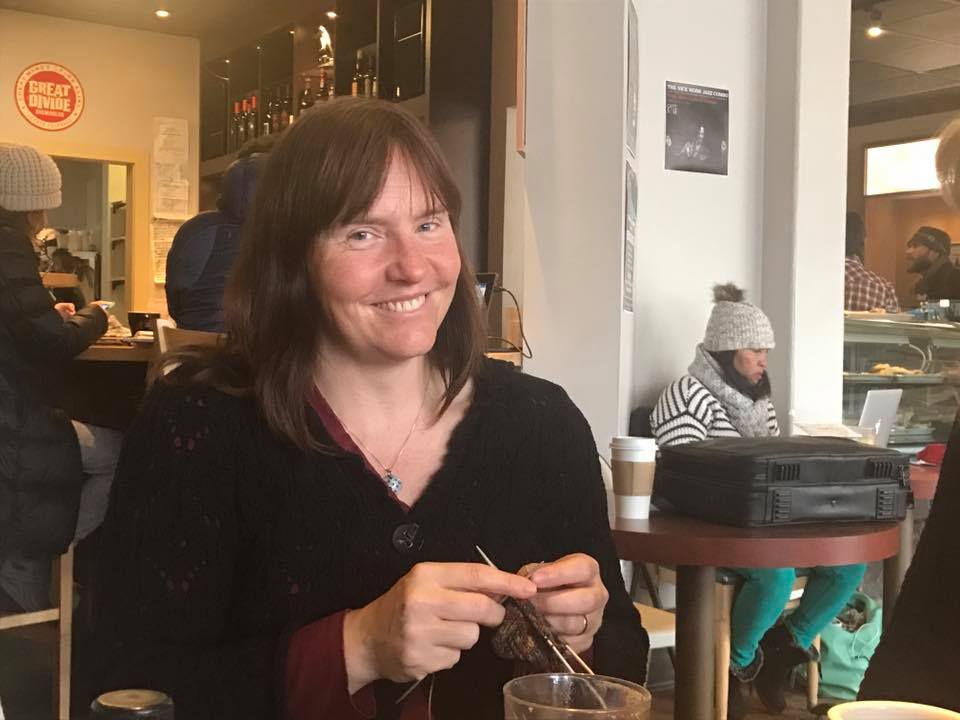
So, no “minutes” here: 8 or 10 hours of hanging out and knitting. Personally I find that knitting helps me relax and focus. By nature I’m an antsy, impatient person; I talk too fast, I read too fast, and I’m always eager to move on to the next thing. So when I get together with friends and want to just sit and talk (or even on conference calls), I often knit at the same time. Knitting has the added bonus of occupying your hands, so that you physically cannot check your phone or browse a mindless website. Like this (photo from Cris Silva at Colorado Translators Association coffee time!)
knitting

Playing the lute is an even slower hobby for me. After three years, I’m not the worst lute player you’ve ever heard, but I’ve barely (even with daily practice) progressed beyond what most people would consider the beginner level. On a good day, maybe advanced beginner. But slow progress is there. My rolled chords are starting to sound a little more like rolled chords than like arpeggios (string musicians will get that one!), and I play in a little group that brings me a lot of joy. And to me, the fact that learning to play an instrument is not an “in minutes” process is part of that joy: the joy of creating something that can’t be created in minutes, but rather takes hours/years of dedication to create.

And a word about wordless: at least for me, sometimes at the end of the day I’ve just had it with words. I love my job, but I rarely read an entire book unless we’re on vacation. I read the New Yorker in bed sometimes, but I also think it’s important to give your brain a break from words and use it in a different way. Music, sports, art, crafting, are all great ways to do that.

If you need some added inspiration, here’s a dragonfly pendant that my daughter and I crafted for her bike team Secret Santa. It’s strung on an eye pin, and the ‘wings’ are a link from a broken bike chain, combined with two wood beads for the head and body, and seaglass beads for the tail. Dab some super glue on the chain links so that they remain in flying position!
dragonfly

Written by Corinne McKay · Categorized: Work/life balance · Tagged: slow hobbies, work/life balance

Jan 25 2016
Corinne McKay

In the Balance: tips for perfectionists and overachievers

If you’re a successful freelancer, chances are that you’re a perfectionist, an overachiever, or both. These traits have a lot of pluses: no one wants to work with someone who’s sloppy, late and doesn’t sweat the details. But they can also have some negative consequences, such as causing you misery and chipping away at your relationships with other people.

In this installment of In the Balance, I suggest five ways to mitigate the negative effects of being a perfectionist and/or overachiever. Enjoy!

Written by Corinne McKay · Categorized: Videos, Work/life balance · Tagged: In the Balance, work-life balance for freelancers, work-life balance for translators

Dec 17 2015
Corinne McKay

Analyzing your own tendencies

Here’s a 30-second summary of this post: as a freelancer, you’ll find that some things feel effortless and some things feel like pushing a cement mixer up a hill. Analyze the difficult things and figure out how to make them less difficult, and your life will be much easier.

This post was inspired by a question from a student in one of my classes. “How do you stay so organized?,” she asked. “You seem to do a lot, but never get stressed or frazzled. What’s the secret?” And two answers popped into my head: 1) I’m probably somewhat less organized than I seem, and I do sometimes get stressed and frazzled (ask my husband!), and b) I don’t know: it just doesn’t feel that hard. I look at my day or my week, and think “What absolutely has to get done?,” then I do that first. Then I think “What should probably get done?,” and then I do that. And then if there’s any time left, I do the “as time allows” tasks. In 13 years of freelancing, I’ve never missed a deadline; a “late” day for me is when I finish work half an hour later than planned. So, when I talk to translators who report that they are routinely up until 2 AM, 3 AM, 4 AM finishing deadlines, I’m essentially never in that boat. I don’t use time tracking software, or a rigid schedule; I just eyeball it and everything seems to get done, in the available amount of time.

And there are other things that don’t feel that hard. I’m good with managing money: at my first job out of college, I made…wait for it…$750 a month plus room and board, and I had some money left at the end of the year. I’ve never carried a credit card balance in my life. In the same vein as time/productivity management, I just look at how much money I have available, and I spend a little less than that so that I can save some.

But…the fact is that everyone has facets of freelancing, or of life in general, that just come naturally. It’s hard to explain how you do them successfully, because you don’t know what you do: they’re just never a problem. Then there are the ‘cement mixer’ facets, which are things that you have to have a strategy for, because your natural tendency is to work against your own best interests. For me, food is one of those things. On the positive side, I’m a vegetarian and I love to exercise (another one of those “comes easily” things; I just don’t get what’s not to love about exercising!); on the negative side, I have the metabolism of a hibernating bear and I love good food; I’m also “fortunate” to be surrounded by people who are incredible cooks–my husband, my parents who live near us, various friends. So there’s never a lack of something tempting to eat. It’s not a crisis, but, like a translator routinely finishing deadlines at 3 AM, or never paying off the last $1,000 of the credit card debt, I gain-lose-gain-lose-gain-lose the same 10 pounds, over and over again.

For me, food is my “can’t just eyeball it” issue. I find diets depressing and counterproductive, but without a system, I chronically eat a little too much, a little too often. Because I’ve recognized this tendency in myself, I’ve developed some systems to protect against it, and to keep the chronic 10 pounds from becoming 50 or 100. I think you can apply this system to your “can’t just eyeball it” issues as well, so that if you can’t overcome them completely, you can at least keep them from dominating your life:

    • Avoid unrealistic rigidity, or anything that involves the words “never again.” You’re not going to immediately start following a to-the-minute time tracking plan, or a to-the-penny budget, or a no-peanut-butter-cheesecake-ever-again-in-this-lifetime rule. Pick small adjustments that you think you can stick to: no Facebook during the work day; no non-paying work until the paying work is done; let non-critical e-mail wait until the end of the day; put $50 in an envelope at the beginning of the month, and that’s your coffee money; leave your credit card at home in a drawer so that you cannot use it for impulse purchases.
    • But create a system that overrides your natural tendencies. For example I have some simple guidelines I try to follow: no more than two cups of coffee a day (because I drink it with cream and sugar), otherwise only water and herb tea; only raw fruits and vegetables for snacks; no eating straight out of a bag or box, only out of a single serving in a bowl, etc. To me, these don’t feel punitive: they feel like the speedometer on a car; just a little tool that helps you stay in bounds.

Whatever your problematic tendency is, you can create a system like this to help you: make a simple checklist of small adjustments that you need to make in order to be successful. Don’t look at it as a punishment, or as if you can’t be trusted to manage your own actions. In my experience, that will only make you more obsessive about the problematic issue. Just give yourself a dashboard gauge so that you can slow down when you’re five miles an hour over the speed limit instead of 30.

Written by Corinne McKay · Categorized: Money, Productivity, Work/life balance · Tagged: money management for freelancers, time management for freelancers

  • Page 1
  • Page 2
  • Go to Next Page »

Copyright © 2026 · Training For Translators · Log in

This website uses cookies to improve your experience. We'll assume you're OK with this, but you can opt-out if you wish. To view this website's privacy policy, click About>Privacy Policy. Accept Read More
Privacy & Cookies Policy

Privacy Overview

This website uses cookies to improve your experience while you navigate through the website. Out of these, the cookies that are categorized as necessary are stored on your browser as they are essential for the working of basic functionalities of the website. We also use third-party cookies that help us analyze and understand how you use this website. These cookies will be stored in your browser only with your consent. You also have the option to opt-out of these cookies. But opting out of some of these cookies may affect your browsing experience.
Necessary
Always Enabled
Necessary cookies are absolutely essential for the website to function properly. This category only includes cookies that ensures basic functionalities and security features of the website. These cookies do not store any personal information.
Non-necessary
Any cookies that may not be particularly necessary for the website to function and is used specifically to collect user personal data via analytics, ads, other embedded contents are termed as non-necessary cookies. It is mandatory to procure user consent prior to running these cookies on your website.
SAVE & ACCEPT