
Corinne McKay (classes@trainingfortranslators.com) is the founder of Training for Translators, and has been a full-time freelancer since 2002. An ATA-certified French to English translator and Colorado court-certified interpreter, she also holds a Master of Conference Interpreting from Glendon College. For more tips and insights, join the Training for Translators mailing list!
Although I love hiking, I’ve never really had a passion for climbing the Colorado 14’ers; the 58 mountains in Colorado that are over 14,000 feet and that meet the definition of being a 14’er. I climbed exactly one 14’er in the first 20 years that we lived in Colorado, and that was only because some friends proposed doing Mt. Bierstadt (one of the easiest) with our families when the kids were little. But between 2012 and 2024, I climbed zero 14’ers!
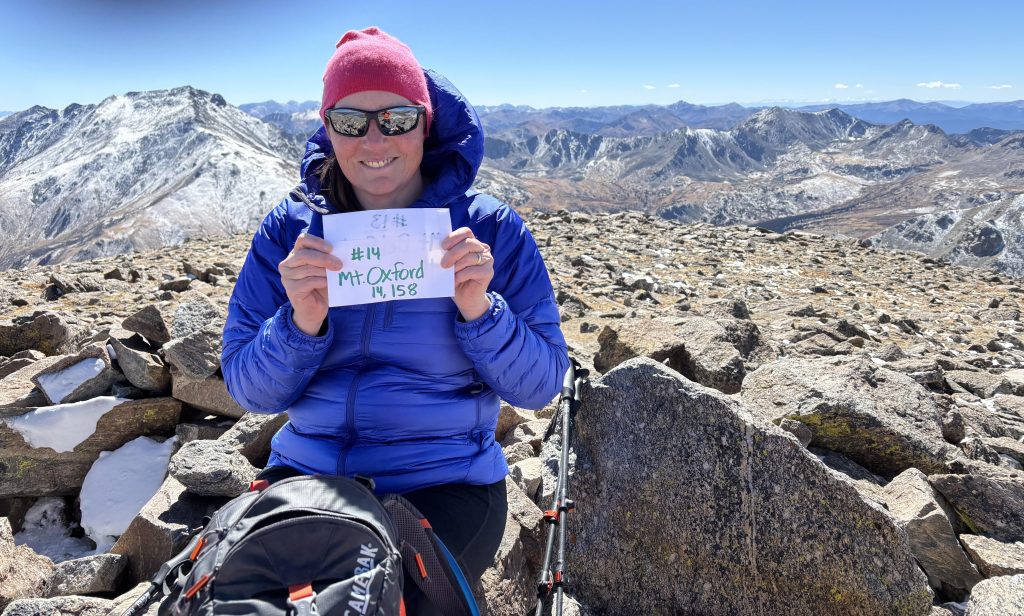
For a variety of reasons, 14’er fever hit me in 2024. Typically, my husband and I spend most of the summer mountain biking, but he was laid up with an injury, while my daughter (who has had 14’er fever for a while) was home from college for a few weeks. In the end, I hiked nine peaks that summer (Quandary, Sherman, Elbert, Grays/Torrey’s, and Democrat/Cameron/Lincoln/Bross) which got me to 10 total. Then it seemed like a cool goal to hit 14 total, so in the summer of 2025 I did Huron, Yale, and Belford/Oxford), and now I’m “thinking about thinking about” trying to get to 25 total before I turn 55 in September 2026 (we’ll see!).
How hard are 14’ers and how do you research them?
If you have any interest in 14’ers, I would start with 14ers.com, its corresponding app, and its Facebook group. I like the website/app for basic research. It has the elevation, trail information, and access descriptions for all 58 peaks, plus lots of helpful categories like the easiest 14’ers. The Facebook group is very helpful for real-time information (snow conditions, can you get to a certain trailhead in a certain type of vehicle).
Access is an issue with some 14’ers. Some trailheads are accessible only with a high-clearance all wheel drive vehicle, otherwise you have to park at a lower trailhead and walk up, and some of those walks can be long. Some trailheads, especially for the peaks closest to Denver, get very crowded on weekends. The 14’ers Facebook group has stories of people getting shut out before 5 AM to climb Bierstadt. On a couple of the peaks, the summit is on private land, so you can’t hike to the true summit. This was the case with Bross when my daughter and I did the Decalibron (a four-peak loop combining Democrat, Cameron, Lincoln, and Bross). Yet other peaks are completely on private land. Kind of crazy-cool to have a 14’er as your backyard, but land ownership in Colorado predates the 14’er checklist phenomenon. Different landowners handle this in different ways: some have a QR code electronic waiver, and some (most notably Culebra Peak as of this writing) require you to obtain a permit in advance. Point being, don’t just show up in a low-clearance, 2WD rental car and expect to drive right to these trailheads. Do your research ahead of time and find out what the road is like, whether there is trailhead parking, whether you need a permit, and what your options are if parking is limited.
Due to parking issues, especially on summer and fall weekends, there are frequent discussions on the 14’ers Facebook group about whether sleeping inside your vehicle constitutes “camping.” Most of the 14’er trailheads prohibit “camping” in the parking lot, but are you “camping” or “taking a nap in the back seat of your car” if you’re sleeping there ahead of a hike. Opinions vary on this! I’ve never done it, but I have slept in my car at a legal, dispersed campsite before climbing Huron Peak, and that worked out fine.
The next thing a lot of people wonder: how hard are these things to climb? Of course, it depends. Your fitness level, acclimatization, etc. are hugely important, and there’s a lot of variation across 58 peaks. I’m focusing only on the Class 1 and 2 peaks, which means that you just walk. You don’t climb using your hands for balance (other than a few short sections, like the top of Mt. Yale), and you definitely don’t climb using a rope. But there are peaks where you can do those things if you want to!
But let’s take a stab at the “how hard” question. Everyone has pluses and minuses Mine include:
- I’m in decent shape and I love long hikes
- I’m a relatively slow hiker
- When I hike, I dislike stopping. I really only stop if I need to eat or drink, I rarely/almost never stop just to take a break.
All of these factors will contribute to your assessment of “how hard”? But for reference, here’s my round-trip time on all of these hikes so far. This is door-to-door, including hiking time and breaks, via the standard route unless otherwise specified. Again, with the caveat that I’m a slow hiker but I don’t stop much.
- Quandary: 6 hours
- Sherman, from the Leadville side: 4 hours
- Elbert, from Halfmoon Creek: 7 1/2 hours
- Gray’s/Torrey’s: 6 1/2 hours from the upper trailhead, but this does not include walking three miles up the access road (got a ride on the way back)
- Democrat/Cameron/Lincoln/Bross: 6 1/2 hours
- Huron: 7 1/2 hours from the 2WD parking lot, but this includes spending a fairly long time on the summit to wait for friends
- Yale: 8 hours from the Denny Creek side
- Belford/Oxford: 10 hours, but this includes both peaks and taking the longer (Elkhead Pass drainage) way down
An additional factor is altitude, especially if you live at sea level. We live in Boulder (5,430 feet) and the altitude still affects me, and there’s really no way to “train” for altitude other than being there, unless you go all in on something like an acclimatization tent at your house. It’s also important to note that you can get actual altitude sickness above around 8,000 feet, and certainly above 10,000 feet, so you should know the signs and descend immediately if you feel sick.
Altitude gets more tolerable as you acclimatize, so if you have an option to stay in the Colorado high country for a week to 10 days, you’ll feel better!
Preparation and gear
It’s pretty amazing to me, and I mean this as a data point, not a judgment, how many unprepared people you see on 14’ers, in terms of both physical training and gear. Always a few people in jeans and Crocs, always a few people carrying a water bottle, a protein bar, and not much else (which might work if you’re trail running, but not for an all-day hike), always a few people who walk for 10 minutes and stop for 30 minutes and lots of people who seem relatively unaware of the risk of being struck by lightning.
Everyone should do 14’ers in the way that makes them happy, as long as you’re not causing a risk to other people. My preparation includes:
- Mentally acknowledging that it’s OK to turn around at any time. When people say that the mountains aren’t going anywhere, they’re right. If something feels “off” or a storm rolls in, better to get down alive and try it another time.
- Taking enough food and clothing to spend a night outside if things really go to heck (someone gets seriously sick or hurt). It might not be a pleasant night, but I want that safety margin.
- Starting early enough to be off the summit before 12. Because I’m slow, this generally means getting up at 5 AM and being on the trail by 6.
- Checking multiple weather forecasts. I usually try to compare NOAA, Apple Weather, and Mountain Forecast. Even with all of those sources, we’ve had hikes where the weather was significantly better, and significantly worse than what was predicted. Which underscores the importance of having a goal but being willing to turn around.
- Pacing. It took me a long time to learn that at least for me, the slowest continuous pace is still faster than stop and go. You see a lot of people on 14’ers who are fast when they’re moving, but they’re moving only about 50% of the time. This isn’t a criticism; you do you, that’s part of the enjoyment. But if you’re slow, I think you’re better off focusing on a sustainable pace rather than pushing yourself and having to stop a lot.
My gear includes:
- Good boots that don’t give me blisters, currently the Asolo Finder, because I found a good deal on a nice pair that had been worn once. For 14’ers, I prefer boots (not trail runners) with a rigid sole and some ankle support. This is not the case for flatter, smoother trails. For example I did Grand Canyon Rim to Rim (the subject of a future post!) in Altra trail runners and I was glad to not be wearing boots for that.
- Good socks (I’m a fan of Ballega and Darn Tough)
- A Garmin InReach mini satellite communicator. I know that opinions vary on these, but I’m a believer, especially since my husband did end up pulling the SOS on ours, on a backcountry ski trip two years ago (everything turned out fine). Carry the InReach (or any similar device) on the outside of your pack, in a spot where you can reach it with your dominant hand. I put mine on a miniature locking carabiner on the front of my left pack strap.
- A good backpack. I use the appropriately named Camelbak Fourteener with a three-liter water bladder. It has a lot of carrying capacity and I find it very comfortable.
- Food. Lots of food. I’m in general a food girl and not someone who “forgets to eat,” but on long hikes I tend to lose my appetite. I check my watch and force myself to eat approximately every hour and a half to two hours. Generally I don’t take a “meal,” just a ton of different snacks so that I have lots of options. I like to mix up protein-y things (Aussie Bites, Kind bars, peanut M&Ms, salted mixed nuts) with some pure sugar (Nerds gummy clusters, chocolate covered salted caramels), and some salty stuff (corn chips, peanut butter crackers). This way, there’s almost always something that seems appealing. If it’s likely to be hot, I also take a separate one-liter bottle of Liquid IV or a similar electrolyte drink, and I always have a couple of emergency nutrition items like a caffeinated gel and an extra packet of electrolyte drink powder, figuring that I could eat it if needed.
- First aid kit. Definitely take at least the basics: bandaids, medical tape, blister kit, Ace bandage, sunscreen, ibuprofen or Tylenol, lip balm
- Layered clothes and a waterproof jacket and waterproof gloves or mittens. I have a pretty basic Patagonia shell jacket and a pair of windstopper gloves, then I always take a sun hat, a warm hat, a packable down jacket, and an additional layer like a fleece pullover. When you’re packing clothes, you need to think not just of how you feel when you’re hiking, but what happens if you have to stop for an extended period of time because of weather, someone feels sick, gets hurt, etc. etc. And the usual clothing rules: no cotton, quick-dry fabrics only, and watch out for fabrics that chafe, because you’re going to be swinging your legs and arms for a long time.
- Trekking poles. I love my poles and I never do strenuous hikes without them. My husband got me the REI Flash carbon poles as a gift, and they’re great. I like them for balance, and because it gives your arms something to do while you’re walking.
- A sign for the summit!! No kidding! It’s totally a thing on 14’ers. People haul all kinds of commemorative signs up there! I’m not that creative or energetic, but I do take a piece of paper with the name of the peak, the summit altitude, and how many 14’ers it makes for me.
Access information and my favorite hikes
I’ve really enjoyed all of the 14’ers that I’ve done; there are none that I would put on the “never again” list. To be fair, this is probably because we live just a couple of hours’ drive from most of these peaks and I have the flexibility to go when the weather is good and the trails are less crowded. I don’t go when it’s raining, and I don’t get up at 3 AM. Herewith, a few preferences:
- The access to Grey’s and Torrey’s is a pain if you don’t have a high-clearance vehicle. Our car, a Kia EV6, is all-wheel drive but low clearance, so we parked at the lower, 2WD parking lot and hoofed it the three miles up the road. We were able to hitch a ride back down, but I think if I did this hike again, I would rent a Jeep or similar.
- Mt. Elbert, because it’s the highest peak in Colorado, is always crowded in terms of parking. My daughter and I did it on a weekday and got the second to last spot in the main parking area at 5:45 AM.
- For Huron Peak, a friend and I camped in the dispersed camping area at the base of the 4WD road and that worked out well. I was glad we weren’t driving the dirt access road in the dark.
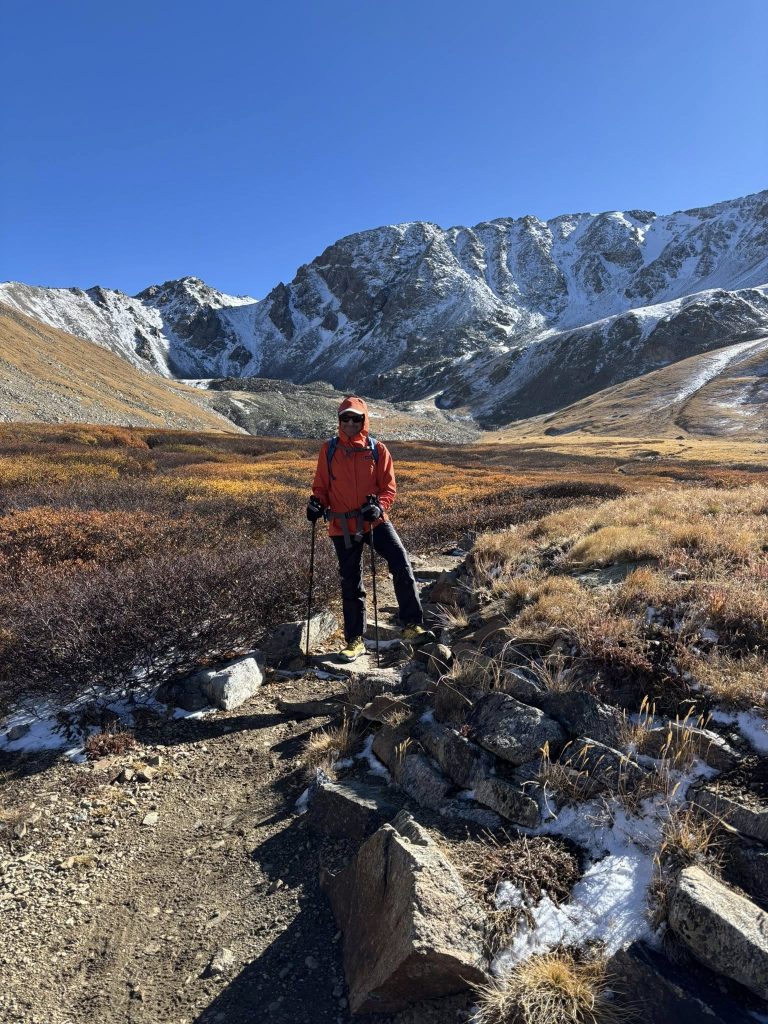
- I would categorize Belford/Oxford plus the Elkhead Pass descent as probably the most beautiful of the hikes I’ve done (husband pictured below; we did this in October, when the light was really gorgeous!).
What’s next?!
I mean, really, who knows, right?? Lots of wild cards coming out of the deck in the world in general these days. But I have my eye on a few peaks for this summer. I’d need to do 11 more to get to 25, which feels ambitious but doable.
The access road to Mt. Blue Sky was closed last year for construction, and it’s supposed to open on Memorial Day this year, so that’s definitely on the list, as is Pikes Peak via the Barr Trail. I may do a trip down to lake Lake City and hit at least Sunshine and Handies. I still haven’t done Massive (near Leadville, a town where we often go for fun), so I feel like I have some good options and at least the potential of doing 10+ 14’ers this summer.
I hope these tips are helpful if you’re planning an adventure of your own!
Leave a Reply