In July 2026, I sent two surveys to my mailing list (~5,000 subscribers) with various questions about the state of freelance translation.
The survey was limited to people who earn the majority of their income as a freelance word person (translator, interpreter, editor, subtitler, etc.), not those who have a full-time job and do this work as a side hustle. For the first survey (general questions about the state of freelancing), 337 people responded, and for the second survey (questions specifically about translation work), 229 people responded.
Following are the results from survey #1, including the data and some comments from me. There were also many (many) individual and “Other” responses that I don’t have space to include here but that I’ve incorporated into my comments. Thank you to everyone who responded! I appreciate your honesty and vulnerability in helping to create this snapshot of where our professions are headed in these turbulent times!
- Question 1: What freelance services do you provide?
- Question 2: If you do machine translation post-editing, why do you do it?
- Question 3: How long have you been freelancing?
- Question 4: What languages do you work in?
- Question 5: Compared to 2025, is your 2026 income…
- Question 6: Compared to 2022 (the last year before ChatGPT really had an effect), is your income:
- Question 7: In 2025, what was your gross freelance income in U.S. dollars? Include everything you earned, *other than* subcontracting/money you took in and immediately paid out to someone else.
- Question 9: Do you want to add anything about your income?
- Question 10: How satisfied do you feel in your freelance career right now? 0 being the lowest and 10 being the highest.
- Question 10: In the past year, how often have you thought about looking for an in-house job or leaving the language business entirely? 0 being “not at all” and 10 being “very often.”
- Question 11: To your knowledge, have you lost a client to AI?
- Question 12: How do you feel about the future of your freelance business?
- Question 13: How do you use AI tools in your freelance business? Choose all that apply.
- Question 14: Which best describes your feelings about the effect of AI on the language business in recent years? Choose only one.
- Question 15: If you’ve started working with a new client in 2026, how did you find them or did they find you? Choose all that apply.
- Question 16: Do you currently work for…
- Question 17: When you think about marketing your freelance business, which of the following statements feel accurate to you? Choose all that apply.
- Question 18: To wrap up, which of the following statements best expresses your thoughts about your freelance business right now? Choose only one.
- Question 19: Anything else you want to tell me?
- So…yeah!
Question 1: What freelance services do you provide?
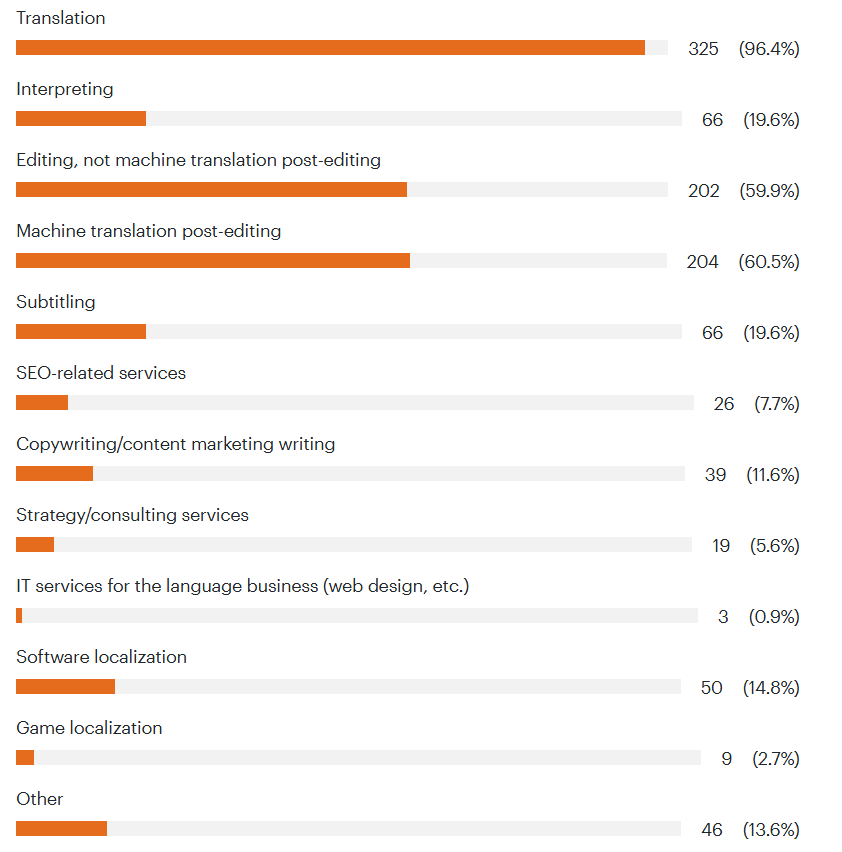
Interesting, I thought I had more interpreters on my list!
“Other” responses included:
- Transcription
- Language teaching
- Voiceover
- Back-translation
- AI training
- Glossary creation
- Teaching T&I in a graduate program
- Bilingual hostess for international conferences
Question 2: If you do machine translation post-editing, why do you do it?
Admittedly, I asked this question for selfish reasons. I hate MTPE, and I thought that its widespread implementation might cause a massive disruption in the industry because translators would simply refuse to do it. Wrong! The MTPE market seems to be thriving, so I wondered why so many people are willing to do this work? Survey says…
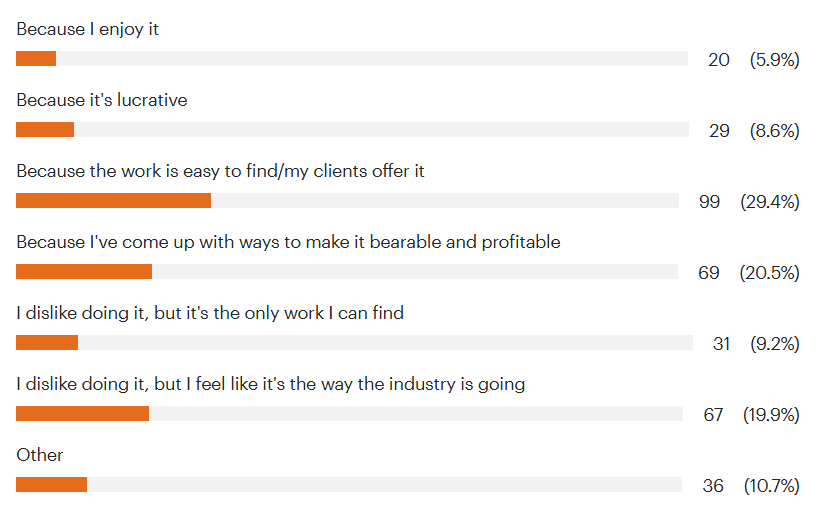
In a sense, I was correct, with only ~6% of respondents doing MTPE because they enjoy it. The “Other” responses were enlightening, indicating mainly that:
- People accept MTPE because “it’s better than not working”
- People accept MTPE in order to retain clients who also send other types of work
Question 3: How long have you been freelancing?
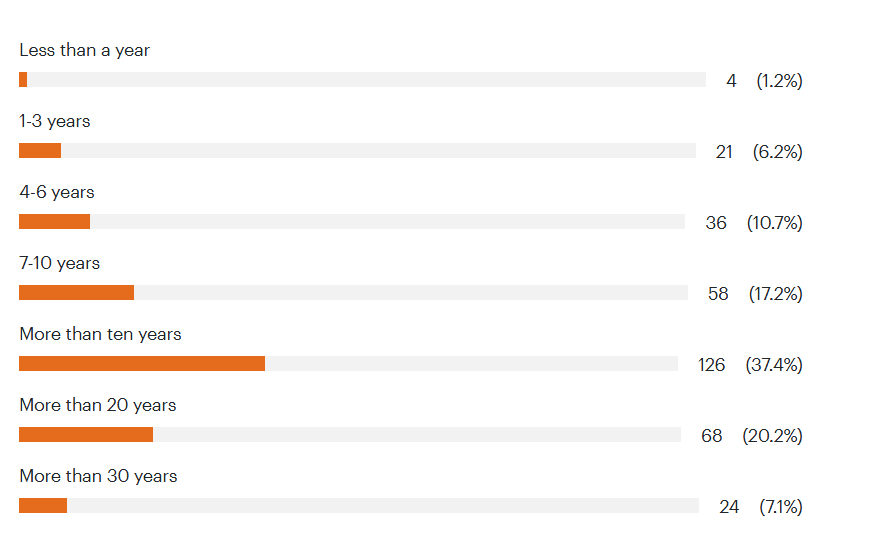
About what I expected! I think it’s interesting that the number of relative newbies (1-3 years) and very experienced freelancers (30+ years) is about the same.
Question 4: What languages do you work in?
This was an open-answer question, so no statistics. As expected, lots of French, Spanish, and German, but also everything else: Greek, Arabic, Breton, Italian, Russian, Portuguese, Polish, Japanese, Latin, Bulgarian, Vietnamese, Serbian, and a few others. I think this gives a good cross-section of the current language market.
Question 5: Compared to 2025, is your 2026 income…
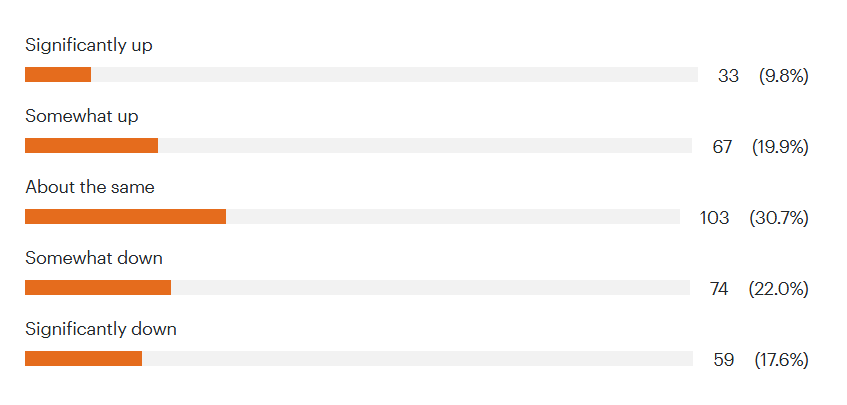
On the surface, this looks pretty positive, with 61% of respondents reporting that their income is the same, up, or significantly up since last year.
However, the next question yields a different picture.
Question 6: Compared to 2022 (the last year before ChatGPT really had an effect), is your income:
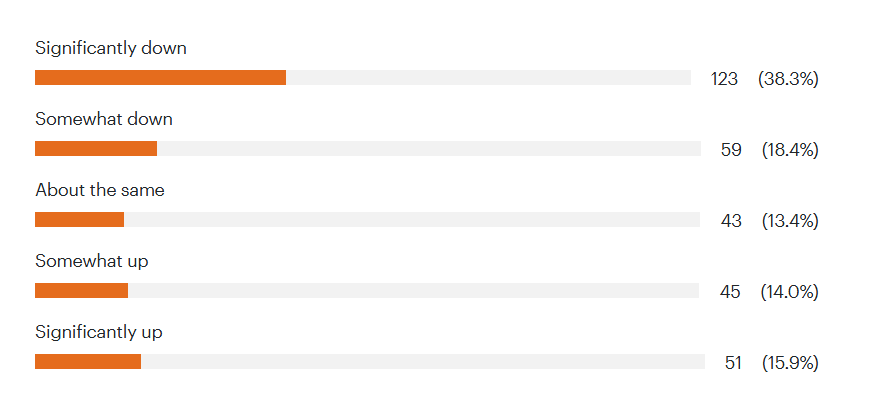
Here, we’ve got nearly 50% of respondents reporting that their income is down, or significantly down since 2022.
Question 7: In 2025, what was your gross freelance income in U.S. dollars? Include everything you earned, *other than* subcontracting/money you took in and immediately paid out to someone else.
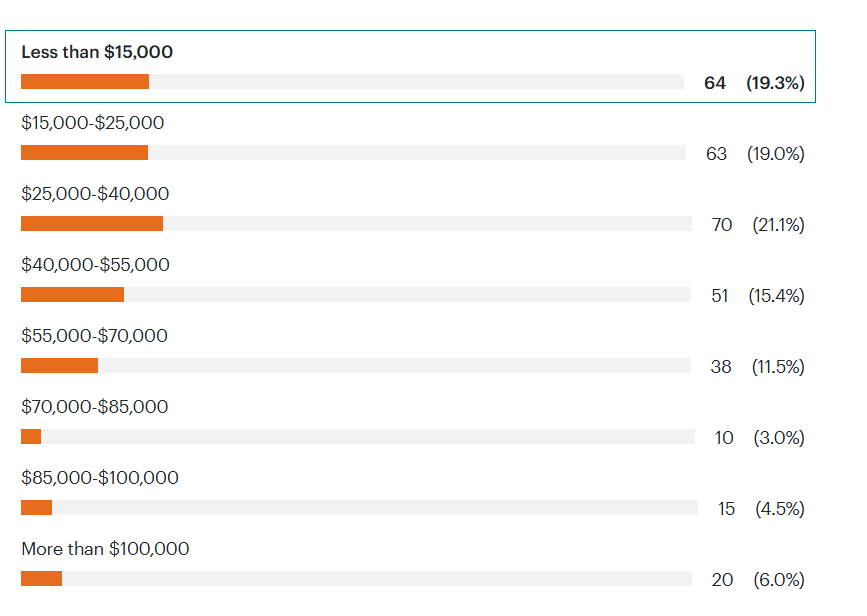
This question isn’t detailed enough to provide much meaningful data (is the respondent working full time, part time, what’s their cost of living, are they freelancing alongside caregiving responsibilities, etc. etc.). But I did find it surprising (in a good way!) that 20 respondents are earning six figures.
Question 9: Do you want to add anything about your income?
Here again, open-ended answers only so no statistics. But very interesting responses, including:
- Multiple people leaning on interpreting for income
- Multiple people with personal situations that kept them from working full time last year
- Multiple people making the bulk of their income from one client or even one project/assignment
- Some people who live in countries with low costs of living
- Some people intentionally working part-time
Question 10: How satisfied do you feel in your freelance career right now? 0 being the lowest and 10 being the highest.
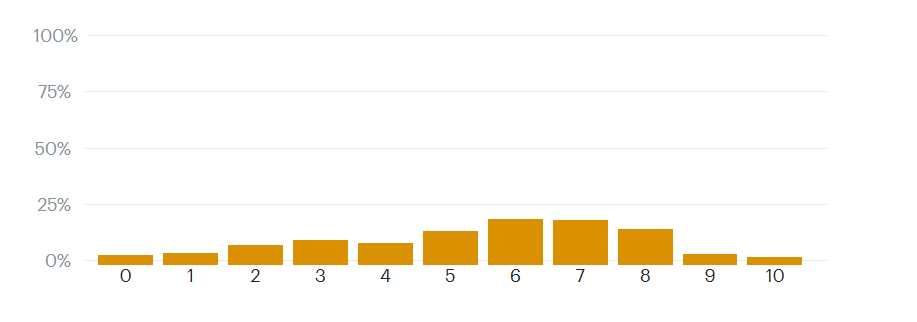
“Meh” is about what I expected, with the majority of responses in the 5-8 range, clustered around the 6-7 range, and very few people in 0-1 or 9-10.
Question 10: In the past year, how often have you thought about looking for an in-house job or leaving the language business entirely? 0 being “not at all” and 10 being “very often.”
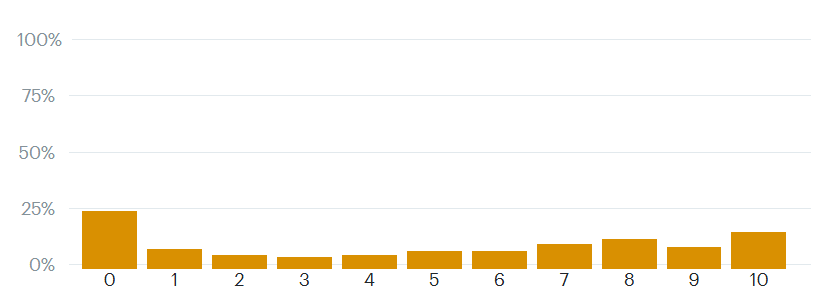
I should have worded this differently. I really wanted to know: “Do you ever fantasize about not being a translator anymore?” Multiple people messaged me to say, “I never think about leaving the language business because I’m not sure what else I would do,” or “I never think about looking for an in-house job because I can’t imagine giving up the flexibility of freelancing.” That being said, the polarized responses didn’t surprise me that much. Most freelancers who contact me are doing pretty well, or really poorly, and not a whole lot in between.
Question 11: To your knowledge, have you lost a client to AI?
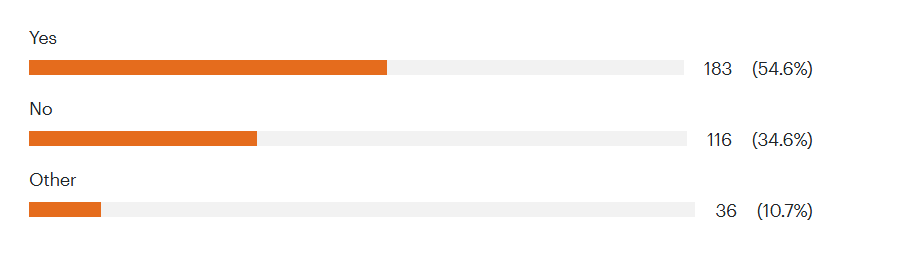
I expected more people to answer “Yes.” However, I should have asked two different questions: one for translation, and one for interpreting. I’m wondering how many of the “No” answers are from interpreters. The most common “Other” response: “My clients are having so many issues that I don’t know why they’re sending less work or not using me at all.” A few people mentioned increased work due to AI: for example monolingual editing/improvement of poorly written AI-generated texts.
Question 12: How do you feel about the future of your freelance business?
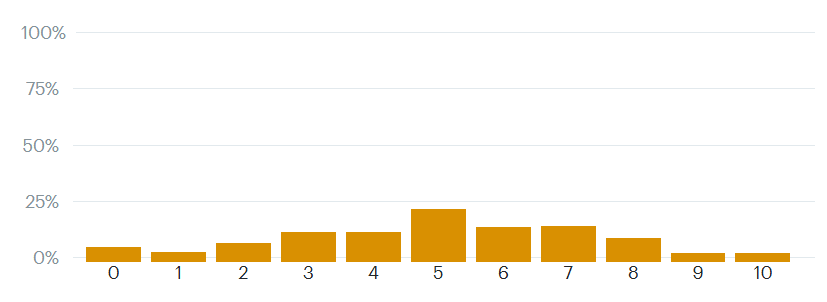
Here again, a resounding “meh.” Very few people are totally miserable, or really happy.
Question 13: How do you use AI tools in your freelance business? Choose all that apply.
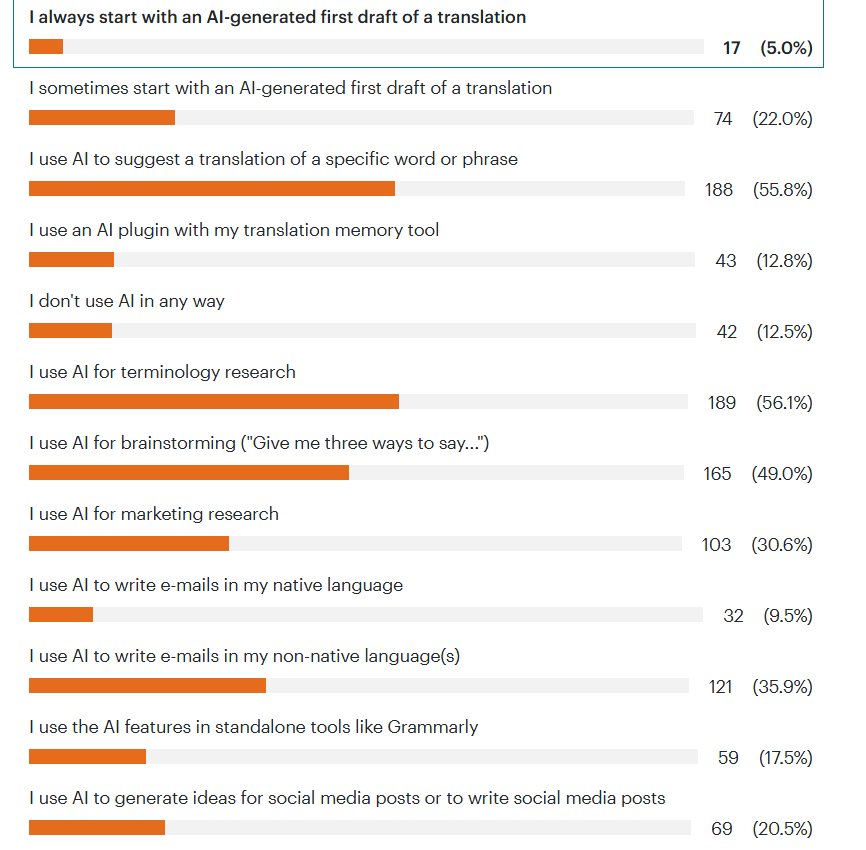
Definitely some surprises here! 27% of respondents always or sometimes start from an AI-generated first draft? The surprise probably reflects my own bias (I do this 0% of the time). I also thought that there would be more never-evers, given that various surveys put non-AI users at 35-50% of the U.S. population.
“Other” ways of using AI included: analyzing freelance business data, brainstorming about rates, generating interpreting practice speeches, explaining source text concepts, proofreading and QA, and getting AI’s suggestions on tricky client situations.
Question 14: Which best describes your feelings about the effect of AI on the language business in recent years? Choose only one.
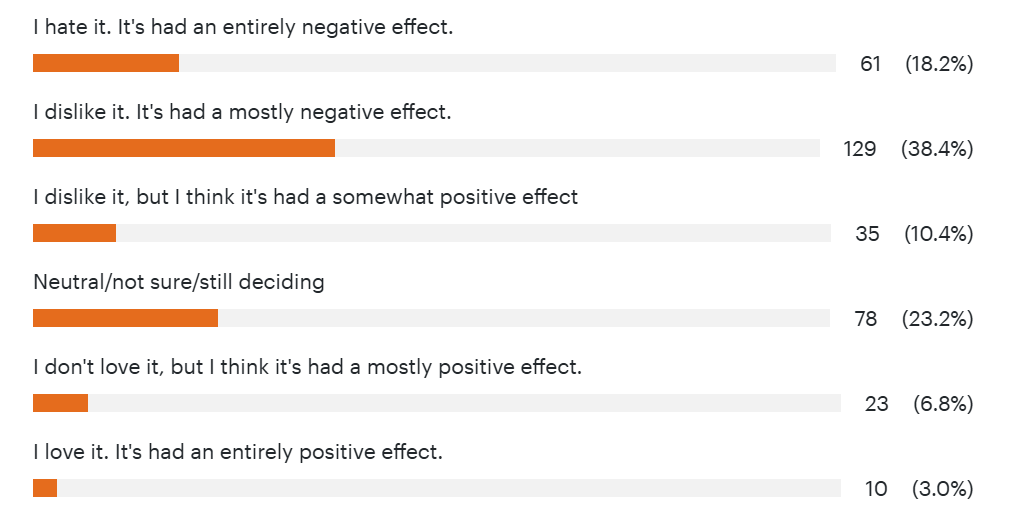
Answers here mirrored the vibe I perceive on LinkedIn and similar platforms: “hate” might be too strong a word, but most freelancers feel neutral at best about the effect of AI on the language professions.
Question 15: If you’ve started working with a new client in 2026, how did you find them or did they find you? Choose all that apply.
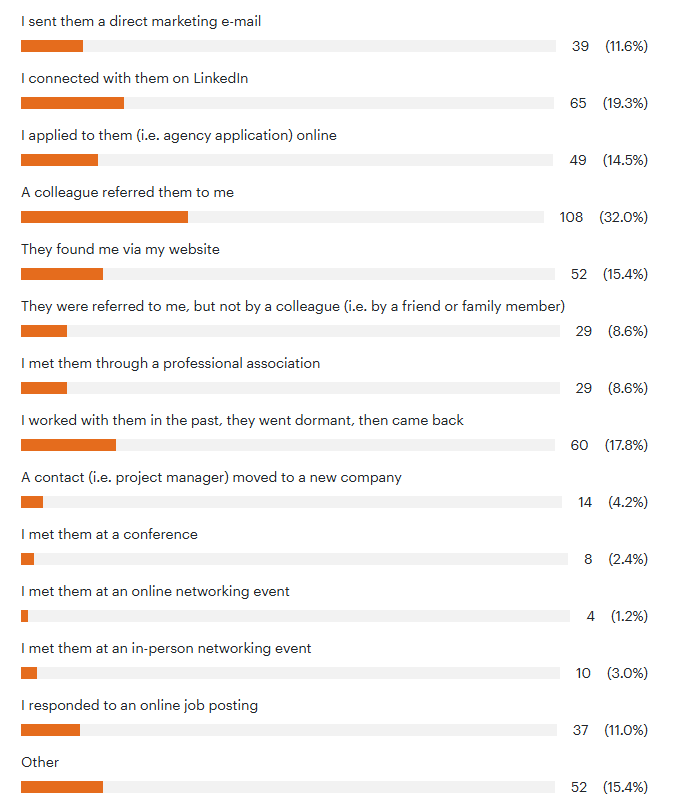
As expected, active marketing is pretty low on most freelancers’ lists! The “Other” answers were some of the most interesting here:
- Client found me through a translators’ association directory (this was the most common “Other” response)
- Met them at a trade fair
- Sent them a letter in the mail
- They found me on LinkedIn
Question 16: Do you currently work for…
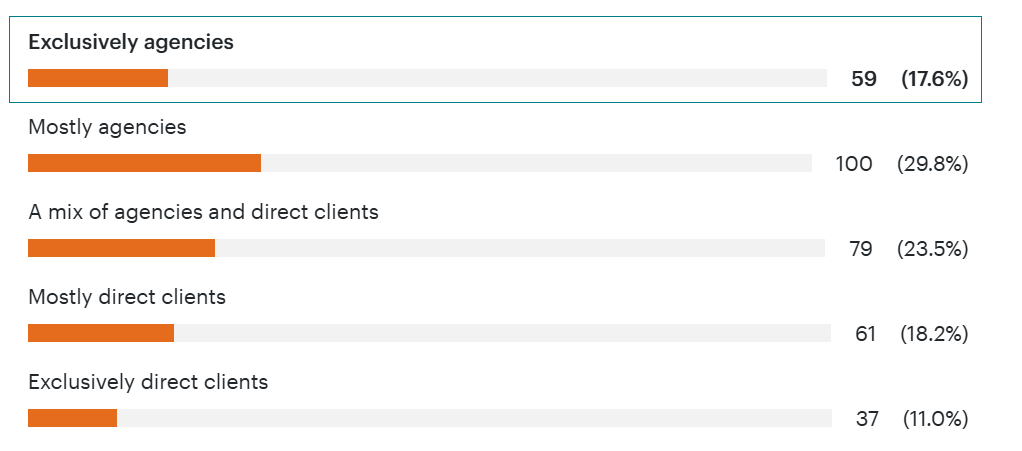
More people working for direct clients than I would have thought! This would seem to indicate that more than half of respondents are working for at least some direct clients.
Question 17: When you think about marketing your freelance business, which of the following statements feel accurate to you? Choose all that apply.
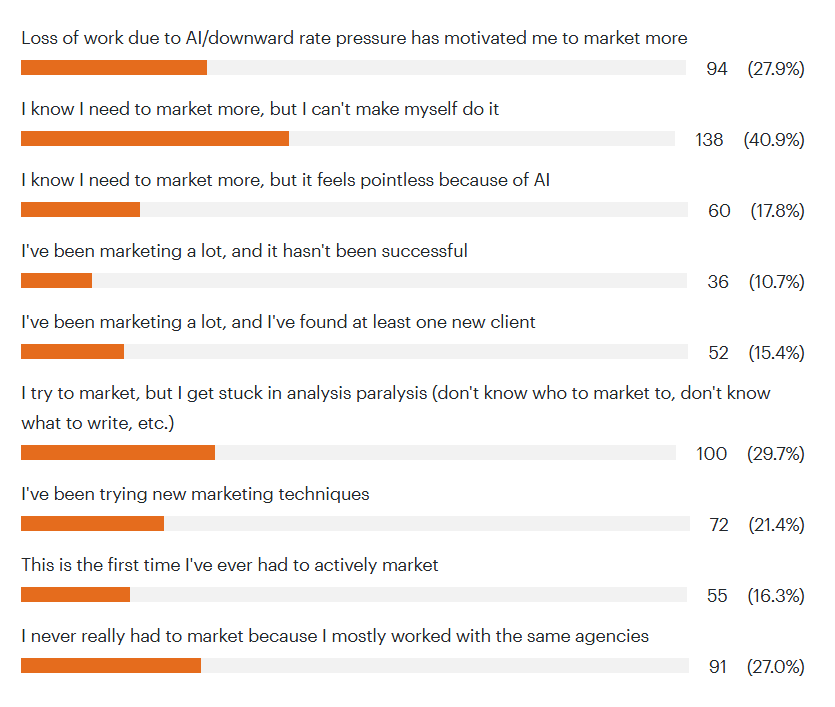
These stats are a little sobering, but on par with what I expected. So many mid-career translators have been hit with a one-two punch: losing work to AI, and having to actively market for the first time in their careers. So they’re trying to migrate from “three agencies and a Gmail address,” to actual entrepreneurship, and that’s not easy. Kudos to the 15% of respondents who’ve found a new client through active marketing, and I’m encouraged that only 10% of respondents say that their marketing has not been successful.
Question 18: To wrap up, which of the following statements best expresses your thoughts about your freelance business right now? Choose only one.
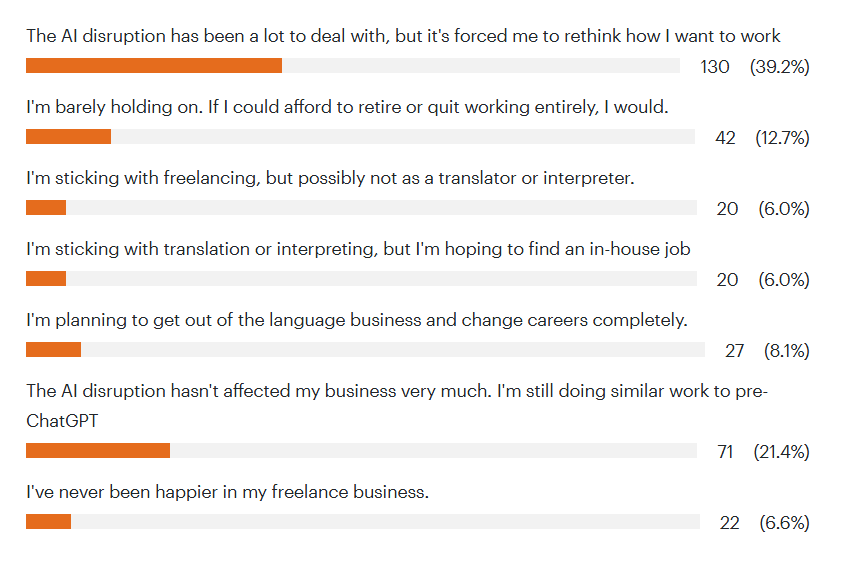
I’d say we ended on a positive note, with almost 70% of respondents saying either that the AI disruption has forced them to rethink how they want to work (which I’d put in the long-term Win column: always good to be intentional), or that AI hasn’t affected their business very much, or that they’ve never been happier in their freelance business.
Question 19: Anything else you want to tell me?
I ask people this question, in all kinds of situations, all the time. It’s one that we should be asking more often. Just put it out there: What else do you want to tell me about this topic? That’s where you often get the most interesting information.
I’m not going to copy/paste the responses, because a lot of people said very personal things and I don’t want to violate their trust. But to summarize and paraphrase:
- Lots of references to work falling off a cliff. I see this as a huge shift from previous economic disruptions where work might have wavered, but rarely cratered. “I lost all of my income at once, six months ago.” “I let one client take too much of my time, then they replaced me with someone else when I sent on vacation and never came back.” “My income dropped by 50% from 2024 to 2025 because my main client sent 75% less work.” My sense here: lots of people’s client base narrowed down to only the good ones, then one or more of the good ones abruptly stopped sending work.
- Lots of references to grief, sadness, confusion, and fear. Even people who are doing OK financially commented on this: “I don’t necessarily disagree with the AI disruption but it makes me sad and confused, I don’t know what to do next.” “Things in my business are fine, but it’s hard not to feed off colleagues’ fears.” “I could afford to retire if I wanted to, but I don’t want to feel like a quitter.” “In many ways I’d like to find an in-house job or leave the language business entirely, but I love being a translator and have no idea what else I would do.” “I spent decades cultivating skills that no one values anymore.” Several people mentioned feeling depressed and even suicidal (to the person who commented this, I’m truly sorry that you’re struggling to this extent, and please know that you matter in the world and there are mental health resources that can help).
- Many people feeling that AI is being oversold as a translation solution. Several people made the distinction between clients’ trained, in-house, proprietary AI systems, and ChatGPT. Many people expressed frustration with the poor quality of the AI-generated translations they’re asked to edit, and that clients don’t seem to care about things like consistency, word choice, tone, etc. “AI has filled the web with empty and often incorrect content; it’s tiring to see people who don’t even know the difference between a good text and a bad text anymore.”
- Several references to markets that seem relatively unaffected by AI. I don’t want to name these specifically and give away these people’s “trade secrets,” but several respondents commented that their clients never cared about technology and still don’t/they’ve never mentioned AI.
- Several references to “what about the new people”? I found this interesting: several people commented that their own workflow is fine, but they worry about how newcomers to the profession will learn to translate in the AI era? Or will translation programs teach only MTPE? Other people commented that they started freelancing within the past few years and have found it slow going: “Agencies seem to want only MTPE and are paying below my minimum rate.” “I’d like to be a gaming translator and that may not even exist anymore, it’s all post-editing.” “I planned to learn the ropes by translating for agencies, but it’s all low-paid MTPE.”
So…yeah!
This was a lot of information to absorb, and in some ways left me mostly with more questions. Which is why I then sent a part II of the survey, specifically about translation work. That’s a topic for a future post! In the meantime, I really (really) appreciate the thought and care that everyone put into their responses, and I hope this information is helpful to various sectors of the language business!

Corinne McKay (classes@trainingfortranslators.com) is the founder of Training for Translators, and has been a full-time freelancer since 2002. An ATA-certified French to English translator and Colorado court-certified interpreter, she also holds a Master of Conference Interpreting from Glendon College. For more tips and insights, join the Training for Translators mailing list!
Leave a Reply