• Skip to main content
  • Skip to primary sidebar

Training for Translators

Classes for translators and interpreters

  • Start here
  • Blog
  • Classes
    • Coaching for freelancers
    • Subscription
  • Books
    • Translate my books
    • Book Shop
  • About/Contact
    • Privacy Policy
  •  
  • Account

Travel

May 24 2024
Corinne McKay

Budget travel tips

To get our weekly posts directly in your inbox, sign up for the Training for Translators mailing list!

This week’s topic: Budget travel tips

Because a) I just got back from roughly two weeks off; first on a hiking trip in Switzerland with my sister-in-law, (Bern-Mürren-Leysin-Geneva) then at the NAJIT conference, so I’m feeling a little mentally drained, b) summer vacation season is coming up, and c) as usual I’m a frustrated travel writer, I thought I’d do a post about budget travel tips. I won’t even call this “off-topic” because every translator and interpreter loves to travel! Here we go; my top tips for hitting the road on the cheap!

Determine your tolerance for the miles and points game

I’m putting this first because it’s a big one. I listen to a lot of travel podcasts, and it’s easy to be drawn in by the promise of “never fly economy again,” “fly business class to Europe for free at least once a year.” And people are really doing this! One of my favorite miles and points podcasts is Frequent Miler, and one of the hosts recently discussed how he scored four business-class tickets to Asia on miles and points.

However, there’s a big “however.” If you dig in (and Frequent Miler is totally up-front about this, which I appreciate), you’ll learn that it’s really difficult to accumulate this many points through normal travel and spending. The real gold mine is in credit card sign-up bonuses, which require more management and tracking than I personally want to do. You need to be constantly tracking which cards are offering the juiciest sign-up bonuses, then meeting the minimum spend (the amount you have to charge to the card in the first few months in order to get the bonus), then paying that card off, cancelling it, and signing up for a new one, sometimes holding three or more cards at one time. Even for free tickets, I’m not ready to go there yet, partially because I’m very financially conservative (I have one credit card and pay it off every month), and partially because I don’t want the hassle of transferring all of my auto-pays over to a new credit card several times a year.

Either way, make the most of the credit card(s) that you have

Even if you don’t want to play the credit card signup game, there are other things you should be doing to save money on travel.

  • Make sure you’re getting all the benefits from the credit card(s) that you have. For example, I have the Southwest Rapid Rewards Premier card, and it was news to me (after reading Frequent Miler’s complete guide to the Southwest Rapid Rewards program) that the card gives me free Early-Bird check-in on two flights a year. Who knew? Not me! I want to use this the next time I fly, especially because rumors are swirling that Southwest may end open seating soon, which may put an end to the whole Early-Bird check-in situation.
  • Check for double/triple/quadruple (or even more!) points increases. My Southwest card gives triple points on all Southwest purchases: a big boost! On a recent Frequent Miler episode, one of the hosts commented that one of his cards has a “rent day” special, where you get double points on all purchases on the first day of the month, even if those purchases are already automatically doubled or tripled. In his case, the card gives triple points on dining, so if you eat out on the first of the month, you actually get 6x points. Make sure that you’re taking advantage of these types of offers!

Other ways to save money on airfare

My other two airplane tickets hacks are pretty simple, but effective. Book early, and try not to travel on peak dates. When my daughter was growing up, we often went to Europe for the month of July, and I would typically book the tickets in December or January. Likewise, when I went to Iceland last summer, we paid around $600 round trip for the tickets (less than I paid for my daughter to fly from New Jersey to Colorado for winter break!!) by booking about six months ahead.

The “avoid peak dates” advice applies in large and small ways. The reality is, if you have kids, you’re locked into their school vacations, so you can’t travel during the shoulder seasons in May and October. This is still true for us now that my daughter is in college, and we take a “splurge” trip over New Year’s (most recently to Belize) every year. But I’ve found that by slightly shifting our dates, for example going from December 30-January 6, slightly later than most people take their holiday vacation, the airfare is less crazy. And traveling during the shoulder season, which I can now do when I travel by myself, is really where it’s at. For my recent trip to Switzerland, I paid $1,200 on United (already a good deal), even though I flew into and out of different cities (into Zurich and out of Geneva). I think this would have easily been over $2,000 in July or August.

Once you’re there, spend strategically

Some places (Switzerland) are generally very expensive, and others (Belize) are generally pretty cheap. My husband and I backpacked in Asia for a year after we got married, and if we spent $20 on a hotel room in Thailand (outside Bangkok), it was a really, really nice place. But the key, especially in an expensive place, is to spend strategically. Is your priority a nice hotel? Great meals? A particular guided activity that you want to do?

Taking my recent Switzerland trip as an example, we stayed in three-star hotels that were about $250 a night including breakfast (fairly “budget” for Switzerland where there really is no inexpensive lodging), and we planned one nice meal in each location. The rest of the time we did picnics from the grocery store, or casual things like crepes. Our primary activity was hiking (free) and we bought snacks at the grocery store.

Don’t ignore low-status status

I often joke about the fact that I have Elite Platinum status at Choice Hotels (the conglomerate chain that runs Econo Lodge, Comfort Inn, and Quality Inn). While some people are getting free nights at floating hotels in the Maldives, I’m treating my husband to a romantic night at Econo Lodge in Grand Junction, CO! But, all joking aside, it’s pretty impressive how quickly you can accumulate enough points for a free night at these types of places. We tend to use these on road trips where we’re literally rolling in at 9 PM and leaving at 8 AM; it saves some money and meets our (admittedly pretty low!) standards.

If the only goal is to save money, stay home!

This is an attitude into which I’ve evolved over the years. When my husband and I traveled for an entire year (2000-2001), we cut the budget to the bone, because we earned nothing and spent a lot during that year. Seven dollars was seven dollars (a pretty decent meal in Southeast Asia!).

But if you’re traveling for a shorter period, there’s a risk that you cut the budget so much that the trip ends up not being fun. If you book a hotel that’s so noisy you can’t sleep, or you don’t pay for a once-in-a-lifetime experience, or you take red-eye flights where you land at 3 AM, the whole trip may be un-fun, and then why not just stay home, which is free.

As I’ve gotten older, I’ve become much more willing to spend money on experiences rather than things. In December 2022, when things were finally (finally!) starting to feel more normal after COVID, we took our first family vacation since 2019. As we sat on the beach together in Sayulita (Nayarit, Mexican Pacific coast) and watched the sun drop into the ocean on the last day of the year, it was one of those priceless moments in life. The trip was expensive by our standards, and I easily would have paid way, way more for the memories we created while we were there, and the feeling that the world was opening up again.

To close,  not a budget tip but just a general travel tip if you live in the U.S. I find TSA PreCheck and Global Entry to be 100% worthwhile, for the fact that the lines are usually shorter, you don’t have to remove your shoes or your electronics, and you can use the automated passport readers when you return to the U.S. Additionally, I just renewed my Global Entry membership and was able to do it entirely online; no interview required and the same low fee ($100 for five years).

If you’re planning a summer vacation, I hope these tips are helpful!

Corinne McKay (classes@trainingfortranslators.com) is the founder of Training for Translators, and has been a full-time freelancer since 2002. An ATA-certified French to English translator and Colorado court-certified interpreter, she also holds a Master of Conference Interpreting from Glendon College. For more tips and insights, join the Training for Translators mailing list!
Written by Corinne McKay · Categorized: Travel

May 14 2024
Corinne McKay

Travel: A week in Switzerland

To get our weekly posts directly in your inbox, sign up for the Training for Translators mailing list!

I spent this past week on a hiking trip to Switzerland with my sister-in-law, who had a week of vacation between two European work trips. When she pitched this idea to me, my reaction, probably common to most if not all freelancers, was, “I shouldn’t take the time off work, and I shouldn’t spend the money.” But once in a while, I take the advice that I give to other freelancers all the time: I am a non-renewable resource, and in order to keep loving what I do for work, I need to recharge myself physically and mentally. I have a business savings account for a reason; so that the money I’m earning now is paying the bills that are due in three or four months, not the bills that are due next week. Armed with that reassurance, off I went!

An inauspicious beginning

I usually have pretty good travel juju, but May 7, 2024 was an exception. I was booked on United, Denver-Chicago-Zurich, which seemed pretty straightforward. After a couple of days of crazy winds in Denver (and I’m talking “scary to be outside,” not just “it’s a little breezy”), I was thrilled when the Denver-Chicago flight took off on time. And then.

I started to get the feeling that we were circling above Chicago. Sure enough, “Well, folks, we’ve got unfortunate news from the flight deck.” Upshot: we couldn’t land in Chicago due to thunderstorms, so we had to reroute to Cedar Rapids, Iowa, to refuel and wait out the storms. The pilots assured us that the weather was “already moving out of the area,” and that we’d surely be on the ground less than an hour, then be on our way back to Chicago. I even had hopes that I would make the Chicago-Zurich flight. And then.

We sat, and sat, and sat, on the tarmac in Cedar Rapids (a very small airport), long after the plane had been refueled. First, there was a ground hold at the Chicago airport due to yet more bad weather (a tornado warning, according to people on the flight). Then, I would assume that the crew timed out, because we were told, “This flight is now cancelled, everyone has to deplane.” No kidding: the flight is cancelled, get off, have a nice day. That was it. A lot of people on the flight were pretty distraught: on their way to weddings, graduations, Mother’s Day celebrations, etc. and hundreds of people immediately lined up to talk to the United customer service agents. I made a strategic decision: Cedar Rapids can’t have that many hotels, so I’m going to secure a hotel room and deal with this mess from there. That proved to be a good choice. After a scenic walk to the convenience store (Cedar Rapids is actually a very pretty place, but a little low on sidewalks, and my grand plan to walk to downtown Cedar Rapids quickly proved unrealistic), United automatically rebooked me on a Cedar Rapids-Chicago flight for the next morning, then the same Chicago-Zurich flight that I was supposed to take the day before, and everything worked out. I arrived in Zurich a day late but otherwise fine, and then hopped on a train to Bern to meet my sister-in-law. And hey, as an optimist who loves to travel, I’ll add that I had never been to Iowa, and now I have.

Credit cards, Swiss public transport, and associated apps

Upon deplaning in Zurich, I met with a hassle, in that my Southwest Rapid Rewards Premier card (which I generally love; it has no foreign transaction fees and I’ve used it all over the world: I’ll do a future “miles and points” post to talk about that) was declined multiple times at the SBB (Swiss train system) ticket machine. After spending almost 30 minutes on the phone with Chase (card issuer) customer service, and first being told that the issue couldn’t be fixed (not true), then told that the issue was permanently fixed (also not true), I managed to get a ticket to Bern.

Little did I realize that this is some weird issue specific only to the SBB physical ticket machines. I spent so much time on the phone with Chase because (particularly when addled after the long overnight flight), I assumed that the “declined, declined, declined” mess meant that this card wasn’t going to work at all in Switzerland, which would have been a major problem. However, after successfully buying some water and snacks, then having the card declined again at the SBB machine, I switched to the SBB app, where I was able to buy tickets with no problem.

At the end of the trip, I had the opposite experience with TPG, the Geneva public transport system. The only way to buy tickets using your phone is by SMS, and my phone appeared to send the ticket request text, but then nothing else happened (no return text, no link to purchase). So I just ended up using my credit card at the physical ticket machines, which worked fine. Go figure.

First stop: Bern and Mürren

Because I had already missed the first day of the trip, we hit the ground running in Bern (such a cool city), walking through the old town (a UNESCO World Heritage site), visiting the bear park (the bears, who are mostly rescued from circuses and roadside attractions, were out and looking pleased, eating lettuce!), and checking out the stained glass windows in the cathedral. As a bonus, the organist was practicing! After grabbing lunch at a lovely outdoor cafe by the bear park, we took the train to the truly charming mountain town of Mürren. I’ve been to the Berner Oberland (home to the Eiger and the Jungfrau, the iconic peaks on many tourist images of Switzerland) many times, but only to the Grindelwald (“front”) side of the valley, which is gorgeous but really crowded and expensive. My sister-in-law picked Mürren (on the “back” side of the peaks) for this trip, and it was a winner!

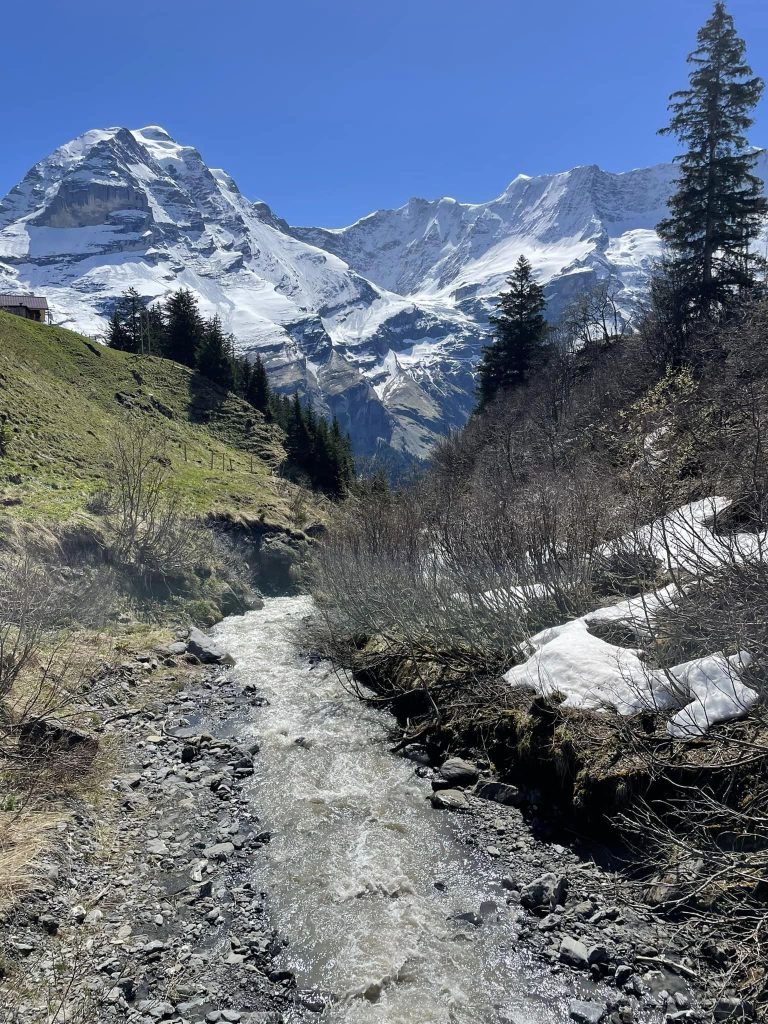
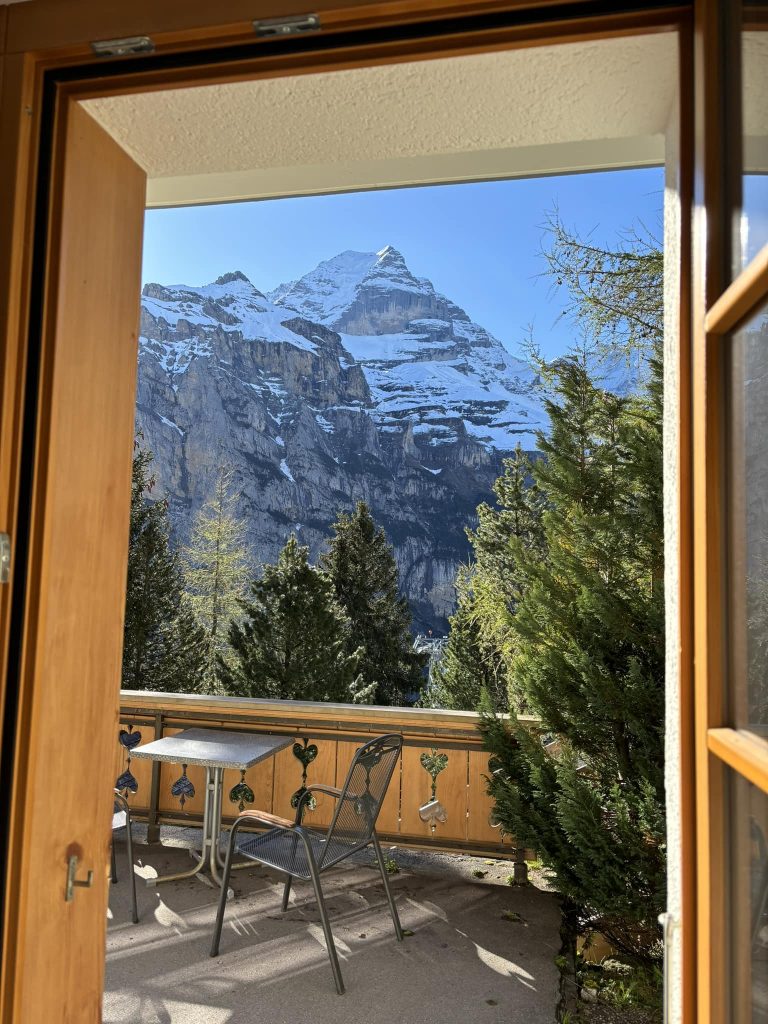
Mürren is accessible only by public transport, unless you live there. We took a regular train from Bern to Interlaken, then Interlaken to Lauterbrunnen, where we switched to a cable car, then a cog train to get to Mürren. This was already cool, and Mürren itself was so incredibly beautiful and peaceful. We stayed at the Hotel Alpenruh, which is at the very end of the main pedestrian street. We really liked this hotel (great breakfast buffet!) and would definitely stay there again. Our room had a private terrace with a mind-blowing view of the mountains, and the weather was incredible. Totally clear, not hot, and not cold. I had brought tons of rain gear and warm clothes from home, and they never even came out of my suitcase.

The nice desk guy at hour hotel recommended a fabulous hike for us, from the village, to the Bryndli (a nearby peak with a fantastic view, steep but worth it), then back via the Sprutz waterfall (very cool, the trail goes behind the waterfall) and the village of Gimmelwald (a nice, peaceful climb through the forest to end the day). I’m not sure how far this was…maybe 10 miles?? It took us pretty much all day, probably 10 AM to 5 PM, so we were excited to get back to the hotel, clean up, and eat a very good local meal in the hotel restaurant. The next day, we did a more mellow walk down to Winteregg on a paved path and a dirt road (also beautiful; everything in that area is just beautiful), then headed to our next stop!

Mürren is tiny and easy to get around, and there are lots of signs for hiking trails if you just want to wing it. There’s also a small but well-stocked Coop grocery story that’s open seven days a week (somewhat unusual for Switzerland).

Leysin and Geneva

Way back in 2012, my husband and daughter and I spent the summer in Leysin while my husband did a consulting job there. We’ve been back several times since, and have always really enjoyed it. After another multi-step but very efficient train ride (plus cable car to get down from Mürren), we took yet another cog train to get from Aigle to Leysin, where we stayed at our favorite hotel, the Central Résidence, which we lovingly refer to as, “the poor man’s Club Med,” due to its huge indoor swimming pool with a window-wall looking out at Mont Blanc. We grabbed dinner at the crepe place in the center of the village (tasty!). The next morning, we hit La Farandole for croissants and coffee, then set off on a loop hike to Prafandaz and La Berneuse, a hike we’ve done several times before, taking the forest route over Riondaz on the way up. There were still a few snow fields at the top, but we had the place to ourselves (it’s a zoo in the summer!) since the cable car was not yet running. A storm was moving in, so we hoofed it down the shorter (mostly dirt road) way through Temeley (a dairy and snack bar in the summer, but the cows were still down in the valley when we were there) and made it back to the hotel without getting rained on.

That night, we had a truly special dinner at the Leysin Fromagerie restaurant, a place where we’ve enjoyed many family meals. They make their own cheese (right there!) and the fondue is to die for. I’m not even a huge fondue person, and I love going there. By that time it was cool and rainy (the only significant rain we had on the trip!) and the perfect weather for fondue.

The next day, we headed down-valley to Geneva, always a beautiful place to spend some time, where we took a long walk by the lake and then I got together with a friend who lives in the area, and that was that! A short and perfect trip!

Overall impressions and costs

I’ve never been to Switzerland in May before. Crazily enough, my main concern was the weather: I packed full rain gear and tons of warm clothes, and in reality the weather was perfect. When we were in the Berner Oberland, it was (no kidding) so sunny that it was almost hard to take good pictures of the mountains because of the glare off the snow. There was definitely still some snow coverage higher up in the mountains, but things were melted out enough that we could still do all-day hikes in both of the locations we visited.

It seems that things in Switzerland mostly open up around May 25 for the summer. Personally, I would much prefer to go a little earlier, have the weather be a little cooler and less predictable than in the summer, but not have to deal with huge crowds. Switzerland is, in general, a pretty tightly packed place, and even at this time of year, we had trouble finding seats on the longer train rides, i.e. Aigle-Geneva. I’m now a fan of going there in May!

No shocker here, Switzerland is an expensive place, and it’s a place where pretty much everything (food, transportation, entertainment) is expensive, but where quality standards are also very high.

All in all, we did pretty well, cost-wise. I paid around $1,200 for my plane ticket on United (Denver-Chicago-Zurich on the way out, Geneva-DC-Denver on the way back). The Mürren hotel was $516 for two nights including tax, the Leysin hotel was $393 for two nights including tax, and the two “nice” meals we had were about $100 for two people including drinks and dessert. There are also ways to eat well and cheaply in Switzerland. We had a couple of excellent picnic meals from Coop (the main grocery store chain in the mountains), plus great pastries, great coffee, great cheese that we got from small stores. Sit-down meals tend to be expensive, but it’s totally possible to put together decent meals without going to fancy restaurants.

Swiss trains are what I would consider quite expensive: for example, the multi-stage ticket from Mürren to Leysin was $117 (!!), but the trains are super-efficient and get you literally anywhere you want to go, without having to rent a car. It’s also possible to buy a half-fare card, where you pay $137 up front and then your tickets are half price; there are also tons of Swiss rail passes that cover everything. We figured that we would just barely break even on this so we just purchased full-fare tickets, but it’s definitely something to look into if you’re going to be moving around a lot.

Our main/only activity was hiking, which is obviously free, and we loved it. Mountain sightseeing in Switzerland (if you’re not under your own power) can quickly eat into your budget. We talked to some people who paid over $200 per person for a “top of Europe” cable car experience on the Jungfrau, but we were totally happy to hike and enjoy the views.

Gear and clothing

I am in general a light packer, even for international trips, and even more so since I converted to the Underseat Pro backpack. I love this thing so much that I wrote a blog post about it, which you can read here. A few additions since I wrote that post:

  • I’ve talked to a couple of people who said that the Underseat Pro did not fit under the seat of an airline that they traveled on. I fly almost exclusively on United and Southwest and that’s never happened to me (even on a small regional jet), but your mileage (haha!) may vary.
  • I would not recommend the Underseat Pro as an additional backpack to go along with another suitcase; if you’re looking for a light, comfortable backpack, there are definitely better options. Its real value is when you want to go on a trip with one bag, end of story. Like when I walk out of my house for this kind of trip, I’m carrying one and only one thing: the Underseat Pro, not even a separate purse or day pack. As another side note, I take along the Sea to Summit Ultra-Sil Day Pack, which, true to their marketing, compresses into a stuff sack that’s the size of an egg (no kidding).

Two pieces of clothing that are hugely helpful to me in packing light (not affiliate deals, I just love them):

  • RBX Active’s everyday ribbed ankle pants. I have the black ones, and I find that they’re great for hiking, they dry quickly enough to wash them in the hotel sink if needed, they’re stretchy enough for yoga, and because they’re solid black, they can pass as “dress pants” in a pinch. On this trip, I paired them with a solid-colored long-sleeve t-shirt and mooched a scarf off my sister-in-law, and it was a decent look for going out to dinner!
  • Danner hiking shoes. The ones I have (the Trailcomber in dusty rose) are sadly no longer made and I ordered mine on Ebay. But: if you’re trying to pack light, one key is to bring only one pair of shoes (the ones you’re wearing on the plane!) plus a pair of flip-flops or similar, for walking around the hotel, going to the pool, etc. Personally I like to have something that I can wear for an all-day hike, but that doesn’t look completely like sneakers, and that can also work if I want to wear something a little dressier than activewear.

There we go! A perfect week in Switzerland! Hopefully this provides some details and information if you’re interested in doing a similar trip.

Corinne McKay (classes@trainingfortranslators.com) is the founder of Training for Translators, and has been a full-time freelancer since 2002. An ATA-certified French to English translator and Colorado court-certified interpreter, she also holds a Master of Conference Interpreting from Glendon College. For more tips and insights, join the Training for Translators mailing list!
Written by Corinne McKay · Categorized: Travel

Jan 12 2024
Corinne McKay

OT: A week in Belize

An off-topic post here! My family spent a week in Belize over New Year’s, and since a) I’m a frustrated travel writer, and b) I struggle to remember the details of a trip several years later, I try to write a blog post about all of our major trips (you can read about last year’s family trip to Sayulita, Mexico here, and my trip to Iceland last summer here).

The basics of the trip

This was our first time in Belize, which we settled on because we wanted to go to a place with really good snorkeling. I (the family trip planner) first researched the Cayman Islands (because of the inexpensive, nonstop flight from Denver on Cayman Air), but ended up ruling it out due to cost, lack of things to do other than go to the beach, and the fact that it seemed hard to do without a car. My unscientific strategy is usually to check where you can fly nonstop or with an easy connection from Denver. This eliminated the Virgin Islands, because most of the flights leave from Atlanta in the morning, so we’d have to either take a red-eye or spend the night in Atlanta. It turns out that Belize is a pretty short (~three and a half hours) flight from Denver on United, and it ticked all the boxes in terms of reasonable cost, things to do in addition to the beach, and ability to get around without a rental car. Tickets on United were actually cheaper than Southwest; I have a Southwest Rapid Rewards credit card so I’m always looking for ways to use it, but for this trip, United won out.

Belize, which had really never been on my travel radar screen, turned out to be an amazing destination for what we wanted to do, and it’s one of my new favorite places!

Belize logistics in general

Belize is, in my opinion, a really easy place to travel. It’s a former British colony so everyone speaks English, and you can spend US dollars anywhere, you just get the change in Belize dollars, which are pegged to the US dollar at 2 Belize dollars per 1 US dollar. The majority of places also take credit cards, and I used my US credit card with no problems (if you do this, just make sure your card has no foreign transaction fees; my Southwest Rapid Rewards card does not). We didn’t spend any time in Belize City, but everywhere we went felt very safe, no visible drug activity other than marijuana (which is legal in Colorado so we’re used to it), and I felt like the party scene for our twentysomething daughter and her girlfriend was fun and safe. They went to the New Year’s Eve beach rave on Caye Caulker and reported that it was lively but not out of control, and that they never felt uncomfortable; they didn’t encounter any anti-LGBTQ sentiment anywhere we went. We used van shuttles to get around and the driving was what I’d consider typical for Central America. Even the major roads are one lane each way, so there’s a lot of illegal passing, but it didn’t feel like India where most car trips involve taking your life into your hands.

Phase one: Caye Caulker

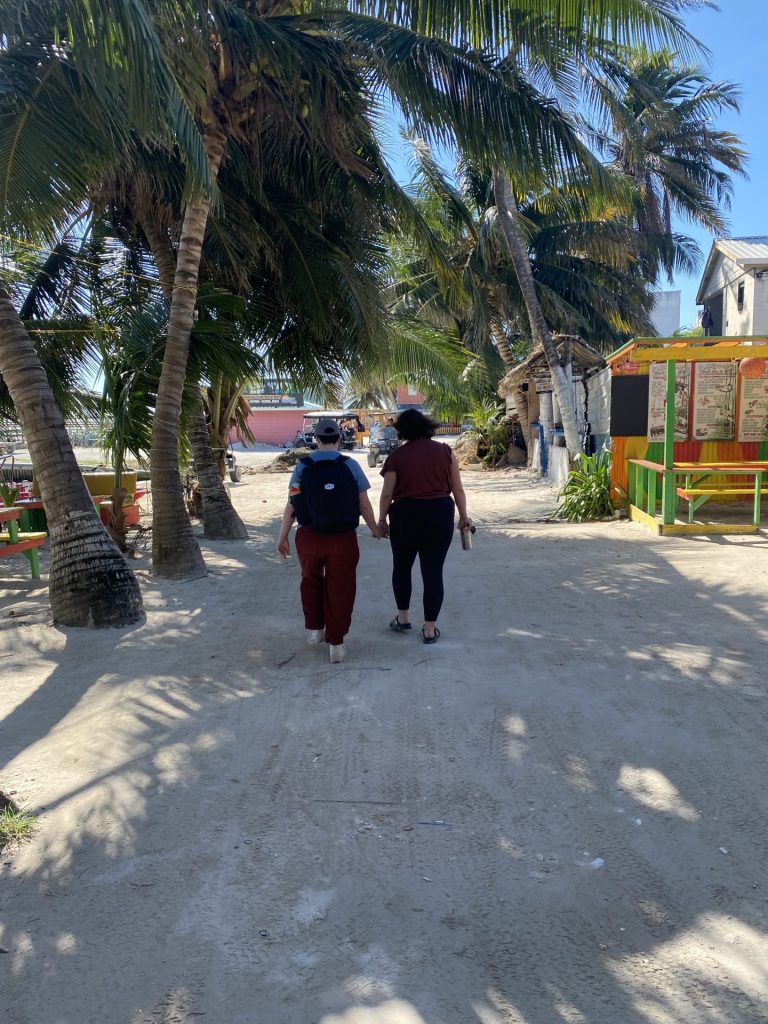
After doing some preliminary research on destinations (Belize has a ton going on for a pretty small country), I decided to book half of the week on an island and half on the mainland. The two main island destinations are Ambergris Caye (home of Belize’s most popular tourist destination, the town of San Pedro), and Caye Caulker. Of the two, Caye Caulker is much smaller and less developed. The whole island is about five miles long, but a hurricane in the 1960s split the island in half, and the northern half (accessed by a very small ferry) is very undeveloped. Caye Caulker has no cars (there’s one fire truck and one garbage truck and that’s it). The only motorized transportation is a few golf carts, and mostly everyone walks or rides beach bikes. The streets are packed sand (no paved roads). This sounded like our kind of place!

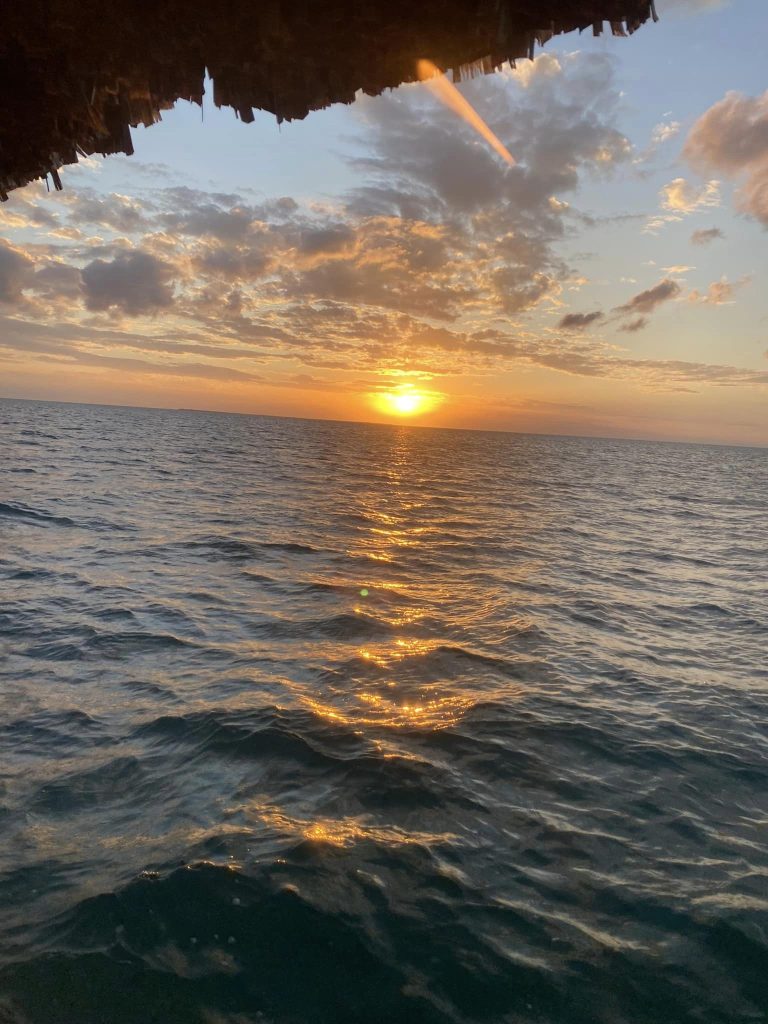
Caye Caulker didn’t disappoint! We flew from Denver to Belize City, then took a seven-minute flight on a tiny Tropic Air plane (like a flying minivan) to Caye Caulker, where we took a golf cart taxi to our AirBnB. We rented this house, which was perfect for our group (myself, my husband, our daughter (21), and her girlfriend (22) ). It was right on the water on the “lagoon” (non-ocean) side, it came with sit-on-top kayaks that we could launch right in front of the house, and the sunsets from the rooftop hammock deck were amazing. Inside, it was immaculately clean, had two nice bedrooms and two full bathrooms, plus a full kitchen and a nice living room with a Netflix-equipped TV. The host lives in another house on the same property, and she was amazingly helpful with whatever we needed, plus restaurant and activity recommendations. Caye Caulker is a really small place, so you want to book your lodging early; I started researching places in July (for a December trip) and some were already booked! The owner of our AirBnB runs a sunset tiki boat cruise which we took and really enjoyed (see sunset photo below!)

Caye Caulker’s motto is “Go Slow,” and it is a place where you really need to slooooooow down and enjoy the beauty and being there. We typically waited an hour for food in restaurants, and coffee/breakfast was only moderately faster (maybe 40 minutes!). But then again, where did we need to be? Nowhere but there! So after the initial adjustment, we just slowed down and really enjoyed it. Highlights included coffee and breakfast in the waterfront palm tree garden at Ice N’ Beans, an incredible dinner at Hibisca, (the “fancy” restaurant on the main drag), plus lots of really good ice cream from the local ice cream shops. There are a number of well-stocked grocery stores, so we also cooked at the AirBnB a couple of times.

Caye Caulker is surrounded by mangroves, and there are no long beaches; don’t go there expecting white sand stretching to infinity. The only beaches are human-made, by pulling out some mangroves and replacing them with trucked-in sand.

The highlight of our stay on Caye Caulker was the all-day “bucket list” snorkeling tour with Salt Life Eco Tours. We didn’t really know what to expect, but Belize has the world’s second-largest barrier reef, so we were hopeful to see some cool stuff. This trip (in a small boat with a group of 10 people) exceeded our expectations and was honestly like swimming in a Jacques Cousteau special. I am really not much of a water person, and I loved it. At one point, I was floating on the surface of the water watching two massive nurse sharks on the bottom (nurse sharks don’t even have real teeth and are totally unconcerned with humans), while a school of probably 500 sparkly blue fish hovered a few feet away, and a massive spotted eagle ray (with probably a six-foot wingspan) “flew” majestically about a foot below me. It was totally amazing; a must-do experience! Plus the Salt Life guides captured all of this in pictures and videos that they sent to us afterward on Dropbox. If we had stayed longer, I honestly would have done this trip more than once.

Phase two: San Ignacio jungle lodge

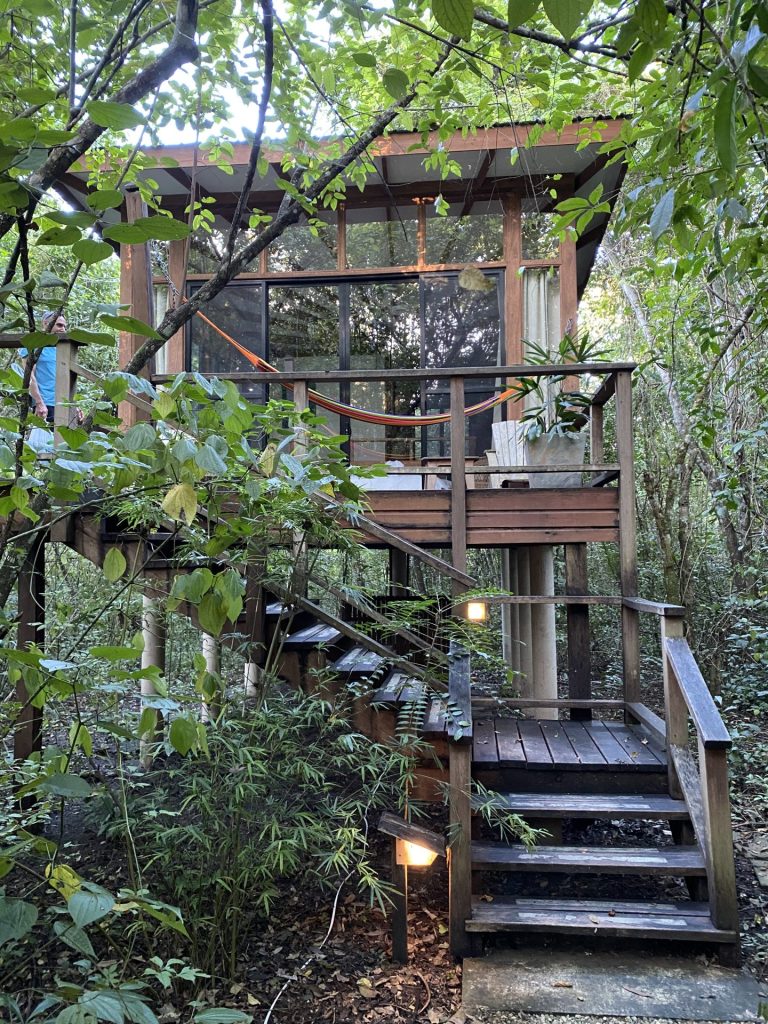
After a glorious three days on Caye Caulker, we took the San Pedro Belize Express water taxi back to Belize City, where the van shuttle driver from our next destination, Vanilla Hills Lodge, was waiting for us. San Ignacio, Belize’s second-largest city (inland, very close to the Guatemalan border) has emerged as a major eco-travel destination, along the lines of the Monteverde and Arenal areas in Costa Rica. We decided to rent two glass treehouses at Vanilla Hills (photo above) and it was honestly one of the neatest places we’ve ever stayed. You’re totally immersed in the jungle, while being totally comfortable (air conditioning which we didn’t really need, huge infinity pool looking out over the jungle, indoor/outdoor shower…it was so amazing). One of my favorite moments of this trip was lying on our bed during sunset/golden hour, watching the glow fill the jungle through the floor-to-ceiling glass walls. Truly one of those “peak” moments of a travel experience!

The food scene in Belize is generally good but pretty basic: we’re vegetarians so we didn’t eat the seafood, which did look amazing, but in general, Belizean food is a lot of rice and beans and barbecued chicken, and Belizeans do not seem to eat a ton of fruit or vegetables, despite the fact that a lot of produce is grown there. As our AirBnB host on Caye Caulker told us, “Don’t get too excited about Belizean salads, they’re generally iceberg lettuce with ranch dressing and nothing else.” Vanilla Hills Lodge’s restaurant is the exception: it was some of the best food we’ve eaten, anywhere, plus they were totally accommodating of vegetarians. I just can’t say enough good things about this lodge!

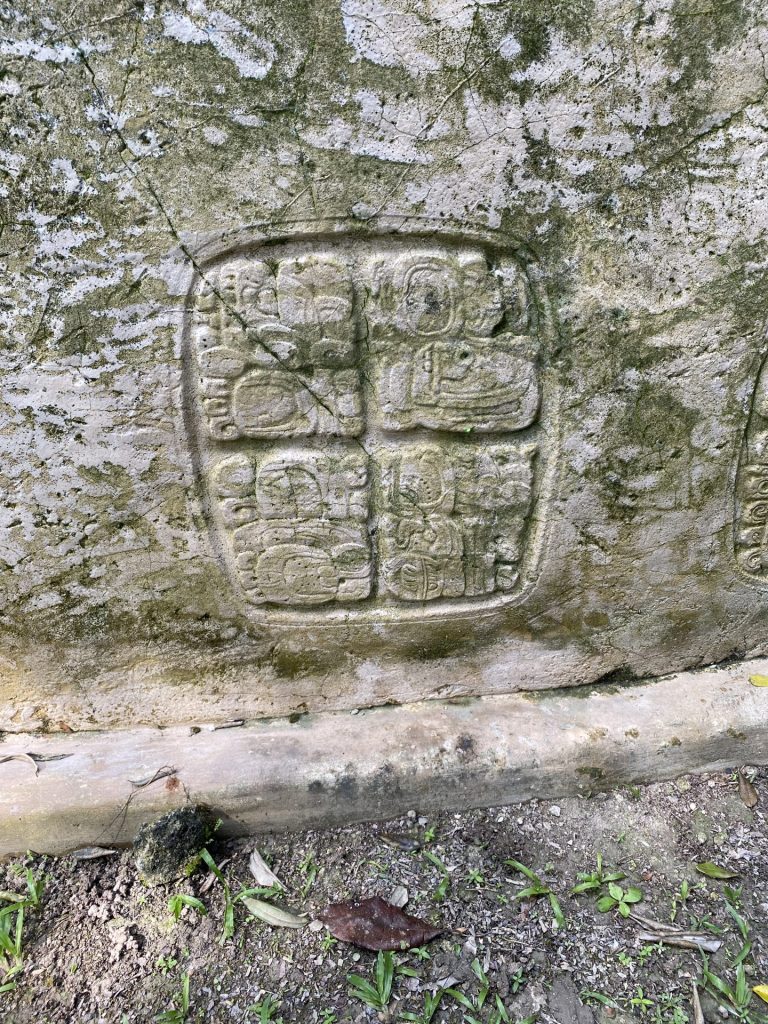
The owner, Claudia, arranged two amazing days of tours for us, first to the nearby Xunantanich Mayan ruins (carving photo above), followed by an afternoon on a pontoon boat with waterfall exploration (Jungle Splash tours), and an entire day in the ATM Caves, about an hour away from San Ignacio. As long as you’re not seriously claustrophobic, this tour is a true must-do, where you swim through a series of caves into a large dry chamber where there are crystallized human sacrifice remains and Mayan artifacts. As a bonus, our guide was a PhD archeologist, so we got to pester him with all of our questions about the local Mayan civilizations in general. If we had had one to two more days in this area, I really would have liked to visit Tikal, the huge Mayan site in Guatemala, which is two to three hours by driving from San Ignacio.

The end!

On our last day, we had one more incredible breakfast at Vanilla Hills (while watching toucans and coatis frolicking!) and then the van shuttle driver dropped us at the Belize City airport, about a two hour drive from the lodge. We connected in Houston on the way back and that went fine. If you fly out of Belize City, be prepared for major crowds and chaos and allow a lot of extra time. The airport was clearly not built for the volume of traffic it’s currently getting, and it was hard to find a place where four of us could stand together, much less sit down. On the day we flew out, the loudspeaker system at our gate was not working, so the poor gate agents had to shout (into a room full of hundreds of cranky travelers) to board the planes (no jetways, you just walk out onto the tarmac). Especially if you have small kids or older people in your group, prepare yourselves for a somewhat uncomfortable few hours at the airport!

Aside from that, this trip was pretty much perfect. We’re pretty frequent travelers, and Belize is at the top of my new favorite destinations. To me, it was less expensive and less built-up than Costa Rica, and felt safer than Mexico. We’ve also repeatedly had issues getting sick (g/i issues; nothing requiring medical treatment but also not a lot of fun when you’re on vacation) in Mexico despite not drinking the tap water and being careful about food, and none of us got sick in any way in Belize, which was also a plus. We loved every second and are already thinking about a return trip!

Corinne McKay (classes@trainingfortranslators.com) is the founder of Training for Translators, and has been a full-time freelancer since 2002. An ATA-certified French to English translator and Colorado court-certified interpreter, she also holds a Master of Conference Interpreting from Glendon College. For more tips and insights, join the Training for Translators mailing list!
Written by Corinne McKay · Categorized: Travel

Sep 26 2023
Corinne McKay

Travel: A week-long work trip with an underseat bag

Greetings, readers! We have a good group signed up for this Friday’s master class with Karen Tkaczyk, Editing and proofreading for into-English translators, and there’s still room for you! This class always gets rave reviews, so sign up now if you’d like to level up your editing and proofreading techniques and processes!

This week’s topic relates to the logistics of work travel (or, honestly, any travel!). Short version: last week, I traveled for a week-long interpreting assignment, with only an underseat bag (including bringing my laptop!) and I’m now pretty much a convert to this style of packing. Read on if you’d like to know the details!

**None of the links below are affiliate links; they are just products that I really like**

For a long time, I traveled primarily on Southwest, where overhead bin space is rarely an issue because it’s free to check bags. I’ve always been a pretty minimalist traveler and I essentially never check luggage other than something like a bicycle that absolutely cannot be carried on. I got into the habit of taking a rollaboard suitcase and my laptop backpack and those basically always fit in the cabin on Southwest. However, lately I’ve been flying United a lot more, and baggage suddenly became a huge problem. United doesn’t check bags for free, and they really want you to pay for an upgraded boarding group; if you don’t do that, there’s a high chance of ending up having to check your bag at the gate (which is free, but also annoying and time-consuming) because the overhead bins are full. With two week-long interpreting assignments and the ATA conference coming up, I decided to investigate some better options.

As luck would have it, various luggage companies have capitalized on this phenomenon and now make underseat bags with approximately the same carrying capacity as a rollaboard suitcase. This works, because you’re eliminating the bulk of the suitcase itself. After doing some research, including watching this YouTube video, I settled on the Underseat Pro backpack, which costs about US $50, and according to the company, has been tested to fit under the seat of most major airlines as long as it’s not overstuffed. I purchased the one with the laptop sleeve since I’m often traveling with a computer.

Cut to the chase: it worked! I was able to fit a week’s worth of work clothes (more on this below), my laptop, and everything else I needed into the backpack, and with a little jiggling, it did fit under the seat on a United flight! Better yet, I was in boarding group four, and the gate agent was checking all rollaboard bags in that group, while I got to breeze onto the plane with my Underseat Pro!

Here are the details on how I did it:

  • It goes without saying that if you’re trying to travel for a week with an underseat bag, you’re paring down to the must-haves, not the nice-to-haves. I really love my B.R.U.S.H curling iron (…there, I said it), but it was definitely not making the cut. You also need really good shoes because you’re probably going to wear a pair and take a pair, and that’s it. My Naturalizer Flexy ballet flats  go with pretty much any outfit, and are comfortable enough that I can wear them for an entire week, then I took my cream-colored Vans Ultrarange shoes, which are comfortable enough for long walks after the work day, but can also kind of/sort of pass as “business casual” shoes.
  • For work clothes, I took a “capsule wardrobe” consisting of one pair of plain black pants, one plain black skirt, and four dressy shirts that could be worn with either the skirt or the pants. I wore the black pants and one of the shirts on the plane, and packed everything else. Pro tip on shirts: as part of my year-end bonus to myself last year, I splurged on some made-to-measure wrap shirts from OdaLux, and they are my absolute favorite thing for work trips. They’re super comfortable but also dressy enough for work purposes, and the wrap belt is great because it’s sturdy enough to hold a microphone transmitter/battery unit, which we use the entire time at one of my travel interpreting assignments. I rounded the clothing out with a pair of yoga leggings and two light, long-sleeved t-shirts to wear in the evenings, a small purse to use during the day, a bag of toiletries, pajamas, a book, and my interpreting notebook and pens, plus my wallet and phone and a small bag of electronics accessories (phone charger, earbuds). All of this fit in the Underseat Pro with even a little room to spare.
  • Obviously, a lot of this is situational and personal. I didn’t need to bring heavy outerwear or very warm clothes on this trip, and personally I’m OK with wearing pretty neutral, nondescript clothes that look professional but aren’t anything special. If you’re the person who wants to be wearing a different snazzy outfit with different shoes every day, this technique will definitely not work. For the record, one of the attendees at the conference I was interpreting for came up to me in the cafeteria on about the fourth day, and said, “You came with only that tiny backpack and you’re always wearing different outfits! Where did you put everything??” So, if you’re worried that people will notice that you brought a limited wardrobe, I would let go of that fear! I think most people don’t really notice or care, and the technique of totally plain pants/skirts with different shirts seems effective!

I’m looking forward to continuing this packing technique on my other upcoming trips. The Underseat Pro backpack is 18 inches long, by 14 inches wide, by 8 inches deep. Not surprisingly, these are the exact dimensions allowed by many major airlines. Interestingly enough, United’s dimensions are actually significantly smaller (17 x 10 x 9) so I think you really don’t want to overstuff the bag, but mine fit quite well. I think that sometimes, you’ll encounter some annoying obstacle (literally and figuratively). I flew on Icelandair in June, and on the return flight, my underseat space had the cable box for the entertainment system, and even my very small backpack had trouble fitting. But otherwise, I highly recommend this style of travel!

I hope these tips are helpful in your upcoming travels!

Corinne McKay (classes@trainingfortranslators.com) is the founder of Training for Translators, and has been a full-time freelancer since 2002. An ATA-certified French to English translator and Colorado court-certified interpreter, she also holds a Master of Conference Interpreting from Glendon College. For more tips and insights, join the Training for Translators mailing list!
Written by Corinne McKay · Categorized: Travel

Jan 23 2023
Corinne McKay

Travel: A week in Sayulita, Mexico

First family vacation since COVID!

I really can’t complain about lack of travel opportunities in the past three years; despite COVID, I still traveled to the Navajo Nation, took tons of bike and ski trips around Colorado, Utah, New Mexico, and went to Canada for an interpreting workshop, and even snuck in a trip to Denmark and Switzerland during the three weeks in 2021 when we thought COVID was over. Yet, one thing we haven’t taken since 2019 is a family vacation, as compared to pre-COVID when we traveled a ton. With my daughter now toiling away as an engineering student on the other side of the country, it seemed like an opportune time to head back out on an adventure! We went to Sayulita, Mexico for a week over New Year’s and loved it, so I thought I’d write a trip report for anyone who might be interested.

Sayulita in a nutshell

Sayulita is a beach town on the Pacific Coast in the state of Nayarit, about an hour’s drive north of Puerto Vallarta. We’ve been to Mexico (Tulum, Oaxaca, Merida, Baja) many times but never to this area. I had heard about it from fellow Coloradans, and then got tons of great tips from a fellow translator, Jennifer Nielsen, who is originally from Colorado and now lives in the Puerto Vallarta area.

We were looking for a vacation destination with:

  • nonstop flight from Denver
  • no mega-resorts
  • activities in addition to the beach
  • reasonably priced lodging near the beach
  • good food

Sayulita ticked all of the boxes, and off we went! Despite the Southwest airlines Christmas logistical debacle and a major snowstorm, our flight was even on time.

What we saw and did

We (myself and my husband, fiftysomethings; my daughter and her girlfriend, twentysomethings) rented a really nice house on AirBnB, about two blocks from the beach on Sayulita’s north side. The cool thing about Sayulita (from our point of view) is that it’s more like a real Mexican town than like a resort. The downside (again, our p.o.v.) is that the downtown would have been too loud and crowded for our taste. But the quieter north side of town suited us perfectly: it’s about a 10 minute walk from the main plaza but our house honestly felt like its own resort: surrounded by a wall and with a swimming pool and hot tub in the courtyard, and really zero noise, but easy walking distance to everything.

For the first four days, the twentysomethings mostly hung out on the beach while my husband and I went hiking in the mornings and beached in the afternoons. I had never tried booking activities through AirBnB Experiences before, and I was pleasantly surprised. I did a beach yoga class, my husband and I hiked Monkey Mountain and the jungle north of Sayulita. A true highlight was a hike and lunch at Natikari Rancho Verde, a jungle preserve right outside of Sayulita where you get to hike with donkeys (no kidding) and then eat amazing guacamole and fruit.

We then did two days of touring all together, and I would highly recommend both. We did a full day tour with Nayarit Uncovered, which was amazing. The guide picks you up in a Jeep, then you go out to breakfast at a local restaurant (we went to Maria’s in nearby San Pancho) and the guide shows you photos and videos of around six different places and activities, such as hiking, snorkeling, petroglyphs, waterfall swimming, etc. We picked petroglyphs and waterfall swimming with a stop at a fruit stand for lunch in between, and it was an incredible day! We particularly loved the waterfall (I don’t think it has a name), where we hiked into the jungle to swim in a gorgeous pool; we were the only ones there and it was truly magical!

For our second tour day all together, we did a boat trip with Ally Cat Sailing Adventures, which we also loved. The boat was a 60-foot catamaran, and you sail out to the Marietas Islands national park (whale sightings along the way!), where you first stop at a beach with some cool caves, then you snorkel (off a smaller boat that picks you up from the catamaran), then you stop in a cove where you can paddleboard, float on “lily pads” (floating mats tethered to the boat), or even dive off the boat if you want to. The boat is definitely a bit of a party atmosphere; nothing too crazy but there’s an open bar the whole day (we were offered mimosas at 8:25 AM!). Don’t do this trip if you want something very quiet and mellow, but I highly recommend it if you want something fun but safe with younger people. We scored a large couch on the boat deck and spent most of the day just lounging there and enjoying the ocean views.

Overview of the trip

I highly recommend Sayulita if you want an easy, fun trip to a place that is not a resort. I know a lot of people love the Cancun area, but we wanted something a little more low-key with things to do other than go to the beach and drink. Sayulita seems quite popular with Canadians and Mexican families, and we really liked the variety of people visiting there. The north end of the beach is pretty quiet, and in about half an hour you can hike to the uninhabited beach (Mal Paso) north of that. The town has pretty much everything you need, and most people who work in stores and restaurants speak at least some English (my daughter worked with lots of Spanish speakers in a restaurant in Colorado on a gap year so her Spanish is actually good, while the rest of us speak between zero and 10 words of Spanish and we did OK).

The food in Sayulita is also great. We ate at a number of local taco places and also bought food to cook at our AirBnB a bunch of times. Surprisingly enough, there are also two great French bakeries in Sayulita, and tons of places to buy local fruits and vegetables. We’re vegetarians and we definitely did not suffer for lack of food options. Sayulita also felt very safe, and I thought that the beach party scene was fun and safe for the twentysomethings. We had an amazing time and would definitely go back!

Written by Corinne McKay · Categorized: Travel

  • Page 1
  • Page 2
  • Go to Next Page »

Primary Sidebar

Subscribe to the Training for Translators mailing list!
Getting Started as a Freelance Interpreter: Available now in print and electronic editions

Learn from our blog:

  • Struggling in your freelance business? Really, you have four options
  • T4T podcast, episode 30: A summary of my “state of freelance translation” survey
  • Survey results: The state of freelance translation in 2026
  • Focus on the clients who can afford you
  • Upcoming direct client marketing class
  • Travel: Cycling Quebec’s Tomifobia Nature Trail
  • Travel: Cycling Burlington, Vermont’s Causeway Bike Trail
  • When part of your business falls off a cliff

Search the Training for Translators blog

Copyright © 2026 · Training For Translators · Log in

This website uses cookies to improve your experience. We'll assume you're OK with this, but you can opt-out if you wish. To view this website's privacy policy, click About>Privacy Policy. Accept Read More
Privacy & Cookies Policy

Privacy Overview

This website uses cookies to improve your experience while you navigate through the website. Out of these, the cookies that are categorized as necessary are stored on your browser as they are essential for the working of basic functionalities of the website. We also use third-party cookies that help us analyze and understand how you use this website. These cookies will be stored in your browser only with your consent. You also have the option to opt-out of these cookies. But opting out of some of these cookies may affect your browsing experience.
Necessary
Always Enabled
Necessary cookies are absolutely essential for the website to function properly. This category only includes cookies that ensures basic functionalities and security features of the website. These cookies do not store any personal information.
Non-necessary
Any cookies that may not be particularly necessary for the website to function and is used specifically to collect user personal data via analytics, ads, other embedded contents are termed as non-necessary cookies. It is mandatory to procure user consent prior to running these cookies on your website.
SAVE & ACCEPT