
Corinne McKay (classes@trainingfortranslators.com) is the founder of Training for Translators, and has been a full-time freelancer since 2002. An ATA-certified French to English translator and Colorado court-certified interpreter, she also holds a Master of Conference Interpreting from Glendon College. For more tips and insights, join the Training for Translators mailing list!
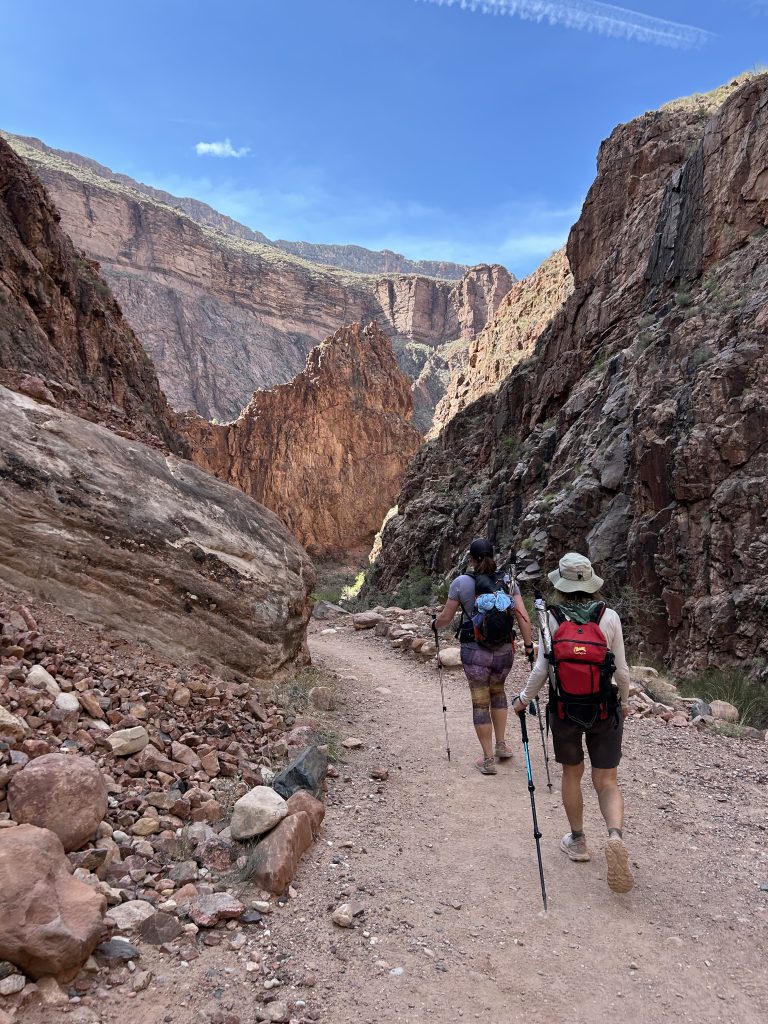
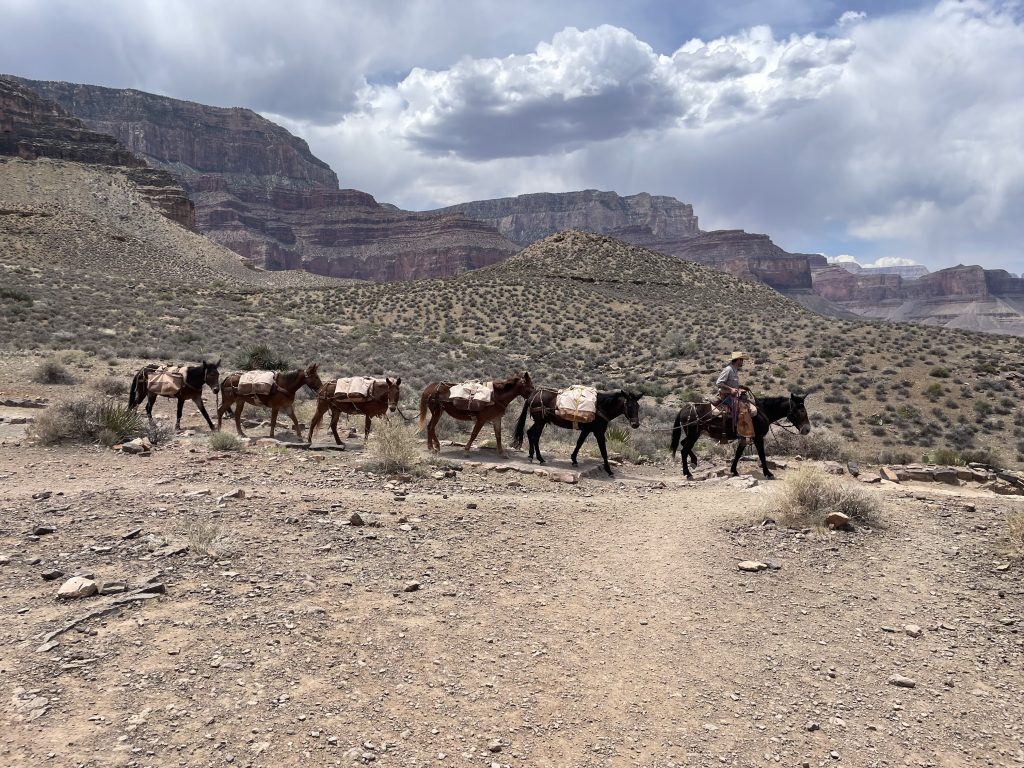
I’m slowly catching up on my travel posting from 2025! Here’s a biggie (literally and figuratively); for our 25th anniversary in May 2025, my husband and I did the Grand Canyon rim-to-rim hike in both directions. Day one: North to South via the North Kaibab and South Kaibab trails, and day two: South to North via the Bright Angel, Tonto, and North Kaibab trails. A friend also hiked with us on the South-North day. Here’s how it went!
Overview
The National Park Service is correct when they call this hike a “classic bucket list adventure” that requires three things for success: the right training, the right gear, and knowing what to expect. The fact that neither of us had been to the Grand Canyon before made it even more amazing. I would rank the Grand Canyon as one of those places like the Taj Mahal (which we visited on our honeymoon in 2000!): as many photos as you’ve seen of it, it just takes your breath away to be there in person.
Rim-to-rim is 24 miles each way, and people do it in all kinds of configurations. The main constraint is that the (much more remote) North Rim is open only from May 15 to October 15. An additional, additional constraint is that, sadly, most of the park infrastructure on the North Rim (including the cabin village where we stayed, and the lodge where we had our 25th anniversary dinner) burned down in the Dragon Bravo fire in July 2025, so the lodging we stayed in is no longer an option.
As with any long-distance hike, you’re going to see people trail running this thing like it’s nothing at all, and you’re going to see people struggling in the first few miles. Your mileage will literally vary. I will say that as someone who tolerates heat reasonably well, lives at 5,430 feet (1,655 meters) and has access to good training areas for long-distance hikes, I found the whole experience neither significantly harder nor significantly easier than I expected (more this below). But that’s with the caveat that you can’t really train for the heat or the altitude if you don’t live in a conducive environment. The South Rim is 7,000 feet/2,133 meters and the North Rim is 8,000+ feet/2,400 meters, plus during the time that the North Rim is open, it’s nearly always hot on the South Rim, so you kind of can’t escape it!
Planning and preparation
The first step in any rim-to-rim adventure is planning and preparation. You can do this thing in all kinds of ways: you can do it over multiple days by camping in a campground, or staying at Phantom Ranch, the cabin village in the bottom of the canyon. You can hike one way and take a shuttle one way. You can hike one way, stay one or more nights on the other side, and then hike back (which is what we did). You can hike or run both directions in one day (we saw many people doing this, too!). You can hike it in one day, but take a long break in the creek at Phantom Ranch. For us, the deciding factors were:
- We like long hikes
- We’d rather not carry camping gear
- If we’ve never been there before, why not hike it both ways and get the full experience?
- If you don’t camp/stay in the Grand Canyon itself, you don’t need a permit, you just need a lodge reservation which is a lot easier to get
So we decided on hiking both ways, staying on the South Rim between the two hiking days. The South Rim is like a city. There are multiple lodges, restaurants, shuttle buses, etc. while the North Rim, even before the lodge burned down, was nothing like that. Most people who do one way do North-South, for this reason (and because the North Rim is 1,000 feet higher, so the uphill at the end is less intense if you go South). I was very happy with how we organized this and I’d do it the same way again.
If you’re on Facebook, I’d recommend the very helpful Grand Canyon Rim to Rim group. It’s particularly good for logistical specifics: parking, water, shuttles, where to stay overnight, gear recommendations, etc. etc.
Training
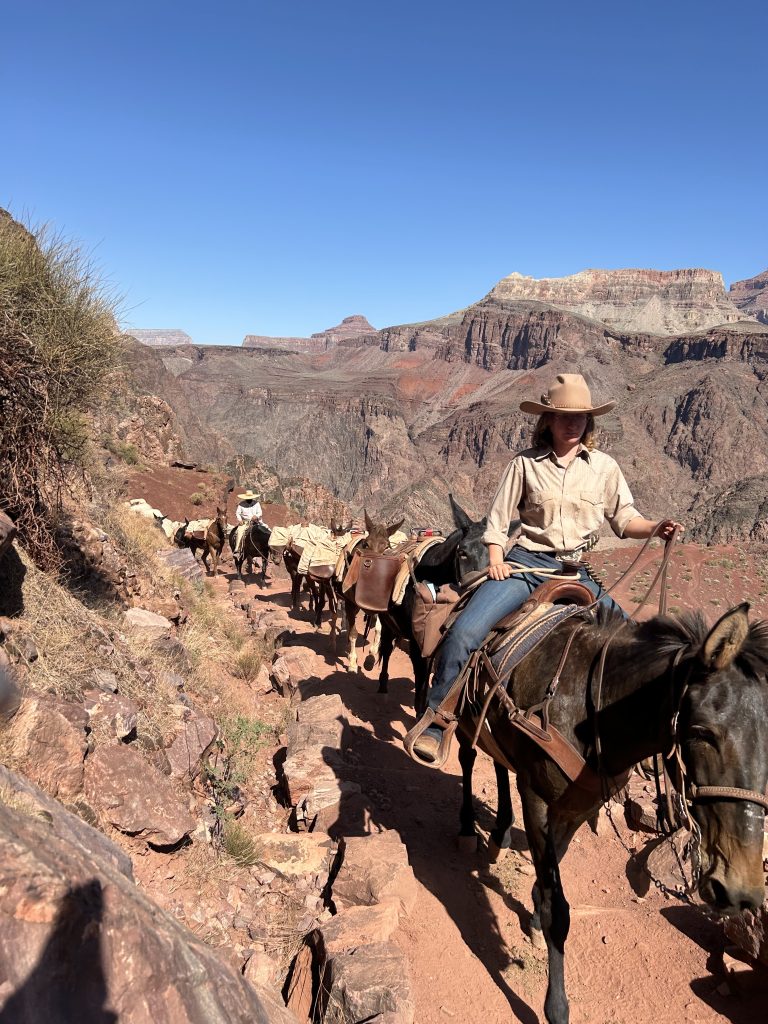
Training for 50 miles of hiking in two days is a big deal. Even if you like to walk, that’s a lot of walking. Fortunately, we have tons of hiking trails where we live (Boulder, Colorado). My goal was pretty simple: to hike three to four times per week, working up to two 20-mile hikes in the month before the trip, and also doing two days a week of strength training and two days of yoga.
For me, this resulted in an experience that was strenuous but still fun. One factor: the hiking trails where we live are actually much more challenging than most of rim-to-rim. They’re steeper, rockier, rougher, just generally more difficult than the Grand Canyon, where the up-and-down trails are strenuous, but once you’re in the bottom of the Canyon, the trail is very smooth and relatively flat. This could be totally different if you don’t live in a mountainous state; we met people who came from Florida and trained by walking stairs in weight vests!
Logistics
As mentioned above, you can really choose your own Grand Canyon adventure, but here’s what we did:
- Flew to Phoenix (with friends, a couple), rented a car, drove to Sedona and stayed there for three nights. Highly recommended; I had never been to Sedona and we loved it.
- Drove from Phoenix to the North Rim and spent the night. We did that at the North Rim Lodge which no longer exists. Today you’d have to stay at the Kaibab Lodge or the Jacob Lake Inn.
- Hiking day one: Our friend who was not doing the hike dropped us off at the North Kaibab trailhead at 5 AM, we started hiking and arrived at the top of the South Kaibab trail on the other side at 4 PM. This was my usual slow and steady pace plus a longish break at Phantom Ranch (which has a canteen where you can buy lemonade, candy bars, chips, etc.). In 2025, it was not possible to hike directly up the Bright Angel trail from the river, because the River Trail was closed for water pipeline construction.
- Stayed overnight at the Bright Angel Lodge on the South Rim. I would recommend this lodge for hikers because if you’re hiking up or down the Bright Angel trail, you can literally see the trailhead from the lodge.
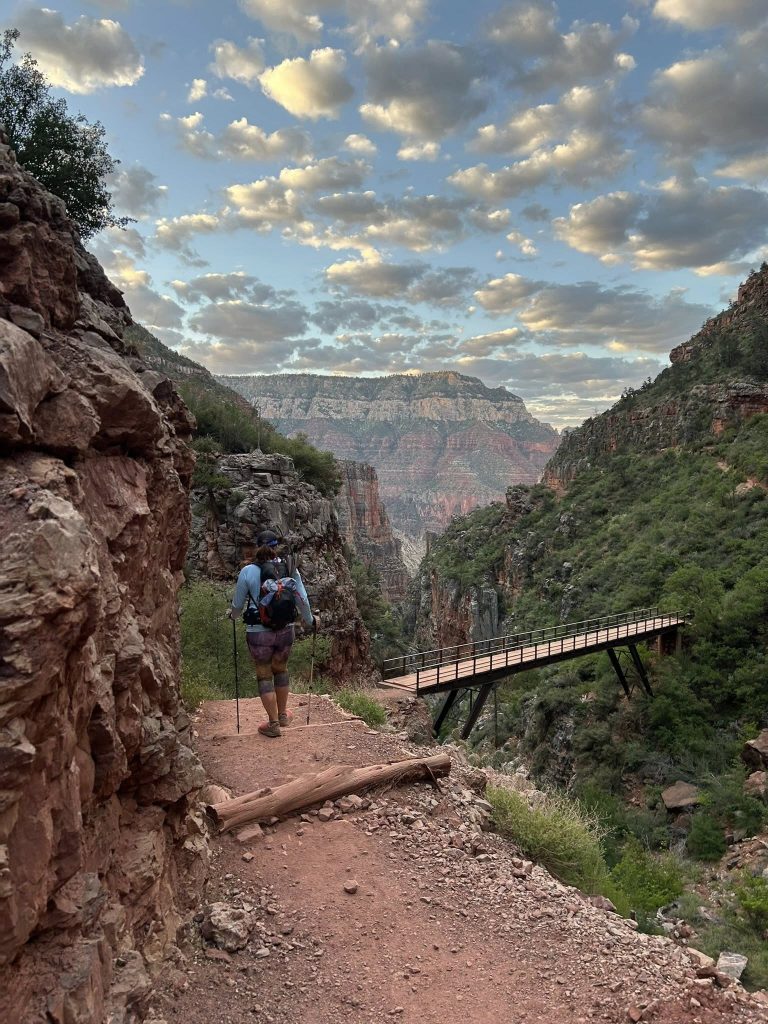
- Hiking day two: We again got up at 5 AM and hiked back via the Bright Angel trail, the Tonto trail (which circumnavigates the closed section of the River Trail) and the North Kaibab trail, arriving at the top at 7 PM. Our friend then picked us up and we stayed again at the North Rim Lodge and had dinner there.
- The next day, we drove back to Phoenix, visiting Flagstaff on the way, stayed at an airport hotel and flew home.
Gear and water
You want the right gear for this kind of hike. The right shoes and socks are critical, because your hike could easily be ruined by blisters or sore feet. Personally I much prefer trail running shoes versus hiking boots when it’s really hot. We did this hike at the very end of May, and the high temperatures were in the 90s/around 35-38 Celsius: hot. So your feet are going to sweat. I wore Altra Lone Peak trail running shoes and Balega Hidden Comfort socks, and they were perfect.
For clothing, I wore a very light 32 Degree Cool t-shirt and capri leggings, with a warmer shirt for the morning, plus a sun hat, and the #1 piece of gear I would recommend for this, or any other long hike in the desert, the Six Moon Designs reflective hiking umbrella. This umbrella looks kind of dorky, but it weighs less than a water bottle and gives you so much more shade than just a sun hat. I honestly am not sure I could have done this hike without it, or at least not as comfortably.
Food and water are their own issue. I took a large selection of sweet, salty, and proteiny food: everything from Nerds gummy clusters, to mixed nuts, to vegan jerky, to Peanut M&Ms. I tend to lose my appetite on long hikes, so I wanted a bunch of tempting options. For a one-day rim-to-rim, you’ll want a backpack that’s larger than what you’d take on a typical day hike, but not a behemoth overnight pack. I love my Camelbak 14’er and it worked really well for this trip!
For water, I took a three-liter hydration pack plus an additional one-liter bottle of electrolyte drink, and that was exactly enough. The downside of hiking up South Kaibab is that there’s no water, and it’s very hot. So you drink as much as you can at Phantom Ranch, fill everything up, and that’s it, or at least it was when we were there (there is sometimes, but not always, water at the Tonto Tip-Off, where Tonto crosses over to Bright Angel). Carrying four liters, I drank the last of my water within sight of the top of the South Rim (where you can buy anything you want).
Trekking poles are a matter of opinion; I’m a poles girl, and I use them even on short day hikes. I like the feeling of doing something with my arms while I’m walking, and my fingers tend to swell up if my hands are just hanging by my side. My husband got me the REI Carbon Flash poles as a gift, and they’re my go-to: very light but very durable.
To sum up
I really loved this trip. My husband and I wanted to do something meaningful for our big anniversary, and this was big! We did the South-North hike (day two) on our actual anniversary day, which was particularly fun. It’s definitely a committing experience, and how hard it is will depend significantly on where you are able to train, but I was thrilled with how this worked out and I would definitely do it again!
Leave a Reply