SEO for freelancers: how important is it? Many freelancers wonder how important search engine optimization (SEO) is, when it comes to your business website and how much traffic you can expect it to attract. Very important? Not at all important? Somewhere in between? With the caveat that this is a very basic introduction and I’m far from an SEO expert, let’s take a look.
First, yes, SEO is important, *if* you want your freelance website or blog to be actively drawing traffic. That sounds obvious, but some freelancers don’t really care about attracting potential clients to their website; they want it simply as an online brochure, or as something to show to clients who are already interested in them. But if you *do* want to actively attract potential clients to your website, SEO is really, really important. Many sources estimate that more than 50%, and perhaps as much as 75% of website traffic is the result of what’s called organic search, meaning that someone Googles “translate German patent,” and finds your web page about German patent translation.
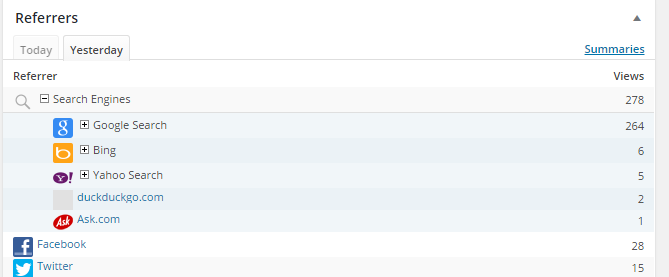
As an example, yesterday my blog got 681 views. Of those, 361 came from “referrers,” meaning an incoming link to my blog. Of those 361, 278 were from search engines, with Google accounting for 264. And that approximate percentage seems fairly constant: the day before yesterday, my site had 912 views, with 484 coming from referrers, of which 309 were Google. So, yes, it’s important.
If you know little or nothing about SEO, start by learning. Search Engine Watch has a fairly technical but very comprehensive list of 22 factors that may affect your site’s search engine ranking. Here’s a less technical explanation for freelance writers, from Daily Writing Tips.
The foundational concept of SEO for freelancers is keywords: meaning that your site needs to include terms that people enter into Google when they need someone like you. As an example, if you Google “certified French translator,” my business website is the third result.
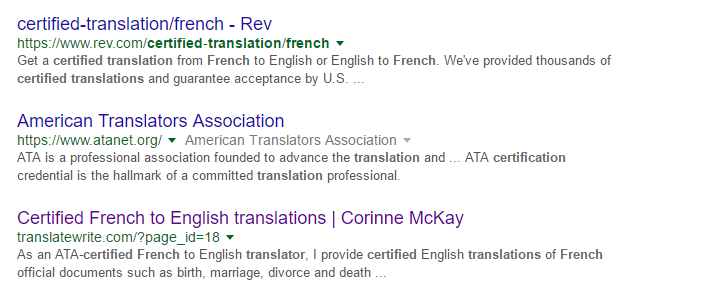
Not surprisingly, an average day in the office brings at least one inquiry from someone who found my website and needs a certified translation. I enjoy this kind of work, so I created a web page specifically for it, for SEO purposes. So, step one of SEO is to make sure that your site includes relevant keywords.
Equally importantly, SEO does not mean writing in a contrived, infomercial-esque style. “Keyword stuffing” (repeating your keywords ad nauseum) can actually hurt your search engine rankings, and helpful, relevant content that a lot of other people link to will definitely help. SEO-friendly writing is a specific (and very marketable) skill; just Google “SEO copywriting course” and you’ll enter a whole universe of learning how to write for SEO.
So that’s the content-related part: get your relevant keywords in there, largely by thinking about what your potential clients are Googling. My unscientific dabbling in SEO also makes me think that a series of web pages dedicated to just one service you provide (i.e. patent translation, literary translation, website localization, conference interpreting) will rank higher than a general “Services” page listing everything you do.
On the technical side, you should do a couple of things. Make sure your site is fast, which is mostly determined by your hosting provider, and make sure it works well across devices, meaning that it looks good and is usable on a regular computer and on mobile devices. Then, at least install a basic SEO plugin so that you have some idea how your pages or posts will rank on Google. I use Yoast SEO (a WordPress plugin) and I’m very happy with it for my purposes. Most helpfully, Yoast gives you real-time feedback while you’re writing. For example, here’s this post’s Yoast SEO analysis as of this very moment:
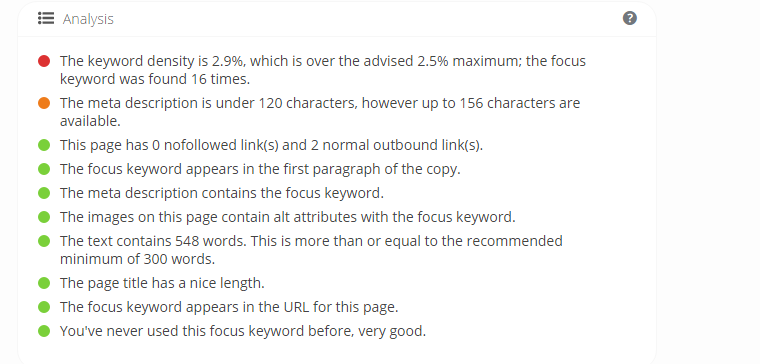
You don’t want to be enslaved by this analysis; for example Yoast thinks that I’m actually using my focus keyword, “SEO,” *too much* in this post, which could cause Google to classify it as spam. But the real-time analysis can be extremely helpful, for example by prompting you to add some images or links to your post, or to add alt tags (the text that displays if the photo doesn’t load) to the images. Again, if you don’t much care about incoming website traffic, don’t let this keep you up at night. But if you do care, it’s worth paying attention to.
I’m sure that many readers know much more than I do about SEO, so feel free to chime in with your own tips too! One question I am often asked: is it worth hiring an SEO expert to work on your site? Not sure, and I’ve never done it. Thoughts from readers?