• Skip to main content
  • Skip to primary sidebar

Training for Translators

Classes for translators and interpreters

  • Start here
  • Blog
  • Classes
    • Coaching for freelancers
    • Subscription
  • Books
    • Translate my books
    • Book Shop
  • About/Contact
    • Privacy Policy
  •  
  • Account

Jun 16 2026
Corinne McKay

Marketing to direct clients? Identify a gap or a hook

Corinne McKay (classes@trainingfortranslators.com) is the founder of Training for Translators, and has been a full-time freelancer since 2002. An ATA-certified French to English translator and Colorado court-certified interpreter, she also holds a Master of Conference Interpreting from Glendon College. For more tips and insights, join the Training for Translators mailing list!

Greetings, Training for Translators subscribers! Tomorrow’s free webinar on planning a book translation is sold out; thanks to all 250 people who signed up! 

Next on the calendar is this month’s master class, Optimizing your website for search engines and generative engines (SEO/GEO) with guest instructor Stacey McCormack.

The live class is on June 24, registration is $75, and everyone who registers will receive the recording.

If you’d like to get ranked and recommended so that clients come to you via your website, you need this class! Stacey is an excellent instructor (I hired her based on a class of hers that I took) as well as a full-time web designer and marketing professional. 

This week’s topic: Using gaps and hooks in your marketing 

“I’m a translator! Do you need a translator?” 

This is the marketing message that many, or even most freelance translators, interpreters, subtitlers, and editors are using when they market to direct clients. 

The problem? This sounds basic, but we know what we do and how we help, so we assume that clients do too. It feels pedantic to explain it: don’t they already know what a translator does and why they might need us? 

But think of it this way: how many times has someone asked you, “What on earth needs to be translated??” Like, they really have no idea what we do. The problem? The potential client may need you, but you’re making them work too hard (“Do we need a translator? I don’t know! Maybe??”). Instead, do this! 

The key: Use a gap or a hook 

Simplify your marketing message by using one of two things:

  • A gap: Something the client is doing poorly, inconsistently, or not at all, and you can help them remedy that
  • A hook: Something about the client that you noticed, and that indicates a potential need for your services 

Here’s how to do it!

E-mail to the Director of Communications at an advertising agency in Germany. You’re a German to English translator: 

“Hello Martina, I hope you’re doing well. I recently came across [name of company]’s website while researching international advertising firms in Germany. As a German to English translator, I was impressed to see that you publish your blog in both German and English. In looking over your posts, I noticed that the last update to the English version was in February. Have you thought about using a freelancer to help you get that going again? I translate content marketing materials for a number of my clients; would you be the correct person to speak with about potentially working together?”

This points out a gap: a specific pain point that you’re available to solve, right now. 

You can do the same thing with:

  • A company that’s expanding into a market with a new language: “I noticed the announcement about your new branch office in New York, and I can imagine there might be a need for an into-English translator to help with contracts and legal documents related to this move.” 
  • A missed opportunity: “I wondered if you’ve considered making your museum’s recorded audio guide available in Japanese?” 
  • A need that the company may not have thought about: “I noticed that your upcoming conference features a presenter who speaks [insert language]; have you thought about interpretation services for this talk?” (Actual pitch used by one of my students: the conference organizers had not thought about interpreting, and she got the job!) 

Pointing out a gap, or using a hook, is what differentiates you from the “I’m a translator! Do you need a translator?” pitch. It also helps ease imposter syndrome, because you’re already showing a valuable service that you provide. Try it, and let me know how it goes! 
Written by Corinne McKay · Categorized: Uncategorized

Jun 16 2026
Corinne McKay

Getting out of the translation/interpreting echo chamber

Corinne McKay (classes@trainingfortranslators.com) is the founder of Training for Translators, and has been a full-time freelancer since 2002. An ATA-certified French to English translator and Colorado court-certified interpreter, she also holds a Master of Conference Interpreting from Glendon College. For more tips and insights, join the Training for Translators mailing list!

Greetings, subscribers! About a year and a half ago, I decided to try an experiment: getting more business strategy input from people who know nothing about translation and interpreting. 

I did this for a few reasons:

  • I feel like I’ve maxed out many of the “traditional” ideas for business development in the language world and wanted a fresh perspective. 
  • To be totally honest, the LinkedIn feed (especially when it comes to “pure” translation) is pretty depressing these days. Nearly every time I log on, someone is quitting, someone has no work and is “open to absolutely anything,” etc. etc. 
  • I surmised that “outsiders” might see possibilities in my business that I don’t see (and this turned out to be correct). 

How I got out of the echo chamber

Here are some things I did. You don’t have to do these things, but maybe they’ll give you some inspiration:

  • It’s true that translation and interpreting are pretty unique/specific lines of business, but they do have a lot in common with other freelance knowledge work. In my case, I decided to tap into resources for freelance writers: people who do content marketing writing, ghostwriting, and similar things. I think there’s a lot of overlap with what we do, and it doesn’t hurt that a lot of writers earn significantly more than a lot of translators and interpreters do. 

In no particular order, I:

  • Worked with a business coach who had never worked with a translator or interpreter before (that’s Treasa Edmond; I love her!) 
  • Joined a Facebook group for content marketing writers (that’s The Freelance Content Marketing Writer) 
  • Volunteered to head up a sub-group of The Freelance Content Marketing Writer, for people making around 10K per month and looking to increase 
  • Subscribed to a couple of freelance writer newsletters, including Jen A. Miller’s Notes from a Hired Pen, and Lizzie Davey’s Freelance Friday Tips
  • Signed up for a SCORE mentor (he’s great!) which then gives you access to SCORE’s business development webinars which are free or very low cost
  • Attended Austin Church‘s Advanced Freelancers Summit 
  • Started listening to some non-translator/interpreter podcasts, including Lizzie Davey’s It’s Fine, I’m a Freelancer, and Amelia Hruby’s Off the Grid

How has this worked out?  

For me, this “advice diversification” effort has been very successful on a few fronts:

  • Last year was my highest-earning year in 22 years of freelancing (details here) and this year is on a similar track although I’m working less than last year
  • I’ve embraced new things; through some new marketing strategies I landed a large writing client in the translation industry, which is a goal I’ve had for a while 
  • I feel like I’m doing better work, feeling more engaged in what I’m doing 
  • I feel a lot more positive about the future of my freelance business and the future of wordy freelancing in general 

Important note on taking advice from other people 

Here’s one of the most important things I learned: When you solicit advice from someone outside your “usual suspects,” you’re not going to agree with everything they say. In fact, you may vehemently disagree with some of what they tell you. 

Cases in point: When I did business coaching with Treasa, she suggested that I think about starting a translation company (never in a million years). Jen Miller is vehemently, vocally anti-AI and refers to ChatGPT as “the lying plagiarism machine” (I love the expression, I respect people who want nothing to do with AI, and I’ve actually found some really helpful uses for it). I enjoy Amelia Hruby’s stuff even though I don’t want to completely quit social media. I find Austin Church’s newsletters really interesting, but also long and rambling so I tend to skim them. 

I point this out because I think we have a tendency toward black/white thinking when we take advice from someone new. Like, “I was with her, until she mentioned that she’s vegan, and I could never take advice from a vegan.” We feel that if we don’t agree with 100% of what someone says, their way of thinking isn’t for us. 

My take: Many people who give good business advice, do so in an extreme way. “You should ALWAYS do X. You should NEVER do Y. No successful freelancer would ever do Z.” Take those statements with a grain of salt. Personally, I feel that if I get one good nugget from someone, I’ve gotten a lot of benefit from what they have to say, and I’m allowed to filter out what I find valuable and what I don’t. 

You can get out of the echo chamber in lots of ways: start going to an in-person networking group, follow new people on LinkedIn, listen to new podcasts, join a new online community, just get some new voices in your head! I hope these tips are helpful if you need some new energy in your freelance business.

Written by Corinne McKay · Categorized: Uncategorized

Jun 05 2026
Corinne McKay

Can you run a successful freelance business without social media?

Corinne McKay (classes@trainingfortranslators.com) is the founder of Training for Translators, and has been a full-time freelancer since 2002. An ATA-certified French to English translator and Colorado court-certified interpreter, she also holds a Master of Conference Interpreting from Glendon College. For more tips and insights, join the Training for Translators mailing list!

Greetings, Training for Translators readers, I hope you’re all doing well! Here’s what’s up with T4T this week:

Upcoming classes

  • The June session of Direct Client Research Lab is sold out. E-mail classes@trainingfortranslators.com if you’d like to be on the wait list for a future session. 
  • Free webinar! On June 17, guest instructor Laurie Bennett teaches a one-hour session on How to plan a book-length translation. We have 250 spots available and everyone who registers will receive the recording. 
  • This month’s master class: On June 24, guest instructor Stacey McCormack teaches a two-hour master class, Optimizing your website for search engines and generative engines (SEO/GEO). This class will teach you the basics of how to get ranked by traditional search engines like Google, how to get recommended by AI engines like ChatGPT, and how your social media and content presence affects your website’s rankings. Registration is $75 and includes the recording. 

This week’s topic: Can you run a successful freelance business without social media? 

I picked this for a newsletter topic after getting this question from multiple students and readers. Some variation of:

  • I loathe social media, do I have to be on it?
  • Is it possible to find clients without being on social media?
  • Social media is terrible for my mental health; I try to get on and get off, but I end up scrolling, full of doom and FOMO, and there goes the day. Can I quit??

Short answer: Keep the free in freelance; anything that makes you miserable needs to get out of your life 

I really mean this: I’ve said many times, if you’re OK working for a horrible boss, work for a horrible boss who at least gives you paid vacation and a retirement plan. Don’t be a horrible boss of yourself, forcing yourself to do things that you hate. If you truly despise social media, quit it today!

The real question: What are you actually asking?

This is important. You can 100% quit social media. But if you’re actually asking, “Can I have a thriving business where I do no marketing at all, I’m basically invisible, and the high-paying clients with interesting work somehow discover me, knock on my door, and beg me to work with them?” then my answer is going to be a hard no.

“Let the clients come to you” was just barely possible when I started freelancing in the early aughts and agencies still paid well for “pure” translation. In my opinion, it’s now very difficult/next to impossible to run a successful freelance business without some type of active marketing. What kind of marketing is up to you, but you can’t just work on what lands in the inbox, unless you have very specialized skills that clients know about and will pay well for. 

It’s also important to identify what you really hate about social media. My guess is that it’s the feeds: the part of social media that tempts you to compare everyone else’s highlights with your lowest moments as a freelancer. The FOMO. The guilt. The dread that, as well as your business might be doing, things could crumble to dust tomorrow. The people complaining about AI. The people complaining about the people complaining about AI. That’s probably what you’d like to quit. More on this below. 

For what it’s worth, it’s also possible to be on social media and feel OK about it. I honestly enjoy social media, partially because I’ve developed a combination of “you do you” (I know my priorities and what makes me happy, and I stick to those things), and an ability to get on and get off the social media that I enjoy. I go there for a specific purpose, and when that’s done, I log out. 

A freelancer who quit social media and now coaches other people on how to do the same 

This year, I’ve been trying to branch out of the translation and interpreting echo chamber and get some new perspectives on freelancing. My friend and colleague Abigail Stone suggested Austin Church‘s Advanced Freelancers Summit, which I attended and really enjoyed. Although I’m not planning to quit social media, one of my favorite presentations was about that very topic. 

The presenter, Amelia Hruby, is a six-figure freelancer who makes money as a podcast audio engineer, and as a content creator focused on helping freelancers thrive without social media. Here’s her website, Off The Grid, and I’ve started listening to her podcast by the same name. I was interested in hearing the details of Amelia’s income breakdown, so I also subscribed to her $5 per month Clubhouse, which gets you members-only podcast episodes and a newsletter. I really admire that Amelia does detailed income breakdowns, and talks about topics that are adjacent to quitting social media (i.e. selling a self-published book without depending on Amazon). 

It’s true that Amelia is not on any feed-based social media, which is impressive. You can look at her LinkedIn and Instagram profiles that publicly announce this. She does have a very active podcast (see above) and a Substack, which might or might not be considered social media. But as I said above, I’m guessing that what you really hate about social media is the feed, and Amelia is proof that you can be a six-figure freelancer without being on LinkedIn, Instagram, Facebook, etc. etc. 

The real key: What ARE you willing to do to market yourself? 

To me, this is the heart of the question. If you hate social media, quit it today. But immediately after logging off LinkedIn for the last time, you need to assertively pursue some other marketing strategies. Amelia has tons of ideas for you in her free toolkit. You’ll need to accept, from the get-go, that the visibility you get from social media needs to be replaced with other things, possibly including:

  • Attending in-person, client-side events
  • Gaining visibility by hosting a podcast, writing a blog, hosting online or in-person events
  • Writing things that your potential clients would like to read and publishing them on your website, Substack, Medium, etc. 
  • Writing an e-mail newsletter
  • Getting together in person, one-on-one, with potential clients
  • Improving your website’s SEO
  • Volunteering your translation/interpreting/writing skills in exchange for referrals or testimonials 
  • Writing fan letters to people you admire, who might then recommend you for work 
  • Writing articles for trade publications that your potential clients read 

As an example, I’ve talked to a growing number of Europe-based freelancers who feel that their target clients just are not receptive to direct marketing. They want to get to know someone before working with them. So, these freelancers are mostly focusing on in-person events, often hosted by local business incubators or startup communities. Then, they follow up the old-fashioned way: sending “great to meet you” e-mails, inviting people for coffee, offering to speak at events, etc. etc. If direct marketing grosses you out, this is an option to consider. 

Wrapup Q&A 

Can you quit social media? Yes! You can quit today if you want! If you aren’t giving yourself that kind of permission, I’d ask why you’re freelancing? 

Are there going to be tradeoffs? Of course! Every “against the grain” business decision has tradeoffs. When you go to a networking event and tell people, “I’m not on LinkedIn, send me an e-mail!” there will definitely be some raised eyebrows. 

Are successful freelancers quitting social media? Also yes. That doesn’t mean they’re going under the radar (unless they don’t want clients). But there are definitely examples of successful freelancers who have outright quit the feed-based platforms like LinkedIn, Instagram, and Facebook, or who have significantly decreased their use of them. 

Can you quit social media and just sit there? Nope! My advice: before quitting social media, think about the ways in which you are willing to market. Particularly, think about whether you’d be willing to participate in real-life or virtual networking groups or referral circles. 

If social media is making you nuts, I hope these tips are helpful! Have a great week.

To get our weekly posts directly in your inbox, sign up for the Training for Translators mailing list!

Written by Corinne McKay · Categorized: Uncategorized

May 19 2026
Corinne McKay

Five years as an interpreter, and how it’s going now

Corinne McKay (classes@trainingfortranslators.com) is the founder of Training for Translators, and has been a full-time freelancer since 2002. An ATA-certified French to English translator and Colorado court-certified interpreter, she also holds a Master of Conference Interpreting from Glendon College. For more tips and insights, join the Training for Translators mailing list!

Upcoming classes!

Friday is the last day to register for Breaking Into the Subtitling Market, taught by guest instructor Molly Yurick. This is a hybrid class, with self-paced lessons and two live sessions. Registration is $110, and you get six months of access to the recorded materials, plus recordings of the live sessions. Past participants tell us that this class gave them the confidence to branch out into subtitling and audiovisual translation! 

I’ve opened 10 spots in the June session of Direct Client Research Lab, my personalized direct marketing course. Registration is $195 and closes on May 29 or whenever all 10 spots are sold. If you’re looking for individual attention and a direct client marketing plan customized to you, this is it! “I’m now full of ideas on how to take my business forward!” says a past participant! 

Five years as an interpreter…and how it’s going now!

In the mid 20teens, I caught the interpreting bug! I had always been interpreting-curious, but remote interpreting wasn’t much of a thing pre-COVID, and my main reason for going freelance was to spend more time with my then-infant daughter, so I pretty much gave up on interpreting. 

But then, my daughter grew up (as children tend to do!), I was wrapping up my term on the American Translators Association Board, and I was ready for something new. In 2018, I had a “now or never” moment with interpreting (I was then 47, and thought I needed to get moving on this goal if it was ever going to happen), studied for a year and a half for the Colorado state-level French court interpreter exam, passed that in 2019, and interpreted in the Colorado courts for about six months before COVID hit and everything ground to a halt. 

Conference interpreting was always my goal, but (for reasons I would stick with today), I decided to start with court, and I actually love court interpreting. It just doesn’t pay that well when you’re doing mostly minimum charge assignments, and there’s not a full-time demand for French interpreters in the U.S. courts. The obstacle to getting a conference interpreting degree had always been logistical: there are no MCI programs anywhere near my home, my husband’s job isn’t portable, my daughter was in high school, etc. etc., but COVID changed all of that. I hate to mention any upside of a pandemic that killed more than a million Americans, but all of a sudden, there was the option to do a conference interpreting degree online. I jumped on it, passed the advanced entry exams for the Glendon College/York University MCI, and finished the program in 2021. I took the exit exams five years ago this week, so it seemed an opportune time to take a look back! 

Executive summary: I’ll always love translating and writing, *and* pursuing interpreting is, hands-down, one of the best career decisions I’ve made in over 20 years of freelancing. Interpreting involves a kind of quick thinking that I really enjoy, and I really enjoy the person-to-person aspect, rather than wondering whether anyone actually read the thing I worked so hard to translate. Diplomatic interpreting (my original goal) really hasn’t worked out for me, but who knows for the future. And I think that the next five years will tell us a lot about where automated interpreting is headed. 

How it’s going, five years in

If you want to read about my interpreting preparation process, the two posts linked above will tell you. If you really want to be an interpreter, training is key. There are a lot of self-taught translators out there who do really good work, and the market doesn’t seem to care that they’re self-taught. In my opinion, those things are less true in the interpreting world: I think that trained interpreters generally have much better skills than self-taught interpreters, and many more clients want a certified or trained interpreter. So first off, my answer to, “Does an interpreting certification or degree make a difference??” is a resounding “Yes.” Unfortunately, a lot of conference interpreting programs are closing, so there are fewer options. Try the AIIC Schools Directory for options! 

I also think that the Glendon MCI program prepared me really well for the real world of interpreting. The cost (US $19,000 for international student tuition) was much less than the other programs I looked at, and the instructors were top-notch. Sadly, the program is not accepting students for next year (no final decision on whether it will be revived in the future). 

When I finished the Glendon program, I had modest expectations for my interpreting work volume. I’m not sure if I’m the only one who thought this, but I assumed that most things would go back to in-person once COVID wound down. There’s very little conference interpreting work where I live, and I’m not really interested in moving to a major city. So I thought, well, at least I’ll be a better court interpreter, and if conference interpreting comes my way, I’ll take it. 

Spoiler: I was completely wrong about this. At least in the court and conference markets I work in, most things have remained remote, or the interpreters are remote even when the event is in person or hybrid. My sense is that most clients simply don’t want to pay travel expenses, unless there’s absolutely no way around it. I had a vague idea that “success” would mean interpreting about 50 days a year, let’s say once a week. But in 2025, I interpreted 95 days in court and 95 days for conferences/non-court for a total of 190 days (this year looks similar). In part, I radically underestimated the shift to remote interpreting, and in part, I radically underestimated the demand for French in court. 

What about diplomatic interpreting?

I always thought that I was meant for diplomatic interpreting. My parents used to work for the State Department, I know a number of people connected to foreign service, and I have dual Switzerland-U.S. citizenship, which seemed like it would open up a lot of possibilities. And yet, for various reasons both within and outside of my control, this hasn’t worked out for me at all. I’m providing this information purely as data, not in any way to criticize the other entities involved. 

I started the U.S. State Department application process almost as soon as I got my exit exam results from Glendon. The first time I applied, I was told that all of the applications they received during a certain time period were lost in either an IT system transition or an employee transition, and I had to apply again. The second time, various people told me it would look advantageous to get recommendations from current State Department contract interpreters, which I did. I was also hopeful that because I worked as a FBI Contract Linguist in the early 2000s and had Top Secret security clearance, the background check wouldn’t be too big of a deal. Instead, after a lot of waiting and multiple followups, the State Department told me that they’re no longer testing French interpreters, so that’s it for now. 

I also immediately applied for AIIC Pre-Candidate status. For that, you just need three AIIC members (in any language pair) to sign for you, then you have three years to get 150 days of conference interpreting experience, plus three sponsors who have been AIIC members for at least five years, two of whom have to be in your region. After three years, I had no sponsors, so I discontinued my membership for now. 

Getting AIIC sponsors can be either no big deal (if you work in a market with a lot of AIIC members), or very difficult (if you don’t). I would give myself a C+ for effort on this; really, it’s on me that it didn’t work out. That being said, I feel like the key to AIIC is in-person networking. As soon as you get approved as a pre-candidate, start going to their in-person events, even if you have to travel to do it. To me, that’s how you get to know people who might work with you and ultimately sponsor you, and that’s what I didn’t do. I made some attempts (doing online interpreter practice groups, networking by e-mail), but the conference interpreting culture is based much more on in-person stuff. I’m filing this under: not right now. It’s something I might revisit if I move to Europe at some point. 

The big question: automated interpreting

When I think about my next five years as an interpreter, the big question is automated interpreting. So far, my only encounter with automated interpreting is a client who hires live interpreters because they hate their automated interpreting system and it can’t understand French Canadian accents. Job security! But I’ve said for a while that although interpreting is harder than translation to automate, the incentives to do so are greater. Interpreting is expensive, and logistically complicated. There are people whose full-time job is “interpreter scheduler,” and automated interpreting could replace not only the actual interpreters, but the not insignificant logistical infrastructure around them. 

Lots of questions here: Does anyone want to listen to automated interpreting? Will it ever work on speakers with accents, fast-talkers, cultural references, sports idioms, etc.? Honestly, who knows? After literally decades of incremental advances in machine translation, ChatGPT stormed onto the scene and upended a lot of people’s careers, so I think we really won’t know about interpreting until we live through it! 

Otherwise, that’s it! I’m really, really happy that I decided to pursue interpreting, and my work volume is now about 60% interpreting and about 40% translation and writing. I hope this story is helpful if you’re thinking about pursuing interpreting! 

Written by Corinne McKay · Categorized: Uncategorized

May 13 2026
Corinne McKay

Travel: Grand Canyon Rim-to-Rim Hike

Corinne McKay (classes@trainingfortranslators.com) is the founder of Training for Translators, and has been a full-time freelancer since 2002. An ATA-certified French to English translator and Colorado court-certified interpreter, she also holds a Master of Conference Interpreting from Glendon College. For more tips and insights, join the Training for Translators mailing list!

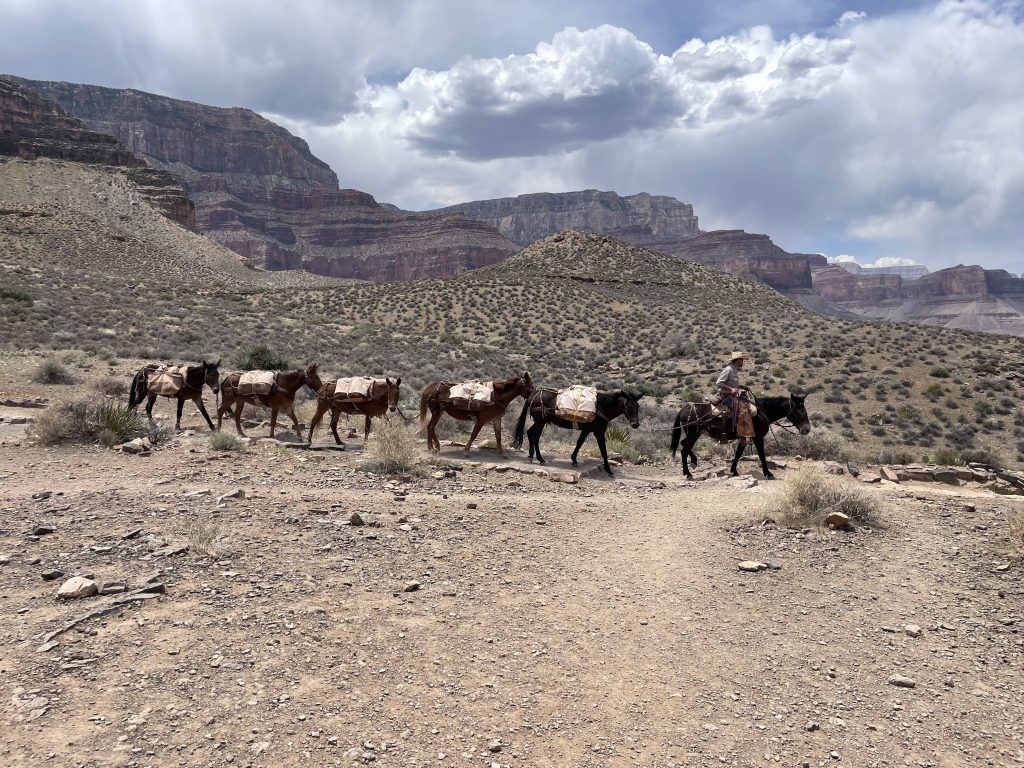
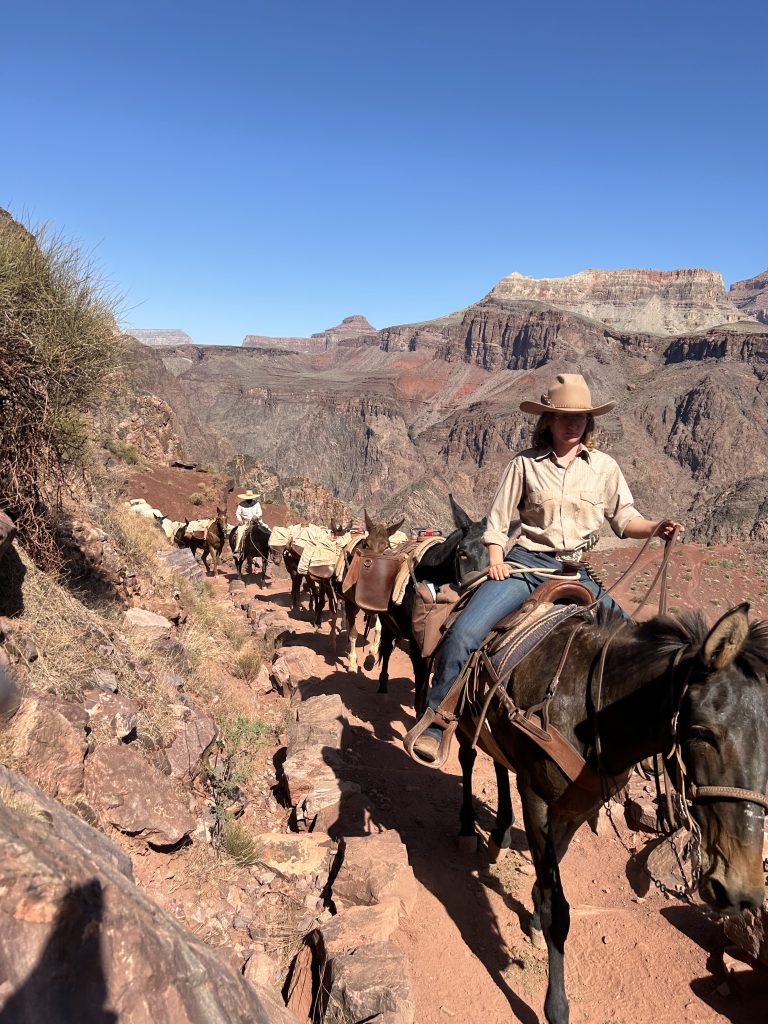
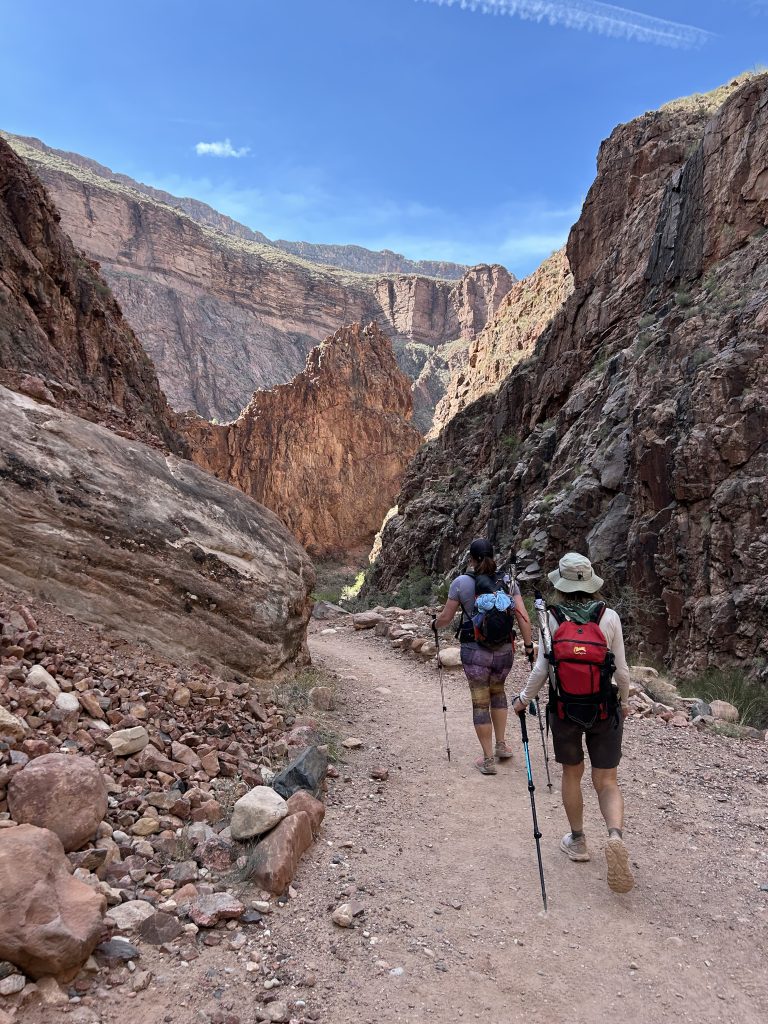
I’m slowly catching up on my travel posting from 2025! Here’s a biggie (literally and figuratively); for our 25th anniversary in May 2025, my husband and I did the Grand Canyon rim-to-rim hike in both directions. Day one: North to South via the North Kaibab and South Kaibab trails, and day two: South to North via the Bright Angel, Tonto, and North Kaibab trails. A friend also hiked with us on the South-North day. Here’s how it went!

Overview

The National Park Service is correct when they call this hike a “classic bucket list adventure” that requires three things for success: the right training, the right gear, and knowing what to expect. The fact that neither of us had been to the Grand Canyon before made it even more amazing. I would rank the Grand Canyon as one of those places like the Taj Mahal (which we visited on our honeymoon in 2000!): as many photos as you’ve seen of it, it just takes your breath away to be there in person.

Rim-to-rim is 24 miles each way, and people do it in all kinds of configurations. The main constraint is that the (much more remote) North Rim is open only from May 15 to October 15. An additional, additional constraint is that, sadly, most of the park infrastructure on the North Rim (including the cabin village where we stayed, and the lodge where we had our 25th anniversary dinner) burned down in the Dragon Bravo fire in July 2025, so the lodging we stayed in is no longer an option.

As with any long-distance hike, you’re going to see people trail running this thing like it’s nothing at all, and you’re going to see people struggling in the first few miles. Your mileage will literally vary. I will say that as someone who tolerates heat reasonably well, lives at 5,430 feet (1,655 meters) and has access to good training areas for long-distance hikes, I found the whole experience neither significantly harder nor significantly easier than I expected (more this below). But that’s with the caveat that you can’t really train for the heat or the altitude if you don’t live in a conducive environment. The South Rim is 7,000 feet/2,133 meters and the North Rim is 8,000+ feet/2,400 meters, plus during the time that the North Rim is open, it’s nearly always hot on the South Rim, so you kind of can’t escape it!

Planning and preparation

The first step in any rim-to-rim adventure is planning and preparation. You can do this thing in all kinds of ways: you can do it over multiple days by camping in a campground, or staying at Phantom Ranch, the cabin village in the bottom of the canyon. You can hike one way and take a shuttle one way. You can hike one way, stay one or more nights on the other side, and then hike back (which is what we did). You can hike or run both directions in one day (we saw many people doing this, too!). You can hike it in one day, but take a long break in the creek at Phantom Ranch. For us, the deciding factors were:

  • We like long hikes
  • We’d rather not carry camping gear
  • If we’ve never been there before, why not hike it both ways and get the full experience?
  • If you don’t camp/stay in the Grand Canyon itself, you don’t need a permit, you just need a lodge reservation which is a lot easier to get

So we decided on hiking both ways, staying on the South Rim between the two hiking days. The South Rim is like a city. There are multiple lodges, restaurants, shuttle buses, etc. while the North Rim, even before the lodge burned down, was nothing like that. Most people who do one way do North-South, for this reason (and because the North Rim is 1,000 feet higher, so the uphill at the end is less intense if you go South). I was very happy with how we organized this and I’d do it the same way again.

If you’re on Facebook, I’d recommend the very helpful Grand Canyon Rim to Rim group. It’s particularly good for logistical specifics: parking, water, shuttles, where to stay overnight, gear recommendations, etc. etc.

Training

Training for 50 miles of hiking in two days is a big deal. Even if you like to walk, that’s a lot of walking. Fortunately, we have tons of hiking trails where we live (Boulder, Colorado). My goal was pretty simple: to hike three to four times per week, working up to two 20-mile hikes in the month before the trip, and also doing two days a week of strength training and two days of yoga.

For me, this resulted in an experience that was strenuous but still fun. One factor: the hiking trails where we live are actually much more challenging than most of rim-to-rim. They’re steeper, rockier, rougher, just generally more difficult than the Grand Canyon, where the up-and-down trails are strenuous, but once you’re in the bottom of the Canyon, the trail is very smooth and relatively flat. This could be totally different if you don’t live in a mountainous state; we met people who came from Florida and trained by walking stairs in weight vests!

Logistics

As mentioned above, you can really choose your own Grand Canyon adventure, but here’s what we did:

  • Flew to Phoenix (with friends, a couple), rented a car, drove to Sedona and stayed there for three nights. Highly recommended; I had never been to Sedona and we loved it.
  • Drove from Phoenix to the North Rim and spent the night. We did that at the North Rim Lodge which no longer exists. Today you’d have to stay at the Kaibab Lodge or the Jacob Lake Inn.
  • Hiking day one: Our friend who was not doing the hike dropped us off at the North Kaibab trailhead at 5 AM, we started hiking and arrived at the top of the South Kaibab trail on the other side at 4 PM. This was my usual slow and steady pace plus a longish break at Phantom Ranch (which has a canteen where you can buy lemonade, candy bars, chips, etc.). In 2025, it was not possible to hike directly up the Bright Angel trail from the river, because the River Trail was closed for water pipeline construction.
  • Stayed overnight at the Bright Angel Lodge on the South Rim. I would recommend this lodge for hikers because if you’re hiking up or down the Bright Angel trail, you can literally see the trailhead from the lodge.
  • Hiking day two: We again got up at 5 AM and hiked back via the Bright Angel trail, the Tonto trail (which circumnavigates the closed section of the River Trail) and the North Kaibab trail, arriving at the top at 7 PM. Our friend then picked us up and we stayed again at the North Rim Lodge and had dinner there.
  • The next day, we drove back to Phoenix, visiting Flagstaff on the way, stayed at an airport hotel and flew home.

Gear and water

You want the right gear for this kind of hike. The right shoes and socks are critical, because your hike could easily be ruined by blisters or sore feet. Personally I much prefer trail running shoes versus hiking boots when it’s really hot. We did this hike at the very end of May, and the high temperatures were in the 90s/around 35-38 Celsius: hot. So your feet are going to sweat. I wore Altra Lone Peak trail running shoes and Balega Hidden Comfort socks, and they were perfect.

For clothing, I wore a very light 32 Degree Cool t-shirt and capri leggings, with a warmer shirt for the morning, plus a sun hat, and the #1 piece of gear I would recommend for this, or any other long hike in the desert, the Six Moon Designs reflective hiking umbrella. This umbrella looks kind of dorky, but it weighs less than a water bottle and gives you so much more shade than just a sun hat. I honestly am not sure I could have done this hike without it, or at least not as comfortably.

Food and water are their own issue. I took a large selection of sweet, salty, and proteiny food: everything from Nerds gummy clusters, to mixed nuts, to vegan jerky, to Peanut M&Ms. I tend to lose my appetite on long hikes, so I wanted a bunch of tempting options. For a one-day rim-to-rim, you’ll want a backpack that’s larger than what you’d take on a typical day hike, but not a behemoth overnight pack. I love my Camelbak 14’er and it worked really well for this trip!

For water, I took a three-liter hydration pack plus an additional one-liter bottle of electrolyte drink, and that was exactly enough. The downside of hiking up South Kaibab is that there’s no water, and it’s very hot. So you drink as much as you can at Phantom Ranch, fill everything up, and that’s it, or at least it was when we were there (there is sometimes, but not always, water at the Tonto Tip-Off, where Tonto crosses over to Bright Angel). Carrying four liters, I drank the last of my water within sight of the top of the South Rim (where you can buy anything you want).

Trekking poles are a matter of opinion; I’m a poles girl, and I use them even on short day hikes. I like the feeling of doing something with my arms while I’m walking, and my fingers tend to swell up if my hands are just hanging by my side. My husband got me the REI Carbon Flash poles as a gift, and they’re my go-to: very light but very durable.

To sum up

I really loved this trip. My husband and I wanted to do something meaningful for our big anniversary, and this was big! We did the South-North hike (day two) on our actual anniversary day, which was particularly fun. It’s definitely a committing experience, and how hard it is will depend significantly on where you are able to train, but I was thrilled with how this worked out and I would definitely do it again!

Written by Corinne McKay · Categorized: Uncategorized

  • « Go to Previous Page
  • Page 1
  • Interim pages omitted …
  • Page 4
  • Page 5
  • Page 6
  • Page 7
  • Page 8
  • Interim pages omitted …
  • Page 245
  • Go to Next Page »

Primary Sidebar

Subscribe to the Training for Translators mailing list!

Getting Started as a Freelance Interpreter: Available now in print and electronic editions

Learn from our blog:

  • Struggling in your freelance business? Really, you have four options
  • T4T podcast, episode 30: A summary of my “state of freelance translation” survey
  • Survey results: The state of freelance translation in 2026
  • Focus on the clients who can afford you
  • Upcoming direct client marketing class
  • Travel: Cycling Quebec’s Tomifobia Nature Trail
  • Travel: Cycling Burlington, Vermont’s Causeway Bike Trail
  • When part of your business falls off a cliff

Search the Training for Translators blog

Copyright © 2026 · Training For Translators · Log in

This website uses cookies to improve your experience. We'll assume you're OK with this, but you can opt-out if you wish. To view this website's privacy policy, click About>Privacy Policy. Accept Read More
Privacy & Cookies Policy

Privacy Overview

This website uses cookies to improve your experience while you navigate through the website. Out of these, the cookies that are categorized as necessary are stored on your browser as they are essential for the working of basic functionalities of the website. We also use third-party cookies that help us analyze and understand how you use this website. These cookies will be stored in your browser only with your consent. You also have the option to opt-out of these cookies. But opting out of some of these cookies may affect your browsing experience.
Necessary
Always Enabled
Necessary cookies are absolutely essential for the website to function properly. This category only includes cookies that ensures basic functionalities and security features of the website. These cookies do not store any personal information.
Non-necessary
Any cookies that may not be particularly necessary for the website to function and is used specifically to collect user personal data via analytics, ads, other embedded contents are termed as non-necessary cookies. It is mandatory to procure user consent prior to running these cookies on your website.
SAVE & ACCEPT