• Skip to main content
  • Skip to primary sidebar

Training for Translators

Classes for translators and interpreters

  • Start here
  • Blog
  • Classes
    • Coaching for freelancers
    • Subscription
  • Books
    • Translate my books
    • Book Shop
  • About/Contact
    • Privacy Policy
  •  
  • Account

Uncategorized

May 05 2026
Corinne McKay

Moving from information to action

Corinne McKay (classes@trainingfortranslators.com) is the founder of Training for Translators, and has been a full-time freelancer since 2002. An ATA-certified French to English translator and Colorado court-certified interpreter, she also holds a Master of Conference Interpreting from Glendon College. For more tips and insights, join the Training for Translators mailing list!

This month’s classes!

This month’s professional development classes are open for registration:

  • Master class: On Monday, May 11, guest instructor Wudan Yan teaches “Fact-checking: How to build your skills and find work.” Registration is $60 and includes the recording. Learn how to properly fact-check print, audio, and video media, to improve the quality of your own work, or to offer fact-checking as a standalone service.
  • Self-paced course with live sessions: Registration ($110) is now open for guest instructor Molly Yurick’s course, Breaking Into the Subtitling Market. You get access to the self-paced lessons for six months, and there are two live sessions in June where Molly will present a bonus lesson and answer your questions. We got excellent feedback from the first round of students in this new format! Registration closes on May 22.

How do we move from information to action?

I’ve gotten a version of this question from multiple students: I take all of these webinars and classes, and then I never do anything with what I learned! Help?!

This issue affects us all, because, let’s be honest, we’d rather take a class and talk about marketing, or website development, or content creation, versus actually doing those things. Additionally, we may:

  • Hate business development so much and so viscerally that we literally cannot do it (yet)
  • Resent that we need to work on our businesses when we’d rather just be working in our businesses
  • Feel that needing to work on our businesses means we’re really not that great at the job, otherwise we’d be swamped with tons of work from referrals and word of mouth

Let’s dig in…

But first, my favorite information sources

Now that I’ve told you it’s not really about information, let’s pause for a moment on information. I’m pretty discerning about the newsletters I subscribe to. But every time I hear from Cal Newport, James Clear, Lizzie Davey, and Jen A. Miller, I read the whole thing. Maybe their newsletters will help you, too!

Next, what’s wrong with “endless learning”

Nothing, really! I tell people all the time, you can 100% push back on my (or anyone else’s) advice, if you’re getting the results you want to get from your business. If you’re reaching your target income and doing interesting work, stop reading and go back to what you were doing. But if you’re not getting the results you want, then you need some input.

Learning is good, when your issue is that you need or want to learn something. That sounds ultra-basic, but here’s what I mean: I recently took an excellent class on SEO/GEO (search engine optimization and generative engine optimization). Why did I take it? Because I wanted to learn more about how to write well for good search results. The class was taught by Stacey McCormack and I thought it was great. I actually put some of the information to use for a client the next day. Success!

But for many of us, and in many areas, we’re taking a class partially to learn something, and partially or even primarily to motivate ourselves to do the thing. We take an e-mail marketing class not because we don’t know how to write a pitch e-mail, but because we need to actually write pitch e-mails and we’re not currently doing that. Learning feels productive, and in many cases it is productive, but it’s not the same as doing.

Think of it this way: If you wanted to get better at something physical, like running, or skiing, or lifting weights, would you read books about it and then expect to immediately be better at the activity? Probably not; you’d know that you had better information, but you had to put the information into practice in order to see results.

So, what now?

One thing I would not recommend: thinking that spending tons of money on classes will motivate you to do something you don’t want to do. I try to keep T4T’s classes affordable, almost always $60-$75 for a one-time class and $90-$250 for something longer. But I’ve talked to students who have spent a lot of money ($1,500 and more) on classes and coaching, and they still didn’t do anything.

Better ways, in my experience:

  • Identify at least some of the Why factor. It can help just to say, “Because I feel caught between two not-great options; having a freelance business that I have to market, or having an in-house job that constrains lots of other things in my life.” “Because I feel physically sick when I think about cold marketing.” “Because I think my target clients aren’t receptive to direct marketing, but I don’t think I can afford to go to client-side conferences and I hate talking to people I don’t know.” There. You said it. Now you can figure out how to move beyond it.
  • Broaden what “counts.” Maybe a structured marketing campaign (identify 100 potential clients, e-mail them all, then connect with them on LinkedIn, then follow up) is ideal. But most of us don’t have the discipline for that kind of thing. Of the freelancers I’ve talked to who are doing well right now, they have something in common: they’re just doing more of any kind of marketing. Maybe one day that’s LinkedIn connection requests, the next day it’s nudging dormant clients, the next day it’s writing an FAQ for their website, the next day it’s asking a colleague if they want to do a LinkedIn Live together. They’re doing the opposite of overthinking it, and for most people it’s working.
  • Make the task so small that it’s impossible to avoid, and make it a priority. You have 15 minutes. I know that, because I’m a pretty disciplined person and I spend at least 15 minutes a day watching videos about how to bottle-feed an orphaned meerkat, or how to pack for a two-week Europe trip in one bag. As Austin Church (ooh, another newsletter I like!) recently noted, “There’s always enough time for what’s most important.”
  • Implement some accountability. Again, even if you’re an Upholder (raises hand!), accountability puts some metrics on the things you feel overwhelmed by, or that you avoid, or that tend to spiral into analysis paralysis. Just today, I told my ATA mentee, “By the time we talk next month, I want you to contact at least 15 potential clients.” I myself have a meeting with my SCORE mentor tomorrow, and guess what I’m doing this afternoon: finishing the stuff that I committed to doing when we had our last meeting. Even if you’re not avoidant about these things, accountability can really help you move it from “someday” to “done.” You could also try Focusmate, an in-person or virtual coworking group, or bribing yourself to do the hated thing (i.e. going to your favorite coffee shop only if you work on accounting while you’re there).
  • Stop doing what doesn’t work. Again, this sounds kind of “duhhhh,” but here’s that I mean. A couple of years ago, I admitted that I just do not watch recorded webinars. I pay for them, and then I never watch them. Literally money out the window. So I made a policy for myself that I don’t sign up for a webinar unless I can attend it live. For you, maybe that’s totally different. I recently talked to a student who lives by herself and told me that she motivates herself to cook a real dinner by watching recorded webinars while she cooks and eats. You do you. But at the very least, stop signing up for classes that you never take action on.

I hope these tips are helpful! Have a great week!

To get our weekly posts directly in your inbox, sign up for the Training for Translators mailing list!
Written by Corinne McKay · Categorized: Uncategorized

Apr 29 2026
Corinne McKay

T4T podcast, episode 25: How’s 2026 going so far?

Episode 25 of the Training for Translators podcast is based on this blog post. You can listen on Apple Podcasts, Spotify, or right here:

In this episode, I talk about how the first quarter of 2026 is going for me, and for other freelancers I’ve talked to!

Corinne McKay (classes@trainingfortranslators.com) is the founder of Training for Translators, and has been a full-time freelancer since 2002. An ATA-certified French to English translator and Colorado court-certified interpreter, she also holds a Master of Conference Interpreting from Glendon College. For more tips and insights, join the Training for Translators mailing list!

Written by Corinne McKay · Categorized: Uncategorized

Apr 28 2026
Corinne McKay

How much is “enough” marketing?

Corinne McKay (classes@trainingfortranslators.com) is the founder of Training for Translators, and has been a full-time freelancer since 2002. An ATA-certified French to English translator and Colorado court-certified interpreter, she also holds a Master of Conference Interpreting from Glendon College. For more tips and insights, join the Training for Translators mailing list!

How much is “enough” marketing

When people talk about the disruptions in the freelance language services world lately (“disruptions”=everything from ChatGPT to wars), I often say, yes, and:

  • Most freelance translators and interpreters don’t do enough of any kind of marketing to really move the needle.
  • It’s rare that I talk to a freelancer who is doing what I would consider enough marketing, even when that person thinks they’re marketing like crazy.

In response to which, a student asked me a good question. What’s “enough”?? What’s an example of someone doing enough marketing?

Great newsletter topic! I’m not going to use myself as an example, because I’m not doing a ton of active marketing at the moment. I’m a huge believer in the concept of Always Be Marketing, and I hold myself to the requirement of doing some kind of marketing action every weekday. And, as I recently wrote in a newsletter, I’m very fortunate that I have a lot of work right now; I’m always open to new work, but I’m not doing a big marketing campaign.

Two good examples

Here are two examples that I think are illustrative. Honestly, I think that only post-ChatGPT examples are relevant right now, because AI has had such an effect on the market for all kinds of freelance work. Both of these are from freelance writers; I find very few examples of translators and interpreters who talk about their marketing and income in detail, and I think that freelance writers’ work is similar enough to ours that we can use them as a good example.

First, let’s look at the March 30, 2026 issue of Jen A. Miller’s newsletter, Notes from a Hired Pen, “Results of a March marketing sprint.” You should subscribe, if you don’t already! Jen is a six-figure freelancer whose writing I really admire. She reports that she started March 2026 “…the most worried I’ve been about my business in a long time,” largely due to a decrease in work from her higher education clients. Jen then did her own March Marketing Sprint, and (even as someone who’s always telling people to do more marketing), both her effort and her results are really impressive.

If you’re working on your own marketing, you should definitely read the “What I did” section of this article. For example, Jen followed up twice with any promising leads from the past. She nudged every dormant client, going back to 2019. She also pitched extra services to her current clients, and immediately followed up with every client that she submitted a piece to, asking them for more work.

This totaled almost 100 letters of introduction to new clients, plus 77 follow ups, and 39 nudges. The result: $15,805 of new work. I’d call this a great example of “enough” marketing, with a great return on the effort.

Next, let’s look at freelance finance writer Carter Kilmann’s LinkedIn Pulse article, Crunching numbers: What 100 pitches taught me about prospecting, published in June 2024. At the time, this article caught my eye because Carter took Ed Gandia’s e-mail prospecting class (an experience he details in this article) and then actually took action! As the title of the article would suggest, Carter then decided to market via targeted e-mail to 100 potential clients in the three months after he took Ed’s class. His results:

  • 67 of his prospects opened either his initial e-mail or the follow-up e-mail. Carter tracked this using a tool called Streak. Tracking e-mail opens requires a certain degree of emotional fortitude, because people do odd things like open your e-mail 11 times and never respond, but Carter correctly notes that it can also allow you to move on from someone who deletes your e-mails without reading them.
  • 12 people responded. He counted any response, positive or negative.
  • Six of the e-mails turned into a conversation.
  • Of those six, two of them turned into clients.

In the three months since he did the campaign, those two clients had sent Carter $6,500 of work. He spent $249 on Ed’s class, and the total time investment (taking the class, finding people to market to, sending the e-mails and the following e-mails) was about 55 hours. Thus, even if he never got any more work from those two clients (and I’m guessing that he did get more work from them, because he went on to write another article about how he had become too busy to continue writing his newsletter, earning as much in one month as in his first two years of freelancing combined), and counting total time, even taking the class, that’s an hourly rate of $118 which is certainly decent.

Why am I telling you this?

Now, why I am I showing you these examples? To taunt you, and to make you feel even worse if you, like a recent attendee in one of my classes, “would rather dig yourself into a hole than do marketing”? No, definitely not.

When you see other freelancers doing these kinds of things, let them lead the way and show you what is possible. Jen and Carter are solopreneur freelancers like you, making a solid six-figure income. They’re not the head of an empire with tons of subcontractors and a big marketing team. You can do this, too. And, as we see here, it takes a lot of work. When we look at Carter’s 12% response rate, the really hard part is slogging through the 88 who never responded. Most of us don’t nudge clients from six months ago, much less do what Jen did and go back six years in our accounting records to find people to nudge. Rather than using this as another reason to feel bad about yourself (none of us need more of those!), use this as inspiration! I’m cheering for you; let me know how your next marketing campaign works out!

To get our weekly posts directly in your inbox, sign up for the Training for Translators mailing list!

Written by Corinne McKay · Categorized: Uncategorized

Apr 22 2026
Corinne McKay

How is this year going so far?

Corinne McKay (classes@trainingfortranslators.com) is the founder of Training for Translators, and has been a full-time freelancer since 2002. An ATA-certified French to English translator and Colorado court-certified interpreter, she also holds a Master of Conference Interpreting from Glendon College. For more tips and insights, join the Training for Translators mailing list!

How is this year going so far? 

Last year in the freelance world was kind of crazy (that’s the technical term). Translation really felt the fallout from ChatGPT, with many, many agencies moving to AI-generated first drafts with human editors. That resulted in a lot less work, or a lot less interesting and lucrative work, for a lot of translators, meaning that a lot of translators looked for in-house jobs or left the language professions entirely. Other freelancers were scrambling for different kinds of work, all of a sudden getting a lot more interested in direct clients, interpreting, “pure” writing, and other services that aren’t so affected by AI. Let’s take a look at how all of this is shaking out, in my world and in what I’m hearing from other people. 

In my opinion, March-April is a good time to do an initial assessment of how the year is going. You have enough data to see some trends, but still enough time to course-correct if things aren’t going well. Mostly, I hope that this analysis helps you to do your own! 

For me, things are good, and somewhat different 

As I wrote about and talked about in January, 2025 was my highest-earning year in 20+ years of freelancing. And yet, I achieved at least some of that by doing the things I tell other people not to do, namely working a bit too much, and having a scarcity mindset about interpreting (“I have to take anything and everything or I’ll have no work”). 

Things this year, I’m happy to report, are looking better in both of those departments. I set a goal of taking more time for yoga and music on weekdays (I almost never work on weekends, but that’s when I tend to do big outdoor things like skiing, hiking, and mountain biking) and I’ve been able to follow through on that. I’ve been going to yoga an average of three times a week, my lute duet partner and I performed at a small community event, and I played in a cello choir through Denver Adult Strings Camp. I feel a lot more rested and more balanced, and I don’t have the “hatchet over my neck” feeling as if I have to be working every single second during the week. 

I’ve read six books on paper so far this year (mini reviews to come in December!) and listened to six audiobooks, after deciding that my mental health needed a break from political podcasts. I’ve also branched out with my own professional development, taking Lizzie Davey’s class Create Better Content (not an affiliate deal) and speaking on AI-era diversification at the virtual conference of the American Society of Journalists and Authors. Finally, I’ve given myself time to do some “just for fun” writing and translation, including a couple of new “frustrated travel writer” blog posts about why I decided to get a United Quest credit card and how I spent part of the last two summers climbing 14 of Colorado’s 14,000-foot peaks. 

The question is whether this improved balance affects my income. That’s still to be determined. This year to date, I’ve earned $41k after deducting payments to my online course guest instructors. That’s less than the $49k I had earned at this time last year, but I’m still on track to earn around $140k, which is fine with me given that I feel like I’m working a lot less. 

Details about my workflow

Admittedly, I need to get (much) better about time tracking. I really am a data person, but time tracking is the one thing that I just can’t force myself to do. I realize that the vague feeling that I’ve had more free time is not really valid, but it’s all I’ve got right now. I’ve also:

  • Landed a new retainer client for corporate writing: this is a translation company where I ghostwrite the CEO’s LinkedIn, write the company newsletter, make white papers into blog posts, etc. I like this work and it meets my income goals. 
  • Landed a new interpreting direct client, through a referral. This is somewhat unique because I interpret mostly for agencies, but I really like the client and the work.
  • Did a couple of fairly large translation projects for my direct law firm clients. This reinforces my opinion that legal translation has been either completely eaten by AI, or the lawyers don’t care about AI, and not much in between. 

What I’m hearing from other people

I’m always at risk of being overly and illogically positive. That seems like a good characteristic, but it can cause me to think that things are fine, when they’re very much not fine. However I do feel that a lot of the AI fallout, in the translation world at least, has fallen. I personally don’t feel that AI is a bubble (sadly). I think that it saves too much time and money, particularly for clients with tight budgets and low quality standards (sorry, true, in my opinion) to go back in the tube. 

But I do feel that a) maybe we’re through the worst of the AI slash-and-burn; clients who are going to go all in on AI have already gone there, b) maybe clients in the language business are becoming more discerning about how and when they use AI, and c) definitely, in my experience, there’s good work to be had in getting clients out of the AI slop. 

This winter, I spoke at a really interesting event for translation students at Kent State University, where a lot of these factors were very apparent. Kent’s programs are a lot smaller than they used to be, and yet the students who are there are pretty fired up about their prospects. A number of them stressed that the job formerly known as translation is now going by a variety of names: 

  • “Language lead” is likely to be mostly translation 
  • “Linguistic data analysis” involves a lot of translation 
  • “Language QA,” also a lot of translation 
  • “Bilingual content specialist,” basically a translator 

As always, most people don’t really embrace change, especially in a job that they really love(d) and that has changed a lot in the past few years. But I do think that there’s still a lot of good work out there, you just have to look for it in different ways. I’ve also talked to more than a handful of good translators who have completely shifted gears, to an in-house job that uses their language skills but isn’t totally focused on translation. Personally, I give this a thumbs-up. It’s way better to adapt than to pine for what used to be! 

With that, onward into the rest of Q2 of this year. If you want to tell me how things are going for you, just leave a comment!

Written by Corinne McKay · Categorized: Uncategorized

Apr 20 2026
Corinne McKay

Travel: Climbing some of Colorado’s 14,000-foot peaks

Corinne McKay (classes@trainingfortranslators.com) is the founder of Training for Translators, and has been a full-time freelancer since 2002. An ATA-certified French to English translator and Colorado court-certified interpreter, she also holds a Master of Conference Interpreting from Glendon College. For more tips and insights, join the Training for Translators mailing list!

Although I love hiking, I’ve never really had a passion for climbing the Colorado 14’ers; the 58 mountains in Colorado that are over 14,000 feet and that meet the definition of being a 14’er. I climbed exactly one 14’er in the first 20 years that we lived in Colorado, and that was only because some friends proposed doing Mt. Bierstadt (one of the easiest) with our families when the kids were little. But between 2012 and 2024, I climbed zero 14’ers!

For a variety of reasons, 14’er fever hit me in 2024. Typically, my husband and I spend most of the summer mountain biking, but he was laid up with an injury, while my daughter (who has had 14’er fever for a while) was home from college for a few weeks. In the end, I hiked nine peaks that summer (Quandary, Sherman, Elbert, Grays/Torrey’s, and Democrat/Cameron/Lincoln/Bross) which got me to 10 total. Then it seemed like a cool goal to hit 14 total, so in the summer of 2025 I did Huron, Yale, and Belford/Oxford), and now I’m “thinking about thinking about” trying to get to 25 total before I turn 55 in September 2026 (we’ll see!).

How hard are 14’ers and how do you research them?

If you have any interest in 14’ers, I would start with 14ers.com, its corresponding app, and its Facebook group. I like the website/app for basic research. It has the elevation, trail information, and access descriptions for all 58 peaks, plus lots of helpful categories like the easiest 14’ers. The Facebook group is very helpful for real-time information (snow conditions, can you get to a certain trailhead in a certain type of vehicle).

Access is an issue with some 14’ers. Some trailheads are accessible only with a high-clearance all wheel drive vehicle, otherwise you have to park at a lower trailhead and walk up, and some of those walks can be long. Some trailheads, especially for the peaks closest to Denver, get very crowded on weekends. The 14’ers Facebook group has stories of people getting shut out before 5 AM to climb Bierstadt. On a couple of the peaks, the summit is on private land, so you can’t hike to the true summit. This was the case with Bross when my daughter and I did the Decalibron (a four-peak loop combining Democrat, Cameron, Lincoln, and Bross). Yet other peaks are completely on private land. Kind of crazy-cool to have a 14’er as your backyard, but land ownership in Colorado predates the 14’er checklist phenomenon. Different landowners handle this in different ways: some have a QR code electronic waiver, and some (most notably Culebra Peak as of this writing) require you to obtain a permit in advance. Point being, don’t just show up in a low-clearance, 2WD rental car and expect to drive right to these trailheads. Do your research ahead of time and find out what the road is like, whether there is trailhead parking, whether you need a permit, and what your options are if parking is limited.

Due to parking issues, especially on summer and fall weekends, there are frequent discussions on the 14’ers Facebook group about whether sleeping inside your vehicle constitutes “camping.” Most of the 14’er trailheads prohibit “camping” in the parking lot, but are you “camping” or “taking a nap in the back seat of your car” if you’re sleeping there ahead of a hike. Opinions vary on this! I’ve never done it, but I have slept in my car at a legal, dispersed campsite before climbing Huron Peak, and that worked out fine.

The next thing a lot of people wonder: how hard are these things to climb? Of course, it depends. Your fitness level, acclimatization, etc. are hugely important, and there’s a lot of variation across 58 peaks. I’m focusing only on the Class 1 and 2 peaks, which means that you just walk. You don’t climb using your hands for balance (other than a few short sections, like the top of Mt. Yale), and you definitely don’t climb using a rope. But there are peaks where you can do those things if you want to!

But let’s take a stab at the “how hard” question. Everyone has pluses and minuses Mine include:

  • I’m in decent shape and I love long hikes
  • I’m a relatively slow hiker
  • When I hike, I dislike stopping. I really only stop if I need to eat or drink, I rarely/almost never stop just to take a break.

All of these factors will contribute to your assessment of “how hard”? But for reference, here’s my round-trip time on all of these hikes so far. This is door-to-door, including hiking time and breaks, via the standard route unless otherwise specified. Again, with the caveat that I’m a slow hiker but I don’t stop much.

  • Quandary: 6 hours
  • Sherman, from the Leadville side: 4 hours
  • Elbert, from Halfmoon Creek: 7 1/2 hours
  • Gray’s/Torrey’s: 6 1/2 hours from the upper trailhead, but this does not include walking three miles up the access road (got a ride on the way back)
  • Democrat/Cameron/Lincoln/Bross: 6 1/2 hours
  • Huron: 7 1/2 hours from the 2WD parking lot, but this includes spending a fairly long time on the summit to wait for friends
  • Yale: 8 hours from the Denny Creek side
  • Belford/Oxford: 10 hours, but this includes both peaks and taking the longer (Elkhead Pass drainage) way down

An additional factor is altitude, especially if you live at sea level. We live in Boulder (5,430 feet) and the altitude still affects me, and there’s really no way to “train” for altitude other than being there, unless you go all in on something like an acclimatization tent at your house. It’s also important to note that you can get actual altitude sickness above around 8,000 feet, and certainly above 10,000 feet, so you should know the signs and descend immediately if you feel sick.

Altitude gets more tolerable as you acclimatize, so if you have an option to stay in the Colorado high country for a week to 10 days, you’ll feel better!

Preparation and gear

It’s pretty amazing to me, and I mean this as a data point, not a judgment, how many unprepared people you see on 14’ers, in terms of both physical training and gear. Always a few people in jeans and Crocs, always a few people carrying a water bottle, a protein bar, and not much else (which might work if you’re trail running, but not for an all-day hike), always a few people who walk for 10 minutes and stop for 30 minutes and lots of people who seem relatively unaware of the risk of being struck by lightning.

Everyone should do 14’ers in the way that makes them happy, as long as you’re not causing a risk to other people. My preparation includes:

  • Mentally acknowledging that it’s OK to turn around at any time. When people say that the mountains aren’t going anywhere, they’re right. If something feels “off” or a storm rolls in, better to get down alive and try it another time.
  • Taking enough food and clothing to spend a night outside if things really go to heck (someone gets seriously sick or hurt). It might not be a pleasant night, but I want that safety margin.
  • Starting early enough to be off the summit before 12. Because I’m slow, this generally means getting up at 5 AM and being on the trail by 6.
  • Checking multiple weather forecasts. I usually try to compare NOAA, Apple Weather, and Mountain Forecast. Even with all of those sources, we’ve had hikes where the weather was significantly better, and significantly worse than what was predicted. Which underscores the importance of having a goal but being willing to turn around.
  • Pacing. It took me a long time to learn that at least for me, the slowest continuous pace is still faster than stop and go. You see a lot of people on 14’ers who are fast when they’re moving, but they’re moving only about 50% of the time. This isn’t a criticism; you do you, that’s part of the enjoyment. But if you’re slow, I think you’re better off focusing on a sustainable pace rather than pushing yourself and having to stop a lot.

My gear includes:

  • Good boots that don’t give me blisters, currently the Asolo Finder, because I found a good deal on a nice pair that had been worn once. For 14’ers, I prefer boots (not trail runners) with a rigid sole and some ankle support. This is not the case for flatter, smoother trails. For example I did Grand Canyon Rim to Rim (the subject of a future post!) in Altra trail runners and I was glad to not be wearing boots for that.
  • Good socks (I’m a fan of Ballega and Darn Tough)
  • A Garmin InReach mini satellite communicator. I know that opinions vary on these, but I’m a believer, especially since my husband did end up pulling the SOS on ours, on a backcountry ski trip two years ago (everything turned out fine). Carry the InReach (or any similar device) on the outside of your pack, in a spot where you can reach it with your dominant hand. I put mine on a miniature locking carabiner on the front of my left pack strap.
  • A good backpack. I use the appropriately named Camelbak Fourteener with a three-liter water bladder. It has a lot of carrying capacity and I find it very comfortable.
  • Food. Lots of food. I’m in general a food girl and not someone who “forgets to eat,” but on long hikes I tend to lose my appetite. I check my watch and force myself to eat approximately every hour and a half to two hours. Generally I don’t take a “meal,” just a ton of different snacks so that I have lots of options. I like to mix up protein-y things (Aussie Bites, Kind bars, peanut M&Ms, salted mixed nuts) with some pure sugar (Nerds gummy clusters, chocolate covered salted caramels), and some salty stuff (corn chips, peanut butter crackers). This way, there’s almost always something that seems appealing. If it’s likely to be hot, I also take a separate one-liter bottle of Liquid IV or a similar electrolyte drink, and I always have a couple of emergency nutrition items like a caffeinated gel and an extra packet of electrolyte drink powder, figuring that I could eat it if needed.
  • First aid kit. Definitely take at least the basics: bandaids, medical tape, blister kit, Ace bandage, sunscreen, ibuprofen or Tylenol, lip balm
  • Layered clothes and a waterproof jacket and waterproof gloves or mittens. I have a pretty basic Patagonia shell jacket and a pair of windstopper gloves, then I always take a sun hat, a warm hat, a packable down jacket, and an additional layer like a fleece pullover. When you’re packing clothes, you need to think not just of how you feel when you’re hiking, but what happens if you have to stop for an extended period of time because of weather, someone feels sick, gets hurt, etc. etc. And the usual clothing rules: no cotton, quick-dry fabrics only, and watch out for fabrics that chafe, because you’re going to be swinging your legs and arms for a long time.
  • Trekking poles. I love my poles and I never do strenuous hikes without them. My husband got me the REI Flash carbon poles as a gift, and they’re great. I like them for balance, and because it gives your arms something to do while you’re walking.
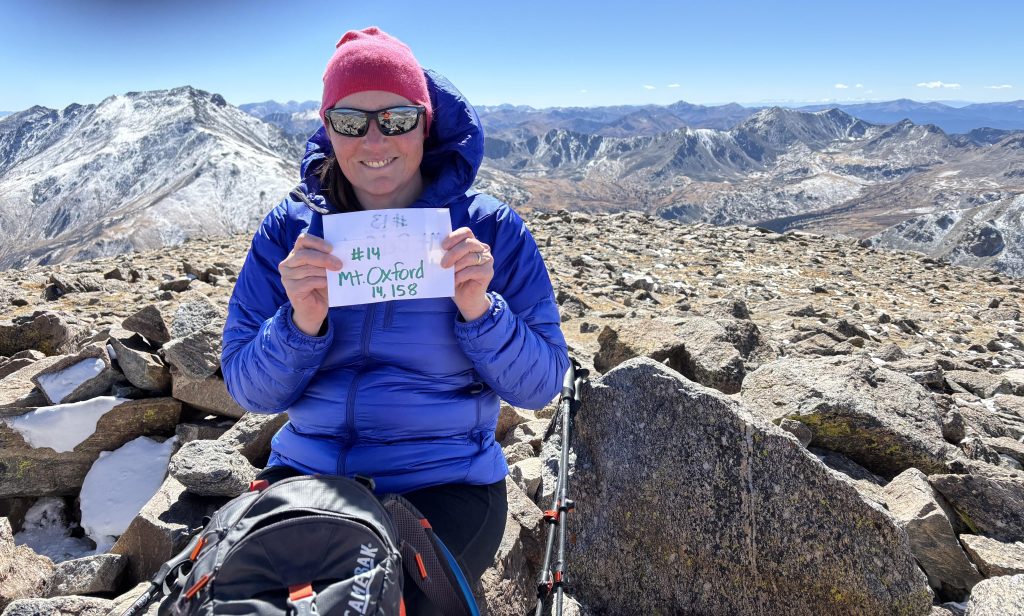
  • A sign for the summit!! No kidding! It’s totally a thing on 14’ers. People haul all kinds of commemorative signs up there! I’m not that creative or energetic, but I do take a piece of paper with the name of the peak, the summit altitude, and how many 14’ers it makes for me.

Access information and my favorite hikes

I’ve really enjoyed all of the 14’ers that I’ve done; there are none that I would put on the “never again” list. To be fair, this is probably because we live just a couple of hours’ drive from most of these peaks and I have the flexibility to go when the weather is good and the trails are less crowded. I don’t go when it’s raining, and I don’t get up at 3 AM. Herewith, a few preferences:

  • The access to Grey’s and Torrey’s is a pain if you don’t have a high-clearance vehicle. Our car, a Kia EV6, is all-wheel drive but low clearance, so we parked at the lower, 2WD parking lot and hoofed it the three miles up the road. We were able to hitch a ride back down, but I think if I did this hike again, I would rent a Jeep or similar.
  • Mt. Elbert, because it’s the highest peak in Colorado, is always crowded in terms of parking. My daughter and I did it on a weekday and got the second to last spot in the main parking area at 5:45 AM.
  • For Huron Peak, a friend and I camped in the dispersed camping area at the base of the 4WD road and that worked out well. I was glad we weren’t driving the dirt access road in the dark.
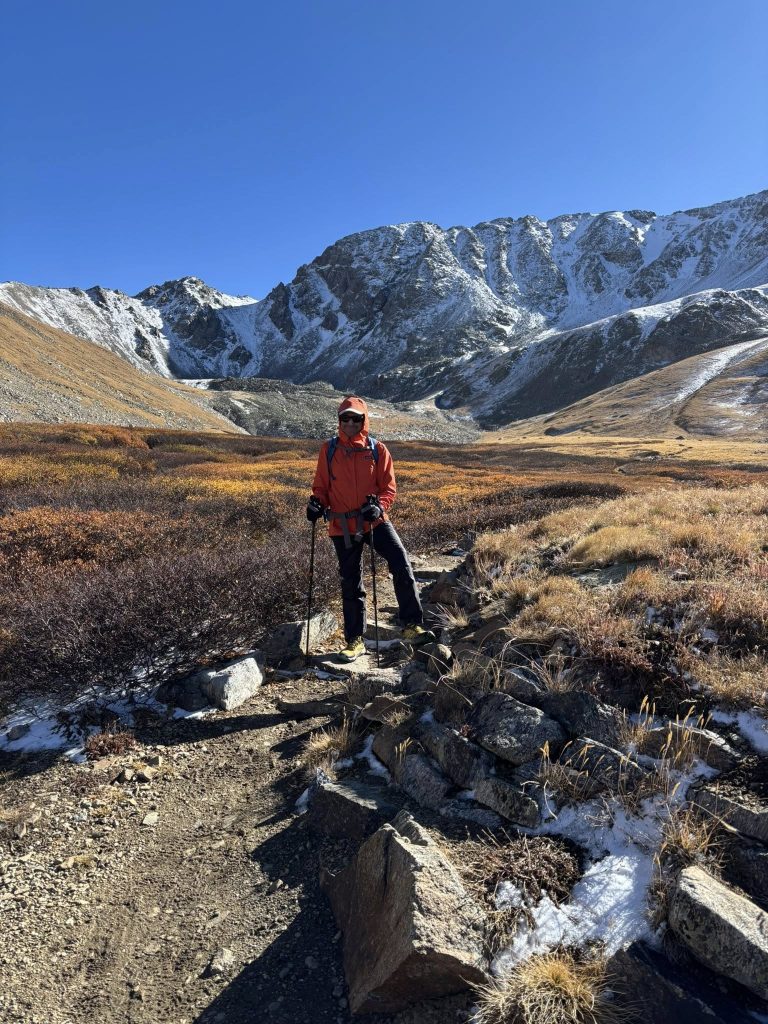
  • I would categorize Belford/Oxford plus the Elkhead Pass descent as probably the most beautiful of the hikes I’ve done (husband pictured below; we did this in October, when the light was really gorgeous!).

What’s next?!

I mean, really, who knows, right?? Lots of wild cards coming out of the deck in the world in general these days. But I have my eye on a few peaks for this summer. I’d need to do 11 more to get to 25, which feels ambitious but doable.

The access road to Mt. Blue Sky was closed last year for construction, and it’s supposed to open on Memorial Day this year, so that’s definitely on the list, as is Pikes Peak via the Barr Trail. I may do a trip down to lake Lake City and hit at least Sunshine and Handies. I still haven’t done Massive (near Leadville, a town where we often go for fun), so I feel like I have some good options and at least the potential of doing 10+ 14’ers this summer.

I hope these tips are helpful if you’re planning an adventure of your own!

Written by Corinne McKay · Categorized: Uncategorized

  • « Go to Previous Page
  • Page 1
  • Interim pages omitted …
  • Page 5
  • Page 6
  • Page 7
  • Page 8
  • Page 9
  • Interim pages omitted …
  • Page 46
  • Go to Next Page »

Primary Sidebar

Subscribe to the Training for Translators mailing list!

Getting Started as a Freelance Interpreter: Available now in print and electronic editions

Learn from our blog:

  • Survey results: The state of freelance translation in 2026
  • Focus on the clients who can afford you
  • Upcoming direct client marketing class
  • Travel: Cycling Quebec’s Tomifobia Nature Trail
  • Travel: Cycling Burlington, Vermont’s Causeway Bike Trail
  • When part of your business falls off a cliff
  • Upcoming free webinar: Honest brand communications through purpose, positioning, and personality
  • Training for Translators Plus is here!

Search the Training for Translators blog

Copyright © 2026 · Training For Translators · Log in

This website uses cookies to improve your experience. We'll assume you're OK with this, but you can opt-out if you wish. To view this website's privacy policy, click About>Privacy Policy. Accept Read More
Privacy & Cookies Policy

Privacy Overview

This website uses cookies to improve your experience while you navigate through the website. Out of these, the cookies that are categorized as necessary are stored on your browser as they are essential for the working of basic functionalities of the website. We also use third-party cookies that help us analyze and understand how you use this website. These cookies will be stored in your browser only with your consent. You also have the option to opt-out of these cookies. But opting out of some of these cookies may affect your browsing experience.
Necessary
Always Enabled
Necessary cookies are absolutely essential for the website to function properly. This category only includes cookies that ensures basic functionalities and security features of the website. These cookies do not store any personal information.
Non-necessary
Any cookies that may not be particularly necessary for the website to function and is used specifically to collect user personal data via analytics, ads, other embedded contents are termed as non-necessary cookies. It is mandatory to procure user consent prior to running these cookies on your website.
SAVE & ACCEPT