• Skip to main content
  • Skip to primary sidebar

Training for Translators

Classes for translators and interpreters

  • Start here
  • Blog
  • Classes
    • Coaching for freelancers
    • Subscription
  • Books
    • Translate my books
    • Book Shop
  • About/Contact
    • Privacy Policy
  •  
  • Account

Jan 30 2024
Corinne McKay

Reader question: My thoughts on retirement

Greetings, Training for Translators readers! Have you signed up for the March Marketing Madness challenge group?? Registrations are going strong; the price ($90) is the same as last year, and my favorite thing is hearing from people who say, “I can’t do the group this year because I have so much work from the marketing I did last year!” We kick off on March 4!

Here’s a topic that a couple of people have asked me about lately? Do I ever contemplate retirement and what it might look like? Short answer: Yes! I’m a planner, so I like to think ahead!

Longer version of the question: A couple of blog readers and online course alumni have asked me:

  • Assuming that money isn’t a problem, have I contemplated when I might retire and what that might look like?
  • What should those of us who aren’t 22 years old think about when we think about retiring?

My thoughts, in various categories. First, the logistical factors:

I’m 52, my husband is 58, and we have one child who is 21 and on track to graduate from college/university in 2026. We are fortunate to have three out of four of our own parents still alive; we are also fortunate that all of them are financially secure and we don’t anticipate having to spend our own money to care for them. Thanks to several decades of frugal living (basically, spending less than we earn), our house is paid for and has approximately tripled in value since we bought it in 2004, we have no other debt, and we have a good amount of money in retirement savings, so I anticipate/hope that money will not be a huge issue when/if we want to retire. I realize that right here, we have a lot of advantages–some are the result of our own careful planning, and some are the result of luck,and I feel grateful for that.

Random question: Why is it becoming more normal to retire in your 50s when most of us are going to live into our 80s and 90s?

Perhaps the most important factor here is that I love my job (more on this below), but this is something that really puzzles me. I was born in 1971, which means that in the US retirement system, I need to work until I’m 67 in order to get full social security benefits. That’s 15 years from now. US life expectancy is now age 73 for men and age 79 for women, and yet, we have a fair number of friends in their mid-50s who are either already at least semi-retired or who are planning to fully retire in the not-too-distant future. Everyone should do what they want, but personally I don’t really get this phenomenon. (End of rant).

The emotional/lifestyle factors:

  • Bottom line, I love my job, I just went back to school for interpreting three years ago, I really have zero interest in retiring right now, and I think that I’m kind of a poor candidate for total retirement in general. I’m easily bored, I don’t enjoy being home all the time, and although I can see wanting more time for non-work activities (more on this below), 30 years of unstructured time isn’t something that really appeals to me.
  • At the same time, I appreciate this question because I also have some fear, especially when it comes to interpreting, of being the person who holds on for too long and doesn’t know when to get off the stage. I really don’t want to be someone about whom others are saying behind my back, “She really needs to retire.”

Thus, here’s my current line of thinking:

  • As long as my mind and body hold out, I’m planning to keep doing what I’m doing until I’m around 70. That being said, life can change a lot, and life can change very quickly. One variable is that my husband is six years older than I am, and is also more interested than I am in fully retiring. If he completely retires in ~7 years, I can see us wanting to do more extended travel, which could affect how much I work.
  • My plan after that is, roughly, to retire from interpreting, or at least from high-stakes interpreting where cognitive processing speed is a big factor. Rightly or wrongly, I think that when older interpreters have trouble hearing, make mistakes or have trouble keeping up, it’s blamed on age. I think this is sometimes unfair; young interpreters have bad days too. It’s also not that hard to just get a hearing test every year and see how you’re doing. But, as stated above, I really don’t want to be the person about whom other people say, “She misses a lot of stuff and needs to retire.”
  • I honestly don’t know that I will ever fully retire from translation unless I physically or cognitively can’t do it anymore. On the question and answer session where I got this question, I said, joking/not joking, “If I translate a couple of birth certificates the day before my funeral, that sounds good to me.” I would also really enjoy being able to dedicate more work time to lower-paying projects like book translation, without worrying about the loss of income.
  • I think the beauty of freelancing is that we can be very flexible. I completely understand why people don’t want to be tied to a 9-5 job with limited vacation until they’re too old to enjoy their non-work interests anymore, but/and I feel like I’m already taking advantage of “the free in freelancing” at this stage of my career. Specifically, I often do not work on Fridays if I don’t have urgent work; I often take a three-ish hour break in the middle of a workday to go play lute duets with a friend; last year I took basically six weeks of vacation, which was really nice. I could see some sort of digital nomad situation in my future; my husband and I both love Canada, and US citizens can spend six months there without any special visa. We also both have dual citizenship in Switzerland, so we can go to Switzerland or any EU country for as long as we want. It’s more that I don’t see an imperative to retire when all of those options are available.
  • I have a couple of examples of freelancers in their 70s who are scaling back in a way that I hope to do. Specifically, one of these freelancers told me that they still work part-time because they enjoy it and want to keep their mind active, but that they have let go of the fear of losing out on work or even losing a client by not being available; they work when they want to, and they don’t work when they don’t want to. I think this is a good philosophy–again, as the initial question-asker said, as long as money isn’t a problem.
  • One final thought: The extent to which all of this is driven by health insurance frustrates me. Assuming that my husband retires at 65 and goes on Medicare, I still have to figure out what to do about health insurance for another six years, and we’ve been spoiled by my husband’s current job situation, where we pay $300 a month for full-coverage medical and dental insurance for all three of us. The thought of paying $1,000+ a month for health insurance for myself (as is the case for several freelancers I know) is not appealing. So I don’t know where that leaves us; just another rant!

Although I’m hopefully several decades away from actual retirement, I found this to be an interesting “food for thought” topic at any age!

Corinne McKay (classes@trainingfortranslators.com) is the founder of Training for Translators, and has been a full-time freelancer since 2002. An ATA-certified French to English translator and Colorado court-certified interpreter, she also holds a Master of Conference Interpreting from Glendon College. For more tips and insights, join the Training for Translators mailing list!

Written by Corinne McKay · Categorized: Freelancing

Jan 23 2024
Corinne McKay

What I’ve learned from 30-day challenges

Greetings, Training for Translators readers! I hope that you’re all doing well! Registration for our annual March Marketing Madness challenge group is now open; and I’m excited that so many of you have already joined! The price is the same as last year ($90) and you get 20 motivational videos, 20 marketing challenges, and an optional (but very fun!) Slack group.

Speaking of challenges, this week I wanted to talk about what I’ve learned from giving myself a different 30-day challenge each month (or sometimes even more than one challenge per month!). Here’s how it happened:

In September of last year, I was looking for a new planner calendar. I still use a paper calendar, not because I’m a Luddite, but because I like the visual aspect of being able to flip through the calendar, and I actually find that I make fewer scheduling mistakes (setting something at the wrong time, on the wrong day/week) when I use a paper calendar. I came across the Commit 30 planner (not an affiliate deal), which, as luck would have it, is a woman-owned business right here in Colorado. At that time, they were running a special to get the 2023 planner for free when you ordered the 2024, so I jumped on it.

Here, a digression. Some of you already know that one of my current obsessions is Gretchen Rubin’s Four Tendencies principle. A good friend turned me onto this when she participated in Gretchen Rubin’s Happiness Project. Basically, the Four Tendencies (please, please take the quiz if you haven’t already) is (are?) about finding out how you respond to both inner and outer expectations: demands you put on yourself, and demands that the outside world puts on you. Cut to the chase, I’m an Upholder in the extreme…the Upholder’s slogan is “Discipline is my freedom,” and (for better and for worse), that’s me, to a T. I love the Todoist app, and every night before I go to bed, I go through my Todoist list and mark every task as complete, or recategorize it to another day. We could spend a lot of time talking about the pluses and minuses of being an Upholder (I’ll tell you the downside: I have a lot of trouble dealing with people who aren’t Upholders, and I have a lot of trouble doing things that have no purpose or goal, even if I enjoy them), but the point being, I respond very well to challenges where you set a goal and tick off your progress, which is exactly what the Commit30 planner is about. It has a spot to write your personal 30-day challenge for every month, it has a list of suggested challenges, and then you get to tick the bubbles for every day that you complete your challenge.

So far, I’ve given myself the following challenges (sometimes I do more than one per month)

  • Meditate with the Calm app every day
  • Walk for an hour or more per day, at least 20 out of 30 days (this didn’t seem realistic/necessary to do every single day because I often go skiing, hiking, or biking for a full day on the weekends)
  • Drink a 20 ounce glass of water with every meal
  • Practice music (I play the cello and the Renaissance lute) at least five days a week
  • Do a 10/20/30 workout (10 minutes of body-weight strengthening, 20 minutes of deep stretching, 30 minutes of yoga or weightlifting) every weekday

Here’s what I’ve learned, in case you’d like to try this out for yourself:

  • I, like most people, waste a lot of time. It really surprised me how many of these activities I could fit into my day without sacrificing other things I needed to do. Basically I think that the “good stuff” crowded out pointless stuff.
  • Doing a 30-day challenge is a good way to form a habit that you don’t have to maintain every single day. For example, doing the Calm app every day was so enjoyable that I set a goal (which you can do in the app) of continuing with it four days a week. That seems doable even over the long haul.
  • Consistency really does help you improve at things. I’m the one who’s always saying, “You don’t have to stay motivated, you have to stay consistent,” and it’s true. I’m admittedly a pretty mediocre musician, but I have really been amazed at how much my playing improves when I practice every day.
  • Doing something every day helps me focus why I’m doing it. One of Gretchen Rubin’s tips for Rebels (people who resist both inner and outer expectations; slogan, “You can’t make me, and neither can I”) is to focus on your Why. If you’re a freelancer because you want to have more time for your triathlon training, focusing on that can help you do what you need to do in order to stay profitable. If you’re working for a particular client because that income is going to help you buy a house, focusing on that can make deadlines more doable. I’m not a Rebel (far from it…haha!), but I found that focusing on something like, I’m practicing cello every day because I need to send my online practice group a video of me playing, or I’m doing this 10/20/30 workout because I sleep so much better and my body feels so much better, really helped me.

If you’d like to try some 30-day challenges of your own, let me know how it goes!!

Corinne McKay (classes@trainingfortranslators.com) is the founder of Training for Translators, and has been a full-time freelancer since 2002. An ATA-certified French to English translator and Colorado court-certified interpreter, she also holds a Master of Conference Interpreting from Glendon College. For more tips and insights, join the Training for Translators mailing list!
Written by Corinne McKay · Categorized: Productivity

Jan 16 2024
Corinne McKay

Combining translation and interpreting

Greetings, Training for Translators readers! I hope that 2024 is off to a good start for all of you. Here’s the news from Training for Translators:

  • I wrote an OT (off-topic) post about my family’s recent trip to Belize (we loved it!!)
  • The T4T training year kicks off today, with a one-hour class on Using objective data to set your freelance rates. Registration ($50) includes the recording.
  • Tomorrow, the four-week session of Getting started as a freelance translator or interpreter…in the age of AI kicks off. Registration is $190, and members of the American Translators Association can use coupon code ATA for $30 off

On to this week’s topic: Combining translation and interpreting in your freelance business. A couple of readers have suggested this topic (if you have a topic you’d like me to address in a future newsletter, just reply to this e-mail!).

For context, from 2002 (when I started freelancing) until 2019 (when I passed the Colorado state court interpreter exam), I was exclusively a French to English translator. From 2019 until 2021 (when I graduated from the Glendon College Master of Conference Interpreting program), my work volume was about 90% translation and 10% interpreting, particularly because court interpreting dropped to almost zero for the first few months of COVID, and I turned down most interpreting assignments during the year I was studying at Glendon.

When I finished the Glendon program, my goal was to be 50/50 translation and interpreting within a year and a half of finishing the program (meaning, by the end of 2022), and I thought that this was wildly optimistic, because I didn’t know much about the conference interpreting market, there’s very little in-person conference interpreting work where I live, and I assumed (incorrectly) that most conference interpreting work was going to go back to in-person once the acute phase of the pandemic was over. In reality, interpreting work is booming: in 2023 I earned US $65K from interpreting–12K from court interpreting and 53K from conference interpreting–and I did almost 200 days of interpreting (103 court assignments and 90 conference assignments). This was almost double the amount of interpreting I did in 2022, while my translation work stayed stable (32K in 2023 as compared to 33K in 2022). If you didn’t read my 2023 wrap-up post with the details, here it is.

In the past year and a half, I’ve come to a few realizations about combining translation and interpreting:

  • Most importantly, I really enjoy doing both. One reader who suggested this topic observed (and I agree) that it’s relatively uncommon to really combine translation and interpreting: you’re more likely to encounter interpreters who occasionally translate at times of the year when interpreting work is slow, or translators who do a small amount of court interpreting, for example. I actually really enjoy doing real amounts of both translation and interpreting, and I hope to continue this!
  • I find that interpreting makes me a better translator, and translating makes me a better interpreter. Interpreting has taught me a lot about focusing on meaning, rather than words; using shorter, simpler ways of expressing complicated concepts; knowing when to add a little flair and when to cut out the fluff. Translation has taught me a lot about finding precisely the right word; slowing down instead of rushing; making sure that the expression is exactly what I want. I feel like both skills have benefited each other.
  • I’ve also come to appreciate the advantages of both translation and interpreting. When you finish an interpreting assignment, whether it went well or poorly, it’s over. Even if you were recorded (which allows you to go back and obsess over what you said!), there’s no way to change it. As one of my music teachers once told me, the reason not to obsess over music mistakes is that by the time you hear them, they’re already over. This is a beautiful thing about interpreting! The beautiful thing about translation is taking as long as you want (as long as you meet the deadline!) to pick just the right word. When you’re interpreting, you have about a quarter of a second to contemplate the difference between the words “maybe” and “perhaps,” or “careless” and “reckless.” At times it can feel like being fired out of a cannon, and I’ve come to really appreciate the luxury of time when I’m translating.
  • It can also be challenging to combine the two, in terms of workflow. Because I (fortunately) have a good deal of interpreting work, I’m often too busy to take on last-minute, large translation projects. I’d like to find at least one new, steady translation client, but I really don’t want a “2,500 words for tomorrow” type of client, because I’m interpreting more days than not. Translation work that blends well with interpreting is definitely somewhat of a niche market.

Then, there are the business aspects of translation and interpreting. A few observations there:

  • Interpreting, at least the flavors of interpreting that I do (mostly remote simultaneous, and court) is really in demand. It took me about the same amount of time (18 months) to really “launch” as translator in 2002 and as an interpreter in 2021, but marketing my interpreting services involved a lot less work.
  • Interesting, well-paid interpreting work tends to find me, whereas I have to knock on a lot more doors to find interesting, well-paid translation work. I don’t feel, at all, that the translation profession is dying. Here’s a post I wrote about where I think the whole MT/AI push is headed. At the same time, there’s a much smaller pool of French conference/court interpreters than the pool of French to English translators. Clients might want to cut corners on interpreting, but you can’t really do simultaneous interpreting if you haven’t studied and practiced it extensively, and automated interpreting is way behind machine translation. I lose a lot of translation work because the client finds someone cheaper, and it’s pretty rare that that happens with interpreting.
  • For reasons that I keep mulling over, without a clear answer, interpreting agency rates haven’t cratered in the way that translation agency rates have. I’d estimate that translation agency rates have dropped by about half in the 20+ years that I’ve been a translator, while I have several interpreting agency clients that voluntarily raised their rates in the past few years. I’m really not sure whether this is a case of increased translation automation, more freelance translators entering the market (giving an “anyone can do it” flavor to the profession), interpreters exerting pressure on other interpreters not to decrease their rates, fewer interpreters entering the market, interpreters who dropped out of the market during COVID or because they hate remote interpreting, all of these factors, none of these factors, or something else entirely.

Overall, I am very, very happy that I decided to pursue interpreting in addition to translation, and I’m happy with the mix of clients that I have right now. If you are also considering such a career pivot, I would encourage it, and I hope that these tips are helpful!

Corinne McKay (classes@trainingfortranslators.com) is the founder of Training for Translators, and has been a full-time freelancer since 2002. An ATA-certified French to English translator and Colorado court-certified interpreter, she also holds a Master of Conference Interpreting from Glendon College. For more tips and insights, join the Training for Translators mailing list!

Written by Corinne McKay · Categorized: Interpreting

Jan 12 2024
Corinne McKay

OT: A week in Belize

An off-topic post here! My family spent a week in Belize over New Year’s, and since a) I’m a frustrated travel writer, and b) I struggle to remember the details of a trip several years later, I try to write a blog post about all of our major trips (you can read about last year’s family trip to Sayulita, Mexico here, and my trip to Iceland last summer here).

The basics of the trip

This was our first time in Belize, which we settled on because we wanted to go to a place with really good snorkeling. I (the family trip planner) first researched the Cayman Islands (because of the inexpensive, nonstop flight from Denver on Cayman Air), but ended up ruling it out due to cost, lack of things to do other than go to the beach, and the fact that it seemed hard to do without a car. My unscientific strategy is usually to check where you can fly nonstop or with an easy connection from Denver. This eliminated the Virgin Islands, because most of the flights leave from Atlanta in the morning, so we’d have to either take a red-eye or spend the night in Atlanta. It turns out that Belize is a pretty short (~three and a half hours) flight from Denver on United, and it ticked all the boxes in terms of reasonable cost, things to do in addition to the beach, and ability to get around without a rental car. Tickets on United were actually cheaper than Southwest; I have a Southwest Rapid Rewards credit card so I’m always looking for ways to use it, but for this trip, United won out.

Belize, which had really never been on my travel radar screen, turned out to be an amazing destination for what we wanted to do, and it’s one of my new favorite places!

Belize logistics in general

Belize is, in my opinion, a really easy place to travel. It’s a former British colony so everyone speaks English, and you can spend US dollars anywhere, you just get the change in Belize dollars, which are pegged to the US dollar at 2 Belize dollars per 1 US dollar. The majority of places also take credit cards, and I used my US credit card with no problems (if you do this, just make sure your card has no foreign transaction fees; my Southwest Rapid Rewards card does not). We didn’t spend any time in Belize City, but everywhere we went felt very safe, no visible drug activity other than marijuana (which is legal in Colorado so we’re used to it), and I felt like the party scene for our twentysomething daughter and her girlfriend was fun and safe. They went to the New Year’s Eve beach rave on Caye Caulker and reported that it was lively but not out of control, and that they never felt uncomfortable; they didn’t encounter any anti-LGBTQ sentiment anywhere we went. We used van shuttles to get around and the driving was what I’d consider typical for Central America. Even the major roads are one lane each way, so there’s a lot of illegal passing, but it didn’t feel like India where most car trips involve taking your life into your hands.

Phase one: Caye Caulker

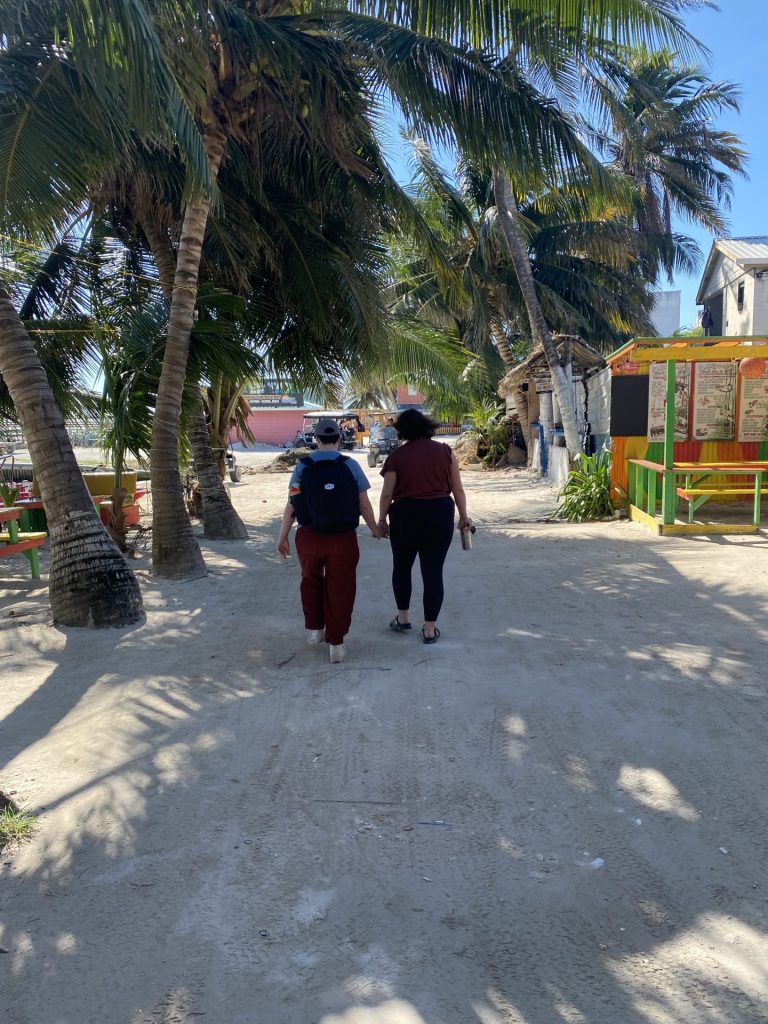
After doing some preliminary research on destinations (Belize has a ton going on for a pretty small country), I decided to book half of the week on an island and half on the mainland. The two main island destinations are Ambergris Caye (home of Belize’s most popular tourist destination, the town of San Pedro), and Caye Caulker. Of the two, Caye Caulker is much smaller and less developed. The whole island is about five miles long, but a hurricane in the 1960s split the island in half, and the northern half (accessed by a very small ferry) is very undeveloped. Caye Caulker has no cars (there’s one fire truck and one garbage truck and that’s it). The only motorized transportation is a few golf carts, and mostly everyone walks or rides beach bikes. The streets are packed sand (no paved roads). This sounded like our kind of place!

Caye Caulker didn’t disappoint! We flew from Denver to Belize City, then took a seven-minute flight on a tiny Tropic Air plane (like a flying minivan) to Caye Caulker, where we took a golf cart taxi to our AirBnB. We rented this house, which was perfect for our group (myself, my husband, our daughter (21), and her girlfriend (22) ). It was right on the water on the “lagoon” (non-ocean) side, it came with sit-on-top kayaks that we could launch right in front of the house, and the sunsets from the rooftop hammock deck were amazing. Inside, it was immaculately clean, had two nice bedrooms and two full bathrooms, plus a full kitchen and a nice living room with a Netflix-equipped TV. The host lives in another house on the same property, and she was amazingly helpful with whatever we needed, plus restaurant and activity recommendations. Caye Caulker is a really small place, so you want to book your lodging early; I started researching places in July (for a December trip) and some were already booked! The owner of our AirBnB runs a sunset tiki boat cruise which we took and really enjoyed (see sunset photo below!)

Caye Caulker’s motto is “Go Slow,” and it is a place where you really need to slooooooow down and enjoy the beauty and being there. We typically waited an hour for food in restaurants, and coffee/breakfast was only moderately faster (maybe 40 minutes!). But then again, where did we need to be? Nowhere but there! So after the initial adjustment, we just slowed down and really enjoyed it. Highlights included coffee and breakfast in the waterfront palm tree garden at Ice N’ Beans, an incredible dinner at Hibisca, (the “fancy” restaurant on the main drag), plus lots of really good ice cream from the local ice cream shops. There are a number of well-stocked grocery stores, so we also cooked at the AirBnB a couple of times.

Caye Caulker is surrounded by mangroves, and there are no long beaches; don’t go there expecting white sand stretching to infinity. The only beaches are human-made, by pulling out some mangroves and replacing them with trucked-in sand.

The highlight of our stay on Caye Caulker was the all-day “bucket list” snorkeling tour with Salt Life Eco Tours. We didn’t really know what to expect, but Belize has the world’s second-largest barrier reef, so we were hopeful to see some cool stuff. This trip (in a small boat with a group of 10 people) exceeded our expectations and was honestly like swimming in a Jacques Cousteau special. I am really not much of a water person, and I loved it. At one point, I was floating on the surface of the water watching two massive nurse sharks on the bottom (nurse sharks don’t even have real teeth and are totally unconcerned with humans), while a school of probably 500 sparkly blue fish hovered a few feet away, and a massive spotted eagle ray (with probably a six-foot wingspan) “flew” majestically about a foot below me. It was totally amazing; a must-do experience! Plus the Salt Life guides captured all of this in pictures and videos that they sent to us afterward on Dropbox. If we had stayed longer, I honestly would have done this trip more than once.

Phase two: San Ignacio jungle lodge

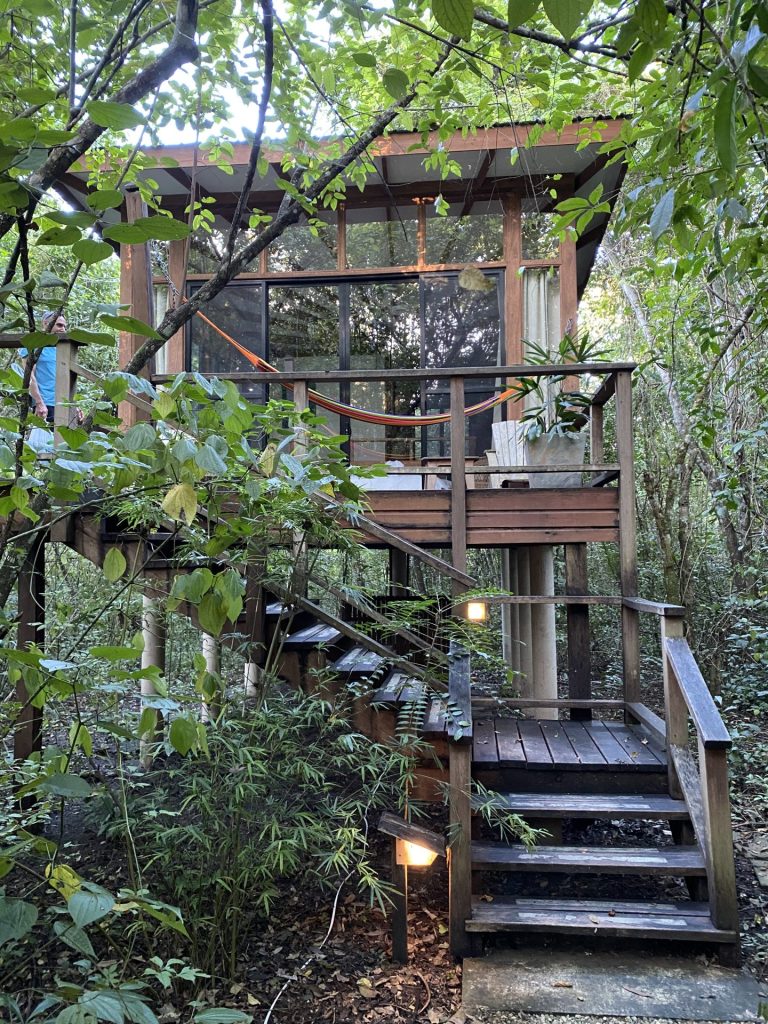
After a glorious three days on Caye Caulker, we took the San Pedro Belize Express water taxi back to Belize City, where the van shuttle driver from our next destination, Vanilla Hills Lodge, was waiting for us. San Ignacio, Belize’s second-largest city (inland, very close to the Guatemalan border) has emerged as a major eco-travel destination, along the lines of the Monteverde and Arenal areas in Costa Rica. We decided to rent two glass treehouses at Vanilla Hills (photo above) and it was honestly one of the neatest places we’ve ever stayed. You’re totally immersed in the jungle, while being totally comfortable (air conditioning which we didn’t really need, huge infinity pool looking out over the jungle, indoor/outdoor shower…it was so amazing). One of my favorite moments of this trip was lying on our bed during sunset/golden hour, watching the glow fill the jungle through the floor-to-ceiling glass walls. Truly one of those “peak” moments of a travel experience!

The food scene in Belize is generally good but pretty basic: we’re vegetarians so we didn’t eat the seafood, which did look amazing, but in general, Belizean food is a lot of rice and beans and barbecued chicken, and Belizeans do not seem to eat a ton of fruit or vegetables, despite the fact that a lot of produce is grown there. As our AirBnB host on Caye Caulker told us, “Don’t get too excited about Belizean salads, they’re generally iceberg lettuce with ranch dressing and nothing else.” Vanilla Hills Lodge’s restaurant is the exception: it was some of the best food we’ve eaten, anywhere, plus they were totally accommodating of vegetarians. I just can’t say enough good things about this lodge!

The owner, Claudia, arranged two amazing days of tours for us, first to the nearby Xunantanich Mayan ruins (carving photo above), followed by an afternoon on a pontoon boat with waterfall exploration (Jungle Splash tours), and an entire day in the ATM Caves, about an hour away from San Ignacio. As long as you’re not seriously claustrophobic, this tour is a true must-do, where you swim through a series of caves into a large dry chamber where there are crystallized human sacrifice remains and Mayan artifacts. As a bonus, our guide was a PhD archeologist, so we got to pester him with all of our questions about the local Mayan civilizations in general. If we had had one to two more days in this area, I really would have liked to visit Tikal, the huge Mayan site in Guatemala, which is two to three hours by driving from San Ignacio.

The end!

On our last day, we had one more incredible breakfast at Vanilla Hills (while watching toucans and coatis frolicking!) and then the van shuttle driver dropped us at the Belize City airport, about a two hour drive from the lodge. We connected in Houston on the way back and that went fine. If you fly out of Belize City, be prepared for major crowds and chaos and allow a lot of extra time. The airport was clearly not built for the volume of traffic it’s currently getting, and it was hard to find a place where four of us could stand together, much less sit down. On the day we flew out, the loudspeaker system at our gate was not working, so the poor gate agents had to shout (into a room full of hundreds of cranky travelers) to board the planes (no jetways, you just walk out onto the tarmac). Especially if you have small kids or older people in your group, prepare yourselves for a somewhat uncomfortable few hours at the airport!

Aside from that, this trip was pretty much perfect. We’re pretty frequent travelers, and Belize is at the top of my new favorite destinations. To me, it was less expensive and less built-up than Costa Rica, and felt safer than Mexico. We’ve also repeatedly had issues getting sick (g/i issues; nothing requiring medical treatment but also not a lot of fun when you’re on vacation) in Mexico despite not drinking the tap water and being careful about food, and none of us got sick in any way in Belize, which was also a plus. We loved every second and are already thinking about a return trip!

Corinne McKay (classes@trainingfortranslators.com) is the founder of Training for Translators, and has been a full-time freelancer since 2002. An ATA-certified French to English translator and Colorado court-certified interpreter, she also holds a Master of Conference Interpreting from Glendon College. For more tips and insights, join the Training for Translators mailing list!

Written by Corinne McKay · Categorized: Travel

Jan 09 2024
Corinne McKay

2023: The year in review!

Greetings, Training for Translators readers, and happy 2024! I hope you all got some well-deserved time off over the holidays, and I’m excited to dive into the new year with all of you. The Training for Translators year kicks off next week:

  • On Tuesday, January 16, I’m teaching a one-hour “flash” class on Using objective data to set your translation and interpreting rates. The start of the year is a great time to run the numbers and see how much you need to charge in order to earn your target income. Most of us either don’t know or can’t face this “big number,” so let’s attack it together. Registration is $50 (special price for this one-hour class).
  • On Wednesday, January 17, my four-week self-paced class, Getting started as a freelance translator or interpreter…in the age of AI kicks off. This class (which I’m always updating, to reflect the new realities of our professions) has launched 750+ freelancers, and you could be next! Registration ($190; ATA members use coupon code ATA for $30 off) includes four weeks of self-paced videos and bonus material, plus question and answer videos to answer all of your questions each week.

2023: How it went!

On to this week’s topic, The year in review. I write this type of post every year (here’s last year’s) to go over the work I did, how much I earned, what worked, and what didn’t. I’ll start with the usual disclaimers:

  • I find it helpful to talk about income; if I’m going to take business advice from another freelancer, I want to know the context: how much they earn, what they mean by “high rates” or “low rates,” how much work they have at those rates, etc. The purpose is not to brag about how much I earn, make you feel bad if you earn less, make you feel bad if you don’t want or need to earn what I earn, or anything else along those lines.
  • That being said, you do you. If you find it cringe-y to talk about income, skip this newsletter. I earned $9,000 in 2003 and I was thrilled. If you’re happy with what you’re making, stick with it.

Executive summary: It was a good year, but there’s always room for improvement

2023 was a good year in my business. I did a lot of interesting work for good clients, I landed a few good new interpreting clients and had more work from my existing clients. Training for Translators’ classes did well, and I’m happy with the new model where I teach most of the classes, along with occasional guest instructors.

I set a higher income goal for this year and actually exceeded it.I’m happy with my translation income, but (for various reasons) I still haven’t found another “anchor” translation client to replace the major direct client I lost in 2022 (because their French project wrapped up).

My 2022 goals list was a mixed bag in terms of what I completed and what I didn’t: I’d like to translate another book, but so far nothing has panned out, and I didn’t finish Getting Started as a Freelance Interpreter, my half-finished book that will hopefully be the companion to How to Succeed as a Freelance Translator when it’s done. I had a good year as a person: I really believe that I am the business, and my own heath and wellness are a huge priority. Overall, I give this year two thumbs up; read on for details if you’d like.

By the numbers

In 2023, I worked for 22 clients total (translation and interpreting combined: this includes only direct clients and agencies, not individuals). I did 103 court interpreting assignments and 90 conference assignments, of which 165 were remote and 28 were in person. Training for Translators ended the year with 633 course registrations. From 2019-2022, I earned around US $110K per year (I define “earned” as my gross income minus subcontracting: I don’t include money that I simply took in and paid out to online course instructors, but I include everything else). That’s obviously a decent income, but I was dissatisfied with it, for two reasons:

  • Stagnation isn’t good, and because our own expenses go up over time, earning the same usually means less buying power.
  • I wanted to aim for the equivalent of a six-figure salaried income, which, because we freelancers pay our own taxes, benefits, vacation time, professional development, etc., is a lot more than 100K.

Last year, I set a 2023 income goal of 120K (and again, “income” means gross income after subcontracting) and I actually earned 130K, which I was really happy with. In 2022, my income was divided almost evenly in thirds: 33K from translation, 33K from interpreting, and 33K from teaching, writing, and consulting. This year, interpreting really expanded, and I earned $12K from court interpreting and $41K from conference interpreting, meaning that my interpreting income almost doubled from the previous year. Translation income was basically unchanged at 32K, and teaching, writing, and consulting were also up significantly, at 45K, due to some Training for Translators classes that did well, and some trainings that I did for other entities.


Interpreting

When I finished my conference interpreting Master’s at Glendon, my goal (which I thought was pretty optimistic) was to have my work volume consist of 50% translation and 50% interpreting within two years of graduating. In reality, I have so much interpreting work that I have to deliberately carve out time for translation (which I don’t want to stop doing) so that I don’t become exclusively an interpreter. Interpreting went really well this year: a couple of my regular clients sent me a lot more work than in 2022, and I landed a couple of new clients, which I was happy about from the perspective of avoiding the “all eggs in one basket” phenomenon.

Translation

As previously mentioned, I keep saying that I need to work on finding a new “anchor” translation client, and (due to inaction and lack of time on my part: no excuses here) it hasn’t happened yet. This year worked out well in terms of translation work, largely because a couple of my agency clients had large projects at decent rates (14-15 cents per word) that I enjoyed working on. I also did a fair bit of translation for my direct law firm clients, and I worked for a couple of asylum cases that needed both translation and interpreting. It all worked out, but the approach feels a little piecemeal and this is something that I’d like to work on.

As mentioned above, I’m interested in translating another book, so I was excited to be approved on Reedsy (an online marketplace for editors, designers, and translators). It’s a pretty extensive application process, you have to have at least five published book translations, then create a profile, then do a live online training. However, so far the experience has been pretty disappointing: I’ve only gotten two inquiries, both from independent authors who went with someone cheaper.

Online courses

Life at Training for Translators was good this year. We had a total of 633 people participate in master classes, four-week classes, and challenge groups, and reviews were generally excellent. Marketing T4T is pretty straightforward, consisting mostly of my e-mail list (~4,000 subscribers), blog (~6,000 views per month), and LinkedIn. Teaching most of the classes myself, with a few guest instructors whose classes I know will do well, has proved to be a good decision. No major changes planned on this front!

Vacation and expenses

I took a good amount of vacation this year: a family trip to Mexico, a friends trip to Iceland, and a work-cation in British Columbia, plus lots of ski and mountain bike trips in Colorado and Utah. My family wrapped up the year in Belize (totally amazing), which I’ll write about in a future post. No complaints on the travel front, and hopefully more to come this year!

My expenses were pretty much the same as last year. My office rent actually went down, from $590 a month to $499 a month. This wasn’t any hard-nosed negotiation on my part; my office landlord told me they were going to raise the rent, so I told them I wasn’t going to renew my lease, and they offered me a different (but still nice) office at a lower rent. Accounting remains expensive. I now pay $80 a a month to my accountant for payroll tax prep, $46 a month to Gusto for the service that actually pulls the money from my business account and then pays me plus the various tax entities, and $62 a month to QuickBooks, for a total of $188 a month in accounting fees, plus year-end tax return prep. This is a lot, but I have an S-Corp and I hate accounting so much that I don’t want to do any of this myself, plus I want to work with an accountant who will represent me to the IRS if I ever get audited, so I don’t see a real way around it. Other subscription fees (MailChimp, Zoom, Thinkific) just are what they are: no way around them unless I want to stop doing business.

Goals (last year’s and this year’s)

Here’s how I did on last year’s goals:

  • Increase my income to at least 120K: Yes; I actually significantly exceeded this goal
  • Find at least one more interpreting client with regular work: Yes, I actually found a few new interpreting clients
  • Publish at least one new book: No (no excuses, I just didn’t do it)
  • Translate another book: No (same story here: this is on me, I put out a few feelers, but nothing panned out)
  • Continue teaching monthly master classes for T4T: Yes, these went really well
  • Start learning to play the cello: Yes; and I’m in a really great online cello group

Here’s what I’m aiming for this year; we’ll see how I do!

  • Maintain an income above 125K. I’m not sure every year will be as good as this year, but now that I’ve broken 125K, I’m hoping to stay there.
  • Maybe take a subtitling class. I’ve been subtitling-curious for while, and maybe this is the year to take action.
  • No, really…finish this darned book!!! I’m really hoping to get Getting Started as a Freelance Interpreter out the door.
  • Keep up at least the volume of translation work that I have right now. This sounds crazy, but I feel like the demand for interpreting work is so high, that I have to put a deliberate effort into remaining also a translator, which I want to do.
  • Keep prioritizing my wellness and happiness. I’ve gotten into a good routine of going to in-person yoga 10-15 times a month, doing stretching and strengthening pretty much every day, and taking enough vacation that I still really love my job.
  • Either go to cello camp this summer, join a community orchestra, or both. I really love playing the cello, and my goal for this year is to do some in-person ensemble playing.

That’s it! The year in a nutshell (a pretty long nutshell: thanks for coming to my TED Talk!!). I hope these data points are helpful as you think about where your own freelance business might head this year.

Corinne McKay (classes@trainingfortranslators.com) is the founder of Training for Translators, and has been a full-time freelancer since 2002. An ATA-certified French to English translator and Colorado court-certified interpreter, she also holds a Master of Conference Interpreting from Glendon College. For more tips and insights, join the Training for Translators mailing list!

Written by Corinne McKay · Categorized: Freelancing

  • « Go to Previous Page
  • Page 1
  • Interim pages omitted …
  • Page 38
  • Page 39
  • Page 40
  • Page 41
  • Page 42
  • Interim pages omitted …
  • Page 245
  • Go to Next Page »

Primary Sidebar

Subscribe to the Training for Translators mailing list!

Getting Started as a Freelance Interpreter: Available now in print and electronic editions

Learn from our blog:

  • Survey results: The state of freelance translation in 2026
  • Focus on the clients who can afford you
  • Upcoming direct client marketing class
  • Travel: Cycling Quebec’s Tomifobia Nature Trail
  • Travel: Cycling Burlington, Vermont’s Causeway Bike Trail
  • When part of your business falls off a cliff
  • Upcoming free webinar: Honest brand communications through purpose, positioning, and personality
  • Training for Translators Plus is here!

Search the Training for Translators blog

Copyright © 2026 · Training For Translators · Log in

This website uses cookies to improve your experience. We'll assume you're OK with this, but you can opt-out if you wish. To view this website's privacy policy, click About>Privacy Policy. Accept Read More
Privacy & Cookies Policy

Privacy Overview

This website uses cookies to improve your experience while you navigate through the website. Out of these, the cookies that are categorized as necessary are stored on your browser as they are essential for the working of basic functionalities of the website. We also use third-party cookies that help us analyze and understand how you use this website. These cookies will be stored in your browser only with your consent. You also have the option to opt-out of these cookies. But opting out of some of these cookies may affect your browsing experience.
Necessary
Always Enabled
Necessary cookies are absolutely essential for the website to function properly. This category only includes cookies that ensures basic functionalities and security features of the website. These cookies do not store any personal information.
Non-necessary
Any cookies that may not be particularly necessary for the website to function and is used specifically to collect user personal data via analytics, ads, other embedded contents are termed as non-necessary cookies. It is mandatory to procure user consent prior to running these cookies on your website.
SAVE & ACCEPT