• Skip to main content
  • Skip to primary sidebar

Training for Translators

Classes for translators and interpreters

  • Start here
  • Blog
  • Classes
    • Coaching for freelancers
    • Subscription
  • Books
    • Translate my books
    • Book Shop
  • About/Contact
    • Privacy Policy
  •  
  • Account

May 24 2024
Corinne McKay

Budget travel tips

To get our weekly posts directly in your inbox, sign up for the Training for Translators mailing list!

This week’s topic: Budget travel tips

Because a) I just got back from roughly two weeks off; first on a hiking trip in Switzerland with my sister-in-law, (Bern-Mürren-Leysin-Geneva) then at the NAJIT conference, so I’m feeling a little mentally drained, b) summer vacation season is coming up, and c) as usual I’m a frustrated travel writer, I thought I’d do a post about budget travel tips. I won’t even call this “off-topic” because every translator and interpreter loves to travel! Here we go; my top tips for hitting the road on the cheap!

Determine your tolerance for the miles and points game

I’m putting this first because it’s a big one. I listen to a lot of travel podcasts, and it’s easy to be drawn in by the promise of “never fly economy again,” “fly business class to Europe for free at least once a year.” And people are really doing this! One of my favorite miles and points podcasts is Frequent Miler, and one of the hosts recently discussed how he scored four business-class tickets to Asia on miles and points.

However, there’s a big “however.” If you dig in (and Frequent Miler is totally up-front about this, which I appreciate), you’ll learn that it’s really difficult to accumulate this many points through normal travel and spending. The real gold mine is in credit card sign-up bonuses, which require more management and tracking than I personally want to do. You need to be constantly tracking which cards are offering the juiciest sign-up bonuses, then meeting the minimum spend (the amount you have to charge to the card in the first few months in order to get the bonus), then paying that card off, cancelling it, and signing up for a new one, sometimes holding three or more cards at one time. Even for free tickets, I’m not ready to go there yet, partially because I’m very financially conservative (I have one credit card and pay it off every month), and partially because I don’t want the hassle of transferring all of my auto-pays over to a new credit card several times a year.

Either way, make the most of the credit card(s) that you have

Even if you don’t want to play the credit card signup game, there are other things you should be doing to save money on travel.

  • Make sure you’re getting all the benefits from the credit card(s) that you have. For example, I have the Southwest Rapid Rewards Premier card, and it was news to me (after reading Frequent Miler’s complete guide to the Southwest Rapid Rewards program) that the card gives me free Early-Bird check-in on two flights a year. Who knew? Not me! I want to use this the next time I fly, especially because rumors are swirling that Southwest may end open seating soon, which may put an end to the whole Early-Bird check-in situation.
  • Check for double/triple/quadruple (or even more!) points increases. My Southwest card gives triple points on all Southwest purchases: a big boost! On a recent Frequent Miler episode, one of the hosts commented that one of his cards has a “rent day” special, where you get double points on all purchases on the first day of the month, even if those purchases are already automatically doubled or tripled. In his case, the card gives triple points on dining, so if you eat out on the first of the month, you actually get 6x points. Make sure that you’re taking advantage of these types of offers!

Other ways to save money on airfare

My other two airplane tickets hacks are pretty simple, but effective. Book early, and try not to travel on peak dates. When my daughter was growing up, we often went to Europe for the month of July, and I would typically book the tickets in December or January. Likewise, when I went to Iceland last summer, we paid around $600 round trip for the tickets (less than I paid for my daughter to fly from New Jersey to Colorado for winter break!!) by booking about six months ahead.

The “avoid peak dates” advice applies in large and small ways. The reality is, if you have kids, you’re locked into their school vacations, so you can’t travel during the shoulder seasons in May and October. This is still true for us now that my daughter is in college, and we take a “splurge” trip over New Year’s (most recently to Belize) every year. But I’ve found that by slightly shifting our dates, for example going from December 30-January 6, slightly later than most people take their holiday vacation, the airfare is less crazy. And traveling during the shoulder season, which I can now do when I travel by myself, is really where it’s at. For my recent trip to Switzerland, I paid $1,200 on United (already a good deal), even though I flew into and out of different cities (into Zurich and out of Geneva). I think this would have easily been over $2,000 in July or August.

Once you’re there, spend strategically

Some places (Switzerland) are generally very expensive, and others (Belize) are generally pretty cheap. My husband and I backpacked in Asia for a year after we got married, and if we spent $20 on a hotel room in Thailand (outside Bangkok), it was a really, really nice place. But the key, especially in an expensive place, is to spend strategically. Is your priority a nice hotel? Great meals? A particular guided activity that you want to do?

Taking my recent Switzerland trip as an example, we stayed in three-star hotels that were about $250 a night including breakfast (fairly “budget” for Switzerland where there really is no inexpensive lodging), and we planned one nice meal in each location. The rest of the time we did picnics from the grocery store, or casual things like crepes. Our primary activity was hiking (free) and we bought snacks at the grocery store.

Don’t ignore low-status status

I often joke about the fact that I have Elite Platinum status at Choice Hotels (the conglomerate chain that runs Econo Lodge, Comfort Inn, and Quality Inn). While some people are getting free nights at floating hotels in the Maldives, I’m treating my husband to a romantic night at Econo Lodge in Grand Junction, CO! But, all joking aside, it’s pretty impressive how quickly you can accumulate enough points for a free night at these types of places. We tend to use these on road trips where we’re literally rolling in at 9 PM and leaving at 8 AM; it saves some money and meets our (admittedly pretty low!) standards.

If the only goal is to save money, stay home!

This is an attitude into which I’ve evolved over the years. When my husband and I traveled for an entire year (2000-2001), we cut the budget to the bone, because we earned nothing and spent a lot during that year. Seven dollars was seven dollars (a pretty decent meal in Southeast Asia!).

But if you’re traveling for a shorter period, there’s a risk that you cut the budget so much that the trip ends up not being fun. If you book a hotel that’s so noisy you can’t sleep, or you don’t pay for a once-in-a-lifetime experience, or you take red-eye flights where you land at 3 AM, the whole trip may be un-fun, and then why not just stay home, which is free.

As I’ve gotten older, I’ve become much more willing to spend money on experiences rather than things. In December 2022, when things were finally (finally!) starting to feel more normal after COVID, we took our first family vacation since 2019. As we sat on the beach together in Sayulita (Nayarit, Mexican Pacific coast) and watched the sun drop into the ocean on the last day of the year, it was one of those priceless moments in life. The trip was expensive by our standards, and I easily would have paid way, way more for the memories we created while we were there, and the feeling that the world was opening up again.

To close,  not a budget tip but just a general travel tip if you live in the U.S. I find TSA PreCheck and Global Entry to be 100% worthwhile, for the fact that the lines are usually shorter, you don’t have to remove your shoes or your electronics, and you can use the automated passport readers when you return to the U.S. Additionally, I just renewed my Global Entry membership and was able to do it entirely online; no interview required and the same low fee ($100 for five years).

If you’re planning a summer vacation, I hope these tips are helpful!

Corinne McKay (classes@trainingfortranslators.com) is the founder of Training for Translators, and has been a full-time freelancer since 2002. An ATA-certified French to English translator and Colorado court-certified interpreter, she also holds a Master of Conference Interpreting from Glendon College. For more tips and insights, join the Training for Translators mailing list!

Written by Corinne McKay · Categorized: Travel

May 16 2024
Corinne McKay

Anchor clients: What are they, and do you need them?

To get our weekly posts directly in your inbox, sign up for the Training for Translators mailing list!

In my experience, translators and interpreters don’t tend to talk that much about anchor clients. We’re more likely to say “dominant client,” or just “my biggest client(s).” And that’s not the worst way to think about it. In my mind, an anchor client is one that represents:

  • At least 10% of your income
  • Or, five figures of income: a client from whom you earn $10,000 or more in a year

By this, I mean that even if you’re earning 200K as a freelancer, $10,000 is still a big client. So let’s use those definitions: 10% or 10K. Most people also think of anchor clients in terms of regular workflow. If a client sends you a 12K project and then disappears, I’d be more likely to call that a windfall. To me, anchor clients are the ones who are sending you $1,000+ of work every single month, or a 3K project four times a year.

Why would you want anchor clients?

In my experience, anchor clients are one of the best routes to a stable freelance income. Anchor clients free you from the need to constantly hustle for work, and they greatly decrease your administrative overhead.

For example, I really enjoy translating official documents for individuals. It’s fulfilling, and it’s some of my highest-paying work per hour. For one page, I generally charge $100, and for more than one page, $75 per page, with each page rarely taking more than 45 minutes. The significant downside is that most projects are small (one to three pages), and clients often refer me to other people or come back with more work, but it’s rare that they have truly ongoing needs. Thus, the client acquisition process starts all over again, from zero, after every project.

Anchor clients are the opposite of that. They’re clients who come to you over and over again, you get to know them and their needs, and your administrative overhead drops a lot. You also tend to get better at their work because you do a lot of it. You have glossaries, you have style sheets, you know what they mean when they describe a project to you.

Anchor clients have a lot of advantages!

What are the downsides?

On the flip side, anchor clients have some risks and disadvantages. Specifically, I’d say:

  • Anchor clients, by definition, really like you (or they wouldn’t use you that much), which can lead to a huge percentage of your income coming from one or two clients.
  • Anchor clients can keep you from branching out; instead, you’re doing the same types of work over and over

Here’s one of my favorite examples of the pluses and minuses of anchor clients. When the Broadway musical Phantom of the Opera closed in 2022 after 13,781 performances, 11 of the show’s 27 orchestra musicians had been playing in the orchestra since the show opened. No kidding. Even with vacation, illness, etc., many of them had played close to 10,000 performances of the exact same music. The pluses: financial stability (how often does that happen for musicians in New York?), a great community, predictability. The minuses: that’s all they do! Instead of alternating between teaching gigs, weddings, music festivals, let’s spend the summer at a cello academy in Rome, they went and played Phantom 10,000 times.

That’s anchor clients in a nutshell. Overall, they’re great. But/and, when you get an anchor client creeping toward 50% or more of your income, that’s a risk, and stagnation in and of itself is a risk.

Still, those risks are survivable. When I translated mostly for agencies, I had several years in a row where my main agency client represented about half of my income. And in a sense, having an anchor client (even if their work gets a little monotonous) frees you up to do other work that might not pay as well.

Can you market specifically to anchor clients?

Not really, but you can smooth the path for anchor clients, in my experience. Most often, anchor clients grow over time; you start small(ish), and then they like you and you like them, and things grow from there. I do think it’s worth letting clients know that you enjoy large/ongoing projects, if you do! In my experience, it’s surprising how many translators and interpreters would rather have 20 clients, each making up five percent of their income. And, I mean, you do you. Personally, I like to have about 70% of my income coming from three to five anchor clients, and the other 30% coming from once-in-a-while or one-off clients.

For example, in 2023 I had four anchor clients, and I actually earned almost 75% of my income from them, with only 25% coming from clients from whom I made less than $10,000. Personally, I like this, and in order to create these kinds of relationships, I specifically tell clients that I’m interested in ongoing work. Particularly with interpreting, there’s a “groove” with each client: the platforms they use, who their interpreters are, what backchannels you use to communicate with your partner, etc. etc. It’s a lot of work to manage this with a client that I only work for a couple of times a year. I let clients know this: if the relationship is a good fit, I would love to work for them several times a month, or more. I currently have an anchor interpreting client for whom I interpret multi-session online courses that last for an entire semester, and I actually love it. Not everyone enjoys this type of work, so make sure to inform clients if you do enjoy it.


I hope these tips are helpful! If you want to add anything to the discussion, just add a comment.

Corinne McKay (classes@trainingfortranslators.com) is the founder of Training for Translators, and has been a full-time freelancer since 2002. An ATA-certified French to English translator and Colorado court-certified interpreter, she also holds a Master of Conference Interpreting from Glendon College. For more tips and insights, join the Training for Translators mailing list!
Written by Corinne McKay · Categorized: Uncategorized

May 14 2024
Corinne McKay

Travel: A week in Switzerland

To get our weekly posts directly in your inbox, sign up for the Training for Translators mailing list!

I spent this past week on a hiking trip to Switzerland with my sister-in-law, who had a week of vacation between two European work trips. When she pitched this idea to me, my reaction, probably common to most if not all freelancers, was, “I shouldn’t take the time off work, and I shouldn’t spend the money.” But once in a while, I take the advice that I give to other freelancers all the time: I am a non-renewable resource, and in order to keep loving what I do for work, I need to recharge myself physically and mentally. I have a business savings account for a reason; so that the money I’m earning now is paying the bills that are due in three or four months, not the bills that are due next week. Armed with that reassurance, off I went!

An inauspicious beginning

I usually have pretty good travel juju, but May 7, 2024 was an exception. I was booked on United, Denver-Chicago-Zurich, which seemed pretty straightforward. After a couple of days of crazy winds in Denver (and I’m talking “scary to be outside,” not just “it’s a little breezy”), I was thrilled when the Denver-Chicago flight took off on time. And then.

I started to get the feeling that we were circling above Chicago. Sure enough, “Well, folks, we’ve got unfortunate news from the flight deck.” Upshot: we couldn’t land in Chicago due to thunderstorms, so we had to reroute to Cedar Rapids, Iowa, to refuel and wait out the storms. The pilots assured us that the weather was “already moving out of the area,” and that we’d surely be on the ground less than an hour, then be on our way back to Chicago. I even had hopes that I would make the Chicago-Zurich flight. And then.

We sat, and sat, and sat, on the tarmac in Cedar Rapids (a very small airport), long after the plane had been refueled. First, there was a ground hold at the Chicago airport due to yet more bad weather (a tornado warning, according to people on the flight). Then, I would assume that the crew timed out, because we were told, “This flight is now cancelled, everyone has to deplane.” No kidding: the flight is cancelled, get off, have a nice day. That was it. A lot of people on the flight were pretty distraught: on their way to weddings, graduations, Mother’s Day celebrations, etc. and hundreds of people immediately lined up to talk to the United customer service agents. I made a strategic decision: Cedar Rapids can’t have that many hotels, so I’m going to secure a hotel room and deal with this mess from there. That proved to be a good choice. After a scenic walk to the convenience store (Cedar Rapids is actually a very pretty place, but a little low on sidewalks, and my grand plan to walk to downtown Cedar Rapids quickly proved unrealistic), United automatically rebooked me on a Cedar Rapids-Chicago flight for the next morning, then the same Chicago-Zurich flight that I was supposed to take the day before, and everything worked out. I arrived in Zurich a day late but otherwise fine, and then hopped on a train to Bern to meet my sister-in-law. And hey, as an optimist who loves to travel, I’ll add that I had never been to Iowa, and now I have.

Credit cards, Swiss public transport, and associated apps

Upon deplaning in Zurich, I met with a hassle, in that my Southwest Rapid Rewards Premier card (which I generally love; it has no foreign transaction fees and I’ve used it all over the world: I’ll do a future “miles and points” post to talk about that) was declined multiple times at the SBB (Swiss train system) ticket machine. After spending almost 30 minutes on the phone with Chase (card issuer) customer service, and first being told that the issue couldn’t be fixed (not true), then told that the issue was permanently fixed (also not true), I managed to get a ticket to Bern.

Little did I realize that this is some weird issue specific only to the SBB physical ticket machines. I spent so much time on the phone with Chase because (particularly when addled after the long overnight flight), I assumed that the “declined, declined, declined” mess meant that this card wasn’t going to work at all in Switzerland, which would have been a major problem. However, after successfully buying some water and snacks, then having the card declined again at the SBB machine, I switched to the SBB app, where I was able to buy tickets with no problem.

At the end of the trip, I had the opposite experience with TPG, the Geneva public transport system. The only way to buy tickets using your phone is by SMS, and my phone appeared to send the ticket request text, but then nothing else happened (no return text, no link to purchase). So I just ended up using my credit card at the physical ticket machines, which worked fine. Go figure.

First stop: Bern and Mürren

Because I had already missed the first day of the trip, we hit the ground running in Bern (such a cool city), walking through the old town (a UNESCO World Heritage site), visiting the bear park (the bears, who are mostly rescued from circuses and roadside attractions, were out and looking pleased, eating lettuce!), and checking out the stained glass windows in the cathedral. As a bonus, the organist was practicing! After grabbing lunch at a lovely outdoor cafe by the bear park, we took the train to the truly charming mountain town of Mürren. I’ve been to the Berner Oberland (home to the Eiger and the Jungfrau, the iconic peaks on many tourist images of Switzerland) many times, but only to the Grindelwald (“front”) side of the valley, which is gorgeous but really crowded and expensive. My sister-in-law picked Mürren (on the “back” side of the peaks) for this trip, and it was a winner!

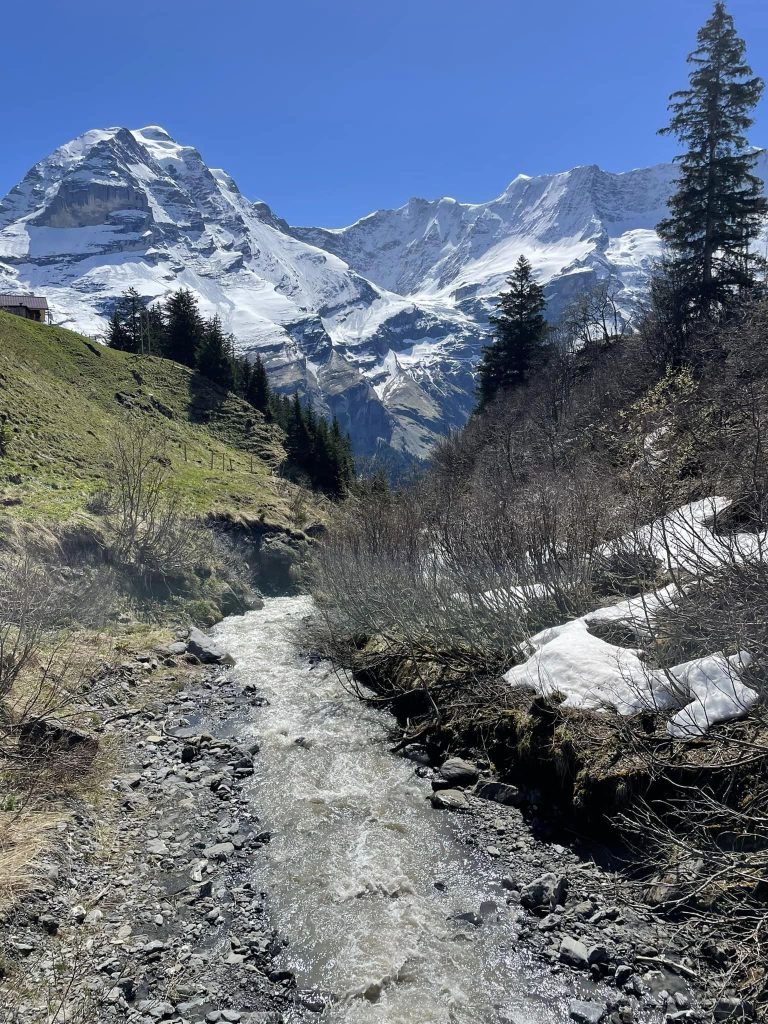
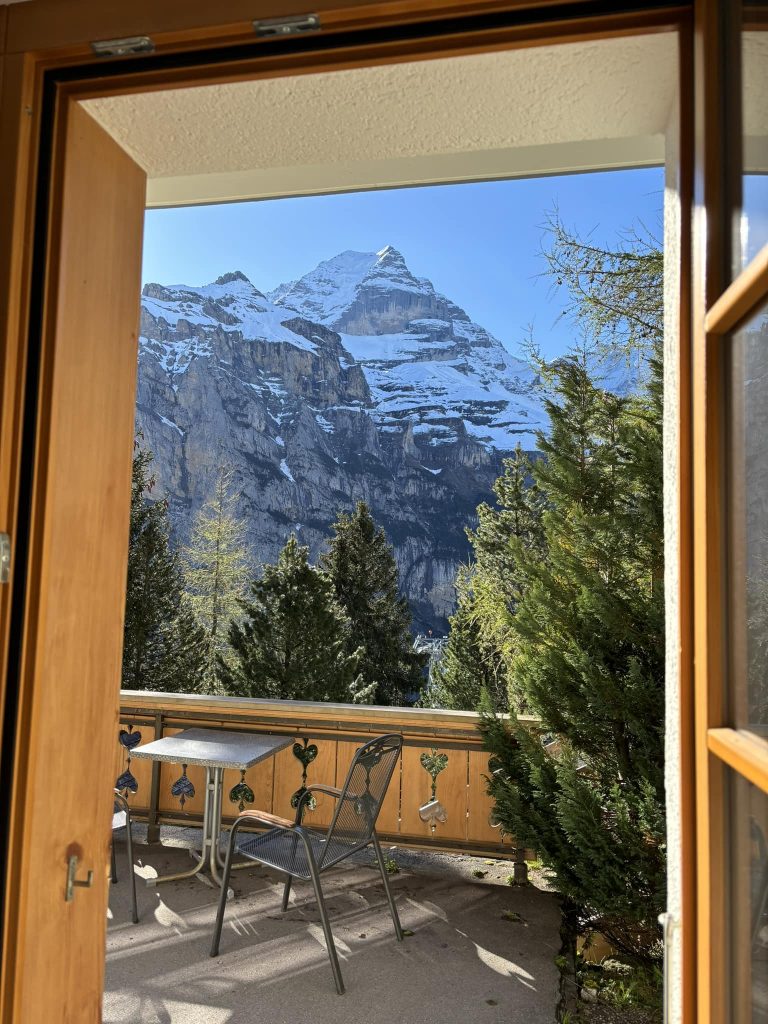
Mürren is accessible only by public transport, unless you live there. We took a regular train from Bern to Interlaken, then Interlaken to Lauterbrunnen, where we switched to a cable car, then a cog train to get to Mürren. This was already cool, and Mürren itself was so incredibly beautiful and peaceful. We stayed at the Hotel Alpenruh, which is at the very end of the main pedestrian street. We really liked this hotel (great breakfast buffet!) and would definitely stay there again. Our room had a private terrace with a mind-blowing view of the mountains, and the weather was incredible. Totally clear, not hot, and not cold. I had brought tons of rain gear and warm clothes from home, and they never even came out of my suitcase.

The nice desk guy at hour hotel recommended a fabulous hike for us, from the village, to the Bryndli (a nearby peak with a fantastic view, steep but worth it), then back via the Sprutz waterfall (very cool, the trail goes behind the waterfall) and the village of Gimmelwald (a nice, peaceful climb through the forest to end the day). I’m not sure how far this was…maybe 10 miles?? It took us pretty much all day, probably 10 AM to 5 PM, so we were excited to get back to the hotel, clean up, and eat a very good local meal in the hotel restaurant. The next day, we did a more mellow walk down to Winteregg on a paved path and a dirt road (also beautiful; everything in that area is just beautiful), then headed to our next stop!

Mürren is tiny and easy to get around, and there are lots of signs for hiking trails if you just want to wing it. There’s also a small but well-stocked Coop grocery story that’s open seven days a week (somewhat unusual for Switzerland).

Leysin and Geneva

Way back in 2012, my husband and daughter and I spent the summer in Leysin while my husband did a consulting job there. We’ve been back several times since, and have always really enjoyed it. After another multi-step but very efficient train ride (plus cable car to get down from Mürren), we took yet another cog train to get from Aigle to Leysin, where we stayed at our favorite hotel, the Central Résidence, which we lovingly refer to as, “the poor man’s Club Med,” due to its huge indoor swimming pool with a window-wall looking out at Mont Blanc. We grabbed dinner at the crepe place in the center of the village (tasty!). The next morning, we hit La Farandole for croissants and coffee, then set off on a loop hike to Prafandaz and La Berneuse, a hike we’ve done several times before, taking the forest route over Riondaz on the way up. There were still a few snow fields at the top, but we had the place to ourselves (it’s a zoo in the summer!) since the cable car was not yet running. A storm was moving in, so we hoofed it down the shorter (mostly dirt road) way through Temeley (a dairy and snack bar in the summer, but the cows were still down in the valley when we were there) and made it back to the hotel without getting rained on.

That night, we had a truly special dinner at the Leysin Fromagerie restaurant, a place where we’ve enjoyed many family meals. They make their own cheese (right there!) and the fondue is to die for. I’m not even a huge fondue person, and I love going there. By that time it was cool and rainy (the only significant rain we had on the trip!) and the perfect weather for fondue.

The next day, we headed down-valley to Geneva, always a beautiful place to spend some time, where we took a long walk by the lake and then I got together with a friend who lives in the area, and that was that! A short and perfect trip!

Overall impressions and costs

I’ve never been to Switzerland in May before. Crazily enough, my main concern was the weather: I packed full rain gear and tons of warm clothes, and in reality the weather was perfect. When we were in the Berner Oberland, it was (no kidding) so sunny that it was almost hard to take good pictures of the mountains because of the glare off the snow. There was definitely still some snow coverage higher up in the mountains, but things were melted out enough that we could still do all-day hikes in both of the locations we visited.

It seems that things in Switzerland mostly open up around May 25 for the summer. Personally, I would much prefer to go a little earlier, have the weather be a little cooler and less predictable than in the summer, but not have to deal with huge crowds. Switzerland is, in general, a pretty tightly packed place, and even at this time of year, we had trouble finding seats on the longer train rides, i.e. Aigle-Geneva. I’m now a fan of going there in May!

No shocker here, Switzerland is an expensive place, and it’s a place where pretty much everything (food, transportation, entertainment) is expensive, but where quality standards are also very high.

All in all, we did pretty well, cost-wise. I paid around $1,200 for my plane ticket on United (Denver-Chicago-Zurich on the way out, Geneva-DC-Denver on the way back). The Mürren hotel was $516 for two nights including tax, the Leysin hotel was $393 for two nights including tax, and the two “nice” meals we had were about $100 for two people including drinks and dessert. There are also ways to eat well and cheaply in Switzerland. We had a couple of excellent picnic meals from Coop (the main grocery store chain in the mountains), plus great pastries, great coffee, great cheese that we got from small stores. Sit-down meals tend to be expensive, but it’s totally possible to put together decent meals without going to fancy restaurants.

Swiss trains are what I would consider quite expensive: for example, the multi-stage ticket from Mürren to Leysin was $117 (!!), but the trains are super-efficient and get you literally anywhere you want to go, without having to rent a car. It’s also possible to buy a half-fare card, where you pay $137 up front and then your tickets are half price; there are also tons of Swiss rail passes that cover everything. We figured that we would just barely break even on this so we just purchased full-fare tickets, but it’s definitely something to look into if you’re going to be moving around a lot.

Our main/only activity was hiking, which is obviously free, and we loved it. Mountain sightseeing in Switzerland (if you’re not under your own power) can quickly eat into your budget. We talked to some people who paid over $200 per person for a “top of Europe” cable car experience on the Jungfrau, but we were totally happy to hike and enjoy the views.

Gear and clothing

I am in general a light packer, even for international trips, and even more so since I converted to the Underseat Pro backpack. I love this thing so much that I wrote a blog post about it, which you can read here. A few additions since I wrote that post:

  • I’ve talked to a couple of people who said that the Underseat Pro did not fit under the seat of an airline that they traveled on. I fly almost exclusively on United and Southwest and that’s never happened to me (even on a small regional jet), but your mileage (haha!) may vary.
  • I would not recommend the Underseat Pro as an additional backpack to go along with another suitcase; if you’re looking for a light, comfortable backpack, there are definitely better options. Its real value is when you want to go on a trip with one bag, end of story. Like when I walk out of my house for this kind of trip, I’m carrying one and only one thing: the Underseat Pro, not even a separate purse or day pack. As another side note, I take along the Sea to Summit Ultra-Sil Day Pack, which, true to their marketing, compresses into a stuff sack that’s the size of an egg (no kidding).

Two pieces of clothing that are hugely helpful to me in packing light (not affiliate deals, I just love them):

  • RBX Active’s everyday ribbed ankle pants. I have the black ones, and I find that they’re great for hiking, they dry quickly enough to wash them in the hotel sink if needed, they’re stretchy enough for yoga, and because they’re solid black, they can pass as “dress pants” in a pinch. On this trip, I paired them with a solid-colored long-sleeve t-shirt and mooched a scarf off my sister-in-law, and it was a decent look for going out to dinner!
  • Danner hiking shoes. The ones I have (the Trailcomber in dusty rose) are sadly no longer made and I ordered mine on Ebay. But: if you’re trying to pack light, one key is to bring only one pair of shoes (the ones you’re wearing on the plane!) plus a pair of flip-flops or similar, for walking around the hotel, going to the pool, etc. Personally I like to have something that I can wear for an all-day hike, but that doesn’t look completely like sneakers, and that can also work if I want to wear something a little dressier than activewear.

There we go! A perfect week in Switzerland! Hopefully this provides some details and information if you’re interested in doing a similar trip.

Corinne McKay (classes@trainingfortranslators.com) is the founder of Training for Translators, and has been a full-time freelancer since 2002. An ATA-certified French to English translator and Colorado court-certified interpreter, she also holds a Master of Conference Interpreting from Glendon College. For more tips and insights, join the Training for Translators mailing list!

Written by Corinne McKay · Categorized: Travel

May 08 2024
Corinne McKay

Direct client e-mail marketing scripts

To get our weekly posts directly in your inbox, sign up for the Training for Translators mailing list!

This month’s free marketing resource for Training for Translators subscribers is a set of direct client e-mail marketing scripts. If you’re on our mailing list, you received these scripts in yesterday’s newsletter. If you’re not on our mailing list, sign up at the link above, and the file link will be in your confirmation e-mail!

This is a PDF file that you can copy, customize, and improve for your own purposes; just something to help you out when you don’t know what to say to a potential direct client! Shoot us an e-mail at classes@trainingfortranslators.com if you decide to try them out.

Corinne McKay (classes@trainingfortranslators.com) is the founder of Training for Translators, and has been a full-time freelancer since 2002. An ATA-certified French to English translator and Colorado court-certified interpreter, she also holds a Master of Conference Interpreting from Glendon College. For more tips and insights, join the Training for Translators mailing list!

Written by Corinne McKay · Categorized: Marketing

May 06 2024
Corinne McKay

Content marketing master class

To get our weekly posts directly in your inbox, sign up for the Training for Translators mailing list!

This month’s master class is Introduction to content marketing, taught by Corinne McKay. Join us if you’d like to use blog posts, newsletters, e-books, social media posts, videos, or lead magnets to:

  • Market your translation or interpreting business, or other products and services that you offer
  • Translate content marketing materials for your clients
  • Do native-language content marketing writing for direct clients or content marketing agencies

The live class runs for two hours on May 23, and registration ($75) includes the recording. We’ll cover:

  • How to start an e-mail list; the foundation of any content marketing effort
  • Blogging for your own platform, or for standalone platforms like Medium and Substack
  • How to use lead magnets and social media posts to grow your e-mail list
  • The advantages and disadvantages of using social media versus your own platforms
  • How to generate ideas for your content marketing materials
  • A few fails/things to avoid

Learn more and register here!

Corinne McKay (classes@trainingfortranslators.com) is the founder of Training for Translators, and has been a full-time freelancer since 2002. An ATA-certified French to English translator and Colorado court-certified interpreter, she also holds a Master of Conference Interpreting from Glendon College. For more tips and insights, join the Training for Translators mailing list!

Written by Corinne McKay · Categorized: Classes for translators

  • « Go to Previous Page
  • Page 1
  • Interim pages omitted …
  • Page 34
  • Page 35
  • Page 36
  • Page 37
  • Page 38
  • Interim pages omitted …
  • Page 245
  • Go to Next Page »

Primary Sidebar

Subscribe to the Training for Translators mailing list!

Getting Started as a Freelance Interpreter: Available now in print and electronic editions

Learn from our blog:

  • Survey results: The state of freelance translation in 2026
  • Focus on the clients who can afford you
  • Upcoming direct client marketing class
  • Travel: Cycling Quebec’s Tomifobia Nature Trail
  • Travel: Cycling Burlington, Vermont’s Causeway Bike Trail
  • When part of your business falls off a cliff
  • Upcoming free webinar: Honest brand communications through purpose, positioning, and personality
  • Training for Translators Plus is here!

Search the Training for Translators blog

Copyright © 2026 · Training For Translators · Log in

This website uses cookies to improve your experience. We'll assume you're OK with this, but you can opt-out if you wish. To view this website's privacy policy, click About>Privacy Policy. Accept Read More
Privacy & Cookies Policy

Privacy Overview

This website uses cookies to improve your experience while you navigate through the website. Out of these, the cookies that are categorized as necessary are stored on your browser as they are essential for the working of basic functionalities of the website. We also use third-party cookies that help us analyze and understand how you use this website. These cookies will be stored in your browser only with your consent. You also have the option to opt-out of these cookies. But opting out of some of these cookies may affect your browsing experience.
Necessary
Always Enabled
Necessary cookies are absolutely essential for the website to function properly. This category only includes cookies that ensures basic functionalities and security features of the website. These cookies do not store any personal information.
Non-necessary
Any cookies that may not be particularly necessary for the website to function and is used specifically to collect user personal data via analytics, ads, other embedded contents are termed as non-necessary cookies. It is mandatory to procure user consent prior to running these cookies on your website.
SAVE & ACCEPT