• Skip to main content
  • Skip to primary sidebar

Training for Translators

Classes for translators and interpreters

  • Start here
  • Blog
  • Classes
    • Coaching for freelancers
    • Subscription
  • Books
    • Translate my books
    • Book Shop
  • About/Contact
    • Privacy Policy
  •  
  • Account

Marketing

Apr 17 2017
Corinne McKay

Do translators need portfolios?

Lots of translators (beginning and experienced) wonder if it’s a good idea to create a portfolio. Something with excerpts of your translations that you can show to potential clients as a marketing tool. My take: a portfolio probably isn’t worthwhile in the way that most translators envision it, but could be helpful in other ways. Let’s take a look:

Most translators think of a portfolio this way: go through your old translations, pull out some excerpts from the source and target text, and make it into a PDF or post it on your website. That has a few problems:

  • The work might be covered by non-disclosure agreements
  • The client might not understand one of the languages involved, so may not be able to assess your translation skill in the way you envision
  • Meanwhile, you’re thinking that the portfolio will help you leapfrog over requirements such as an agency’s tests, which it probably won’t

I do think that a portfolio can be useful to:

  • Show examples of your published work. For example, I have a web page highlighting my French to English translations of non-fiction books.
  • Give examples of “signed” translations that have been published with your name on them. For example, a few years ago I did some translations for a Swiss museum, and they put my name in the exhibition credits. I then sent that photo to a few other arts-sector clients, for credibility purposes
  • Show your writing style, and show examples of the *types* of things you translate
  • Attract clients who are very writing-style conscious, such as clients who need content marketing translations (blog posts, tip sheets, e-books, etc.) where there is a strong emphasis on catchy writing
  • Include reviews of your published translations, or testimonials from clients

Bottom line, I think that most agencies will still require you to take their tests, and most direct clients will want to see an example of your work on *their* materials. For most translators who want to work with direct clients, I think that doing a “teaser” translation of a high-profile item like the client’s home page or Twitter profile is more effective than a portfolio. If you’re interested in using bad translations as a marketing tool, check out this post, and make sure to read the comments for lots of great tips. But for most translators, I also think that a portfolio of excerpts from legal contracts, financial statements, or pharmaceutical documents is unlikely to be useful. Additionally, it may create an expectation that you’ll be able to avoid agencies’ application requirements by using it.

If you enjoyed this post, you might be interested in my Marketing to Direct Clients course, starting May 8, 2017. A past participant commented, “I now have the knowledge and confidence to market myself to direct clients. It was the best investment I made for my freelance business. I regret I didn’t take this course sooner!”

Written by Corinne McKay · Categorized: Marketing · Tagged: translator portfolios

Apr 10 2017
Corinne McKay

Free webinar Wednesday: Three ways to find your first translation clients

This Wednesday (April 12), I’ll be giving a free webinar through SDL’s professional development series, on Three ways to find your first translation clients. Inspired by my blog post on the same topic, I’ll describe how to:

  • work the local market
  • apply to translation agencies that base their hiring only on their own tests
  • cultivate a micro-niche

These strategies are intended mostly for new translators who need a way around the chicken and egg dilemma of, “Clients don’t want to hire me without experience, but how do I get experience if clients won’t hire me?” It’s free, and is not a sales pitch. Hope to see some of you there!

Written by Corinne McKay · Categorized: Announcements, Getting started as a translator, Marketing

Apr 03 2017
Corinne McKay

Thoughts on e-mail subject lines

E-mail subject lines are just a few words, but they generate a lot of angst. Especially if you’re a beginning translator looking for clients, you’re going to be sending out a lot of cold e-mails. You want those e-mails to be read, but you’re selling language services, not no-prescription Viagra. Let’s start with the basics:

  • Never (NEVER) use all caps in the subject line of a marketing e-mail. Nothing screams “spam” like the caps lock button.
  • Never overstep the bounds of familiarity. When you’re mass-marketing a product, including the recipient’s first name in the subject line might be a good idea. “Hey Heather, the birthday cake’s on us!” kind of thing. But when you’re marketing high-end professional services, don’t do that unless you know the recipient.
  • Err on the side of directness. Give the recipient an honest sense of what the e-mail is about. Don’t do a bait and switch.

When you’re sending marketing e-mails to agencies (we’ll look at direct clients in a second), there’s no shame in using a very direct subject line. Agencies need translators. Agencies can’t operate without translators. You don’t have to hide the fact that you want to work for them. So, just use something like:

  • French to English translator seeking new clients
  • English to German medical translator interested in your agency
  • Inquiry from Italian to English translator: legal/financial specialist
  • Responding to your posting for English to Spanish translators

Because we all get so much spam e-mail, if you have any “hook” with this client, use it. That will increase the chances that your e-mail will be opened. “Referral from XYZ colleague,” “German to English translator based in (your area, if the agency is local),” “Following up on our conversation at the ATA conference.”

With direct clients, it’s a little more nuanced. You still want to use a clear subject line, but you don’t want to hit them over the head with a marketing pitch, especially if you’re just trying to create a connection. So, think about what motivated you to contact this client in the first place (other than wanting to work for them). Why are you writing this?

  • Congratulations on your expansion into Germany
  • Noticed your LinkedIn Pulse post
  • Inquiry from a translator specializing in your industry
  • Thanks for the excellent international marketing article

Other readers probably have good examples to share. The point is to be direct, without screaming, “Hire me to translate your stuff!” But when in doubt, just write something straightforward that indicates why you’re reaching out to this person.

Written by Corinne McKay · Categorized: Marketing · Tagged: e-mail subject lines

Feb 21 2017
Corinne McKay

Handwritten notes: a secret business weapon

Here’s an environmentally-incorrect confession: I love paper. I live in a little house, we have one car, I ride my bike to work, I’m a vegetarian, and we don’t have a clothes dryer. But I’m clinging to paper with all I’ve got: the little house is full of paper magazines and books, I take meeting notes on paper, and I love sending and receiving paper cards in the mail. Let’s look at some ways to use handwritten notes as a secret weapon in your freelance business.

Handwritten notes are appealing for obvious reasons:

  • They stand out amid the flood of e-mail that we all receive.
  • They show that you’re willing to take the time to send something truly personal.
  • Who gets anything interesting in the mail anymore? At my house, it’s 98.7% ads and bills. A personal card makes an impression.
  • They are clearly not generated by a spambot. This is sad, but it’s getting hard to differentiate legitimate fan e-mail (“Hey Corinne! I love your blog!”) from fan e-mail that is automatically generated. Handwritten notes circumvent that problem.
  • You can enclose things like a business card in them.
  • You don’t need the person’s e-mail address to send them.
  • They are a gift that doesn’t cost anything, so doesn’t seem like overkill. When someone does a favor for you, and you want to express appreciation but it might seem odd to offer to pay them, a handwritten card can split the difference.
  • They are another way to ping a client without being annoying. Without sending yet another, “Got any work for me yet???” e-mail.

You can use handwritten notes in various situations.

  • I send every client a handwritten note after they pay me for the first project; I think it gives a more personal tone to the relationship and shows them that I appreciate working with them.
  • In the early years of my freelance business, when I was actively looking for agency clients, I made copious use of handwritten notes. If I received any response from the agency, even, “Don’t need you right now but we’ll keep your information on file,” I sent a card. It said something like, “Thank you so much for responding to my inquiry about French to English translation work with your agency. I really appreciate your time, and hope to collaborate with you soon.” Then I popped a business card in it and sent it. Interestingly enough, those business cards kicked around people’s offices for a while, and I received several inquiries years later, still based on those initial cards.
  • I send cards to colleagues who refer me for substantial jobs.
  • I send cards to people who give presentations or classes that I really enjoy.
  • Lately I’ve been experimenting with cards as an actual marketing technique: sending them to prospective clients. This offers the added bonus that you don’t need the person’s e-mail address, only their name and the company’s mailing address.
  • I would definitely recommend handwritten notes if you’re aggressively trying to build up your agency client base. Agencies get so many unsolicited applications, and many of them are spam. Even if the agency doesn’t respond at all, send a card saying, “I recently applied for English to German translation work via your website. I’m looking forward to the next steps in the application process and hope to collaborate with you soon.” Enclose a business card.

Closing tip:

Give some thought to the actual cards. If you live in a distinctive place, that’s a good start. I have a former student from Alaska who sends out “Northern Lights” cards that are very representative of where she lives. If I’m sending the card to someone I know, I might go for something whimsical, like these zoo animals doing yoga. But don’t send an elephant in crow pose to a potential client, unless perhaps you translate for yoga retreat centers! For most prospective clients, go with a high-quality, conservative card and write with a nice pen.

Readers, any other examples of how you use handwritten cards?

Written by Corinne McKay · Categorized: Marketing · Tagged: freelance marketing, handwritten notes, using handwritten notes

Feb 17 2017
Corinne McKay

The LinkedIn “foot in the door” strategy

This is a guest post by Maryam Abdi. Maryam is a registered Somali court interpreter and the owner of Expert Somali Translations, a boutique firm offering Somali > English translations and cultural consulting services to legal and government sectors. She is the creator of Translators Academy where she blogs about marketing, sales and career strategies for aspiring and new freelance translators. Maryam holds a Bachelor’s degree in political science from the University of California, San Diego. She is a recipient of the State Bar of California’s Wiley M. Manuel Award for Pro Bono Legal Services, for her volunteer work as an interpreter and translator for victims of human rights abuses. 

If you’re a freelance translator looking for new clients, the days of bidding on translation job portals and arbitrarily cold-calling translation agencies are over. It’s not a numbers game anymore. Clients these days expect you to spend the time to learn about them before getting in contact. And what’s the best way to do that? The answer is LinkedIn. LinkedIn is nothing short of a goldmine for freelance translators. It’s an incredible tool to learn about prospects, grow your network and find high-quality and well-paying clients. When used correctly, it can create endless work opportunities.

In this blog post, we’re going to dig deep and explore how freelance translators can:

  • Authentically connect with other translators working with their ideal clients
  • Expand their network to get access to translation projects that never get advertised
  • Use the Foot in the Door Strategy to leverage their network and get introductions to “pre-sold” potential clients.

By harnessing the power of LinkedIn, you’ll be well on your way to setting up a well-organized translation sales system that you can maintain in as little as five hours a week.

The step-by-step method to building your high-end LinkedIn network from scratch

Is there a particular translation agency or company you want to work with? But you’re unsure how to go about it? The most effective way to getting in the potential client’s inner circle is to use the Foot in the Door Strategy. It’s a simple, three-step process that you can implement right away on LinkedIn. This is a highly methodical approach that deconstructs the often-confusing prospecting process. It begins with finding other translators who are already working with your ideal clients and translation agencies.

maryam1

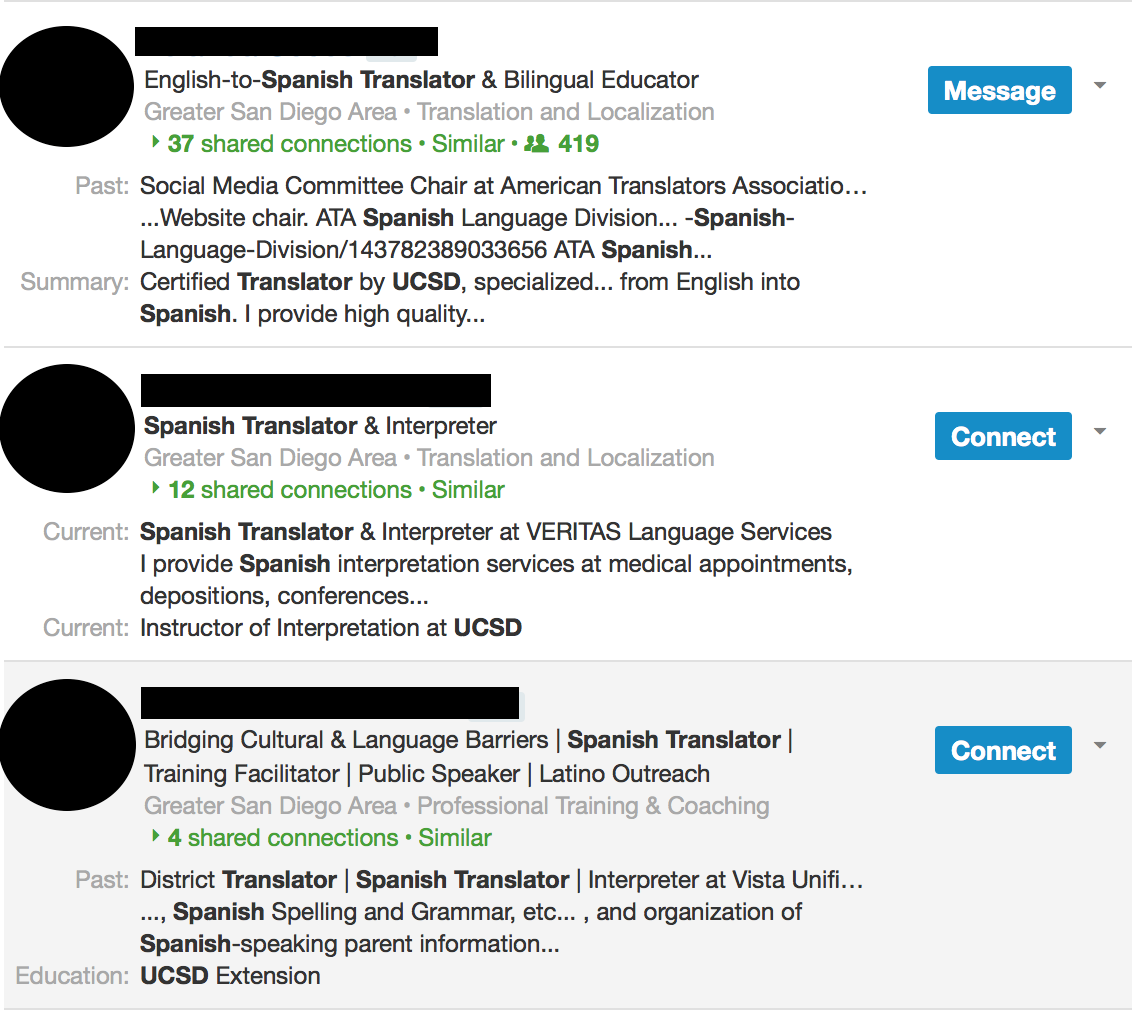
The LinkedIn Advanced People Search tool helps you find the right translators to contact. You can search for translators by their language pairs, specialization and the companies they work with. Here’s the step-by-step process to filling out each field of the Advanced People Search tool:

  • Start with the keywords field and type in the specialization of the translators you want to connect with. If you’re interested in flexible translation positions, this is a great place to enter the keyword “freelance”.
  • To find translators working in similar language pairs as you, enter the preferred languages in the title field. For example, if you’re searching for French <-> English translators you could insert, “French English translator.”
  • Next, enter the name of the agency or potential direct client in the company field. For many translators who don’t populate this field, their search results become limited.
  • In the Advanced People Search tool, you can also filter the results by relationship. A “1st connection” is someone that is already in your network. Assuming you want to find a translator outside of your network, click on the remaining options (2nd connections, Group members and 3rd connections + Everyone else).
  • The next step is to narrow your search by location. Enter your city to find local translators working with your ideal clients.

Once you complete the form, click on the search button to get a list of translators with the information you specified. You can experiment with the Advanced People Search tool to find the specific person you want to contact.


maryam2

After you review the search results, the next step is the “research phase” where you’ll collect information on the translators working with the translation agencies and companies on your prospecting list. Before you contact them, do your homework so you don’t come off impersonal in your approach. Once you’ve found the translators that have a relationship with your ideal clients and you review their profile, now it’s time to find a way to connect with them on LinkedIn.The easiest way to connect with freelance translators working for your ideal clients and agencies is to find a connecting factor. Before you can send them a message you have to demonstrate how you know them. For example, you can connect with a translator who went to the same university or translation programs as you. You could also search by translation association membership or perhaps comb through their profile to see if they have listed their personal email. Either way, you need this information to not only “warm up” your message but to add them to your personal network on LinkedIn. It’s best to reach out to translators who have the same specialization as you or work in complementary language pairs. For example, if you’re a Spanish > English translator find an English > Spanish translator.

Now that I’ve showed you how to find the translators working with your ideal clients, it’s time to authentically contact them with a personalized invitation to connect on LinkedIn. If you’re wondering what to say, you can use the tested word-for-word script below to connect with translators the right way. By using this script you can shave off weeks if not months on your search for new clients.

The word-for-word script to help you find new clients faster

Finding new clients is a lot easier once you leverage the network of your existing clients and colleagues and it all begins with the Foot-in-the-Door Strategy. Here’s a sample message you can use to invite a freelance translator to connect on LinkedIn. Unlike a generic message, this one is personalized and has a high response rate.

maryam_email

Don’t worry about sending this type of message and being met with deaf ears. It’s different from the typical cold emails sent by most freelance translators because:

  • The focus is shifted from you to them and it doesn’t come off as self-serving
  • You’re asking freelance translators to share their story instead of asking for a handout
  • You’re showing you’ve invested some time in getting to know them

This is a much easier way to find new clients without going to random networking events, cold-calling or running expensive advertisements in trade journals.

Building a relationship and requesting an introduction

Once your connection request on LinkedIn is accepted, it’s time to ask for the translator’s insight on the company you’re interested in. You can conduct your informational interview over email, by phone, or even in person if the fellow translator is in the same city as you. During your interview, ask open-ended questions about their experience working with the translation agency or company, the type of projects they work on, and their likes and dislikes about the client you’d like to work with. It’s very important to vet companies and agencies to make sure they’re a good fit for you and your translation services. When it comes to clients, quality is better than quantity. Naturally, the conversation will bounce back to you. In most cases, the translator will ask about your experience. Use this as an opportunity to express your interest in working with the agency or company and ask for an introduction.

However, it doesn’t end there. The point is to make it as simple as possible to get a warm introduction. Just like you, they’re very busy professionals and crafting an email to refer you will be one more thing on their to do list. Make sure to do the “heavy lifting” for them and offer to write the introduction message for them.

Lather, rinse, repeat

It’s often said your network is your net worth and I couldn’t agree more. Freelancing is a business built on relationships. Having the right network of translators will give you access to the well-paying translation projects that never get advertised. If you want to stay top-of-mind when the opportunity arises, stay in touch with translators in your network. Make sure to follow up with the translator after your talk or meeting. Send them a message genuinely thanking them for their time. If they gave you suggestions, tell them you’ll apply the strategies and keep them in the loop with your results. Remember, you also want to nurture your network. You have to give in order to receive and that involves referring your colleagues and presenting them with opportunities to tap into your clientele as well.

The Foot in the Door Strategy isn’t something you only do when you’re in desperate need of clients. Similar to exercising, it’s something you should do consistently in order to see results. Building a network is not easy, but the potential payoff is huge. With time you’ll be able to build the confidence and credibility to approach fellow translators and colleagues on LinkedIn. Eventually, you’ll get faster, more creative and self-assured the more you use the Foot in the Door Strategy.

Now I want to hear from you. Tell me about your experience using LinkedIn to find new clients by sharing your thoughts in the comments below.

Written by Corinne McKay · Categorized: Guest posts, Marketing, Uncategorized · Tagged: finding clients on LinkedIn, LinkedIn, marketing on LinkedIn, Maryam Abdi

  • « Go to Previous Page
  • Page 1
  • Interim pages omitted …
  • Page 3
  • Page 4
  • Page 5
  • Page 6
  • Page 7
  • Interim pages omitted …
  • Page 24
  • Go to Next Page »

Primary Sidebar

Subscribe to the Training for Translators mailing list!

Getting Started as a Freelance Interpreter: Available now in print and electronic editions

Learn from our blog:

  • Should you raise your rates? Now? How?
  • Why most language company content misses the mark, and a few strategic fixes
  • Struggling in your freelance business? Really, you have four options
  • T4T podcast, episode 30: A summary of my “state of freelance translation” survey
  • Survey results: The state of freelance translation in 2026
  • Focus on the clients who can afford you
  • Upcoming direct client marketing class
  • Travel: Cycling Quebec’s Tomifobia Nature Trail

Search the Training for Translators blog

Copyright © 2026 · Training For Translators · Log in

This website uses cookies to improve your experience. We'll assume you're OK with this, but you can opt-out if you wish. To view this website's privacy policy, click About>Privacy Policy. Accept Read More
Privacy & Cookies Policy

Privacy Overview

This website uses cookies to improve your experience while you navigate through the website. Out of these, the cookies that are categorized as necessary are stored on your browser as they are essential for the working of basic functionalities of the website. We also use third-party cookies that help us analyze and understand how you use this website. These cookies will be stored in your browser only with your consent. You also have the option to opt-out of these cookies. But opting out of some of these cookies may affect your browsing experience.
Necessary
Always Enabled
Necessary cookies are absolutely essential for the website to function properly. This category only includes cookies that ensures basic functionalities and security features of the website. These cookies do not store any personal information.
Non-necessary
Any cookies that may not be particularly necessary for the website to function and is used specifically to collect user personal data via analytics, ads, other embedded contents are termed as non-necessary cookies. It is mandatory to procure user consent prior to running these cookies on your website.
SAVE & ACCEPT