• Skip to main content
  • Skip to primary sidebar

Training for Translators

Classes for translators and interpreters

  • Start here
  • Blog
  • Classes
    • Coaching for freelancers
    • Subscription
  • Books
    • Translate my books
    • Book Shop
  • About/Contact
    • Privacy Policy
  •  
  • Account

Aug 29 2016
Corinne McKay

Reader question: how do I choose a translation memory tool?

A reader asks: “How do I choose a translation memory tool? I feel like I need one, but I have no idea how to pick. They all seem confusing and expensive, and I don’t know where to start.”

Short answer: If the TM tool is just for your own use, test-drive a few or ask colleagues about their experiences, then pick the one you like best. If you’re buying the TM tool because your clients require it, or because you think it will be a marketing advantage, then buy the one that your clients (or desired potential clients) want.”

Longer answer: It’s a complicated question. Here’s my story. For years and years, I used Wordfast Classic, which is light, easy to learn to use, and has good documentation and support. I really liked it, and I had sort of vowed to never upgrade to one of the “big guys” because I perceived them as expensive and difficult to learn to use. Then, about five years ago, along came a client who offered me a very large, ongoing project that required Trados Studio. At that point, I realized that I had been resisting buying one of the market leaders simply for the sake of resisting (…they won’t get my money, I’ll patch it together on my own, etc. etc.). So I bought Trados, hired an individual trainer to help me learn to use it, and was up and running in less than a week. And all in all, I like Trados Studio. It’s a bit complicated to learn, it can generate some inscrutable error messages, and it’s a bit bloated for projects like a one-page Word document, but I’m not looking to switch tools.

It’s important to look at a TM tool as a business investment, not an emotional decision. Translators get very emotional about their attachment to, or hatred of, certain TM tools and the companies that make them. As a recovering TM resister, I’m here to tell you that that’s misguided. It’s a business investment: will this tool help you land new clients, work more efficiently or produce better translations? Then buy it. If not, don’t. It’s that simple.

Lots of students in my classes wonder if they should pre-emptively buy a TM tool, as a selling point to potential clients. Maybe. In general, we freelance translators are frugal…sometimes we’re cheap. Frugal is good; frugal means that you’re wise with your money. Cheap is not good; cheap means that you’re unwilling to spend money on a tool that is required in order for your business to thrive. If you’re cheap, and using Windows XP and Office 2003 on an ancient laptop, that’s a false economy. At the same time, it’s not wise to spend $1,000 each on three different TM tools you might never use. But if you’ve heard from other translators that the clients you want to work for require a certain tool, it’s probably a good investment to buy it proactively. The caveat is that, depending on the kind of translation work you do, a TM tool can be either useless (if you translate novels) or indispensable (if you translate software). So, you don’t want to invest in one of the market leaders if you’re not sure you need it.

Some translators wonder if free TM tools are any good. That’s easy: yes. I love OmegaT. I actually find its matching algorithm better than Trados Studio’s, and it’s much more stable (no “object not set to an instance of an object” errors). And the market leaders sure aren’t going to say, “Go ahead and localize our tool into Slovenian! We’re excited to see the results!” The sticking point is that, especially if your client is not particularly tech-savvy, exchanging files through .tmx may entail some hiccups. In theory, the .tmx files are compatible between tools. In practice, each tool is going to do things (like segmentation) slightly differently. So, the client is more likely to say, “To work with us, you have to have X tool.” But yes, free TM tools can definitely get the job done.

An additional factor is that the TM tool market is fragmented; agencies may require memoQ, or Trados, or Wordfast Pro, or Memsource, or Across, or Fluency, or something else that they maintain in-house. Of the market leaders, I would say that Trados is the most widely-used, memoQ has the best reputation for support, and Wordfast Pro is the only one that is truly cross-platform. So, they all have their pluses and minuses. Additionally, you’ll need to either hire a trainer, or put in some unpaid time to learn to use the tool. Just as you don’t learn to use Photoshop in an hour, you don’t master a full-featured TM tool in that amount of time.

To close, two specific tips:
-Whatever your level of interest in translation technology, subscribe to Jost Zetzsche’s newsletter The Tool Box (not an affiliate deal, I just love it!). Jost will follow the trends for you, so that you don’t have to.
–When you buy a tool, don’t pay list price. Purchase the tool at a conference, where discounts are often offered, or use a group buying opportunity on a site like ProZ (again, not an affiliate deal).

Readers, any thoughts on choosing a TM tool?

Written by Corinne McKay · Categorized: Technology · Tagged: choosing a translation memory tool, TM tools, translation memory tools

Aug 22 2016
Corinne McKay

Yelp, Craigslist, Upwork: should you be there?

When it comes to marketing your freelance business, it’s important to cast a wide net. Taking an “if you build it, they will come” approach, for example by putting up a website and waiting for the work to start flowing in, is definitely not the way to go. But how wide should that marketing net be? Specifically, should you be on websites such as Yelp, Craigslist and Upwork? Let’s look at some of the pros and cons.

In my opinion, here’s the main argument for being on these types of websites: many direct clients know nothing…zero about translation (and as I’ve mentioned before, that’s not their fault). So, when they want to hire a translator, they’re likely to look in the places they’d look to hire other kinds of service providers. We may not love the idea of a client thinking, “Wait, I found my lawn guy on Yelp…maybe translators advertise there too,” but if the client puts those two things together, you want to be the person they end up finding.

Additionally, the fact that Yelp and Upwork allow/encourage reviews is likely to inspire trust in a potential client. I think that increasingly, when we ask the question, “How do you find a service provider (whether that’s an orthopedic surgeon or a landscaper) who you feel is trustworthy?” the answer is “I read online reviews before I contact them.” It’s a good idea to put testimonials on your website, but the potential client knows that those are cherry-picked from your favorite clients; online reviews tend to portray a much more realistic picture.

Finally, there’s the fact that you can piggyback on these sites’ very high search engine rankings and advertising power (this is also the reason I think every freelancer should be on LinkedIn). It’s free to create a basic account, and when someone Googles “Italian interpreter Detroit,” these sites are probably going to rank ahead of any individual freelancer’s site.

Then, there are the negatives. Chief among these (and this also applies to LinkedIn, and to online translation marketplaces) is that these sites advertise the competition right alongside you. And when the client is buying something they don’t really understand, like translation or interpreting services, and there are lots of people offering that service, they’re likely to gravitate toward the less expensive people. Encouragingly, I’ve recently read several online posts by translation clients who have used these services (specifically Upwork) and specifically said that they did not go with the cheapest person, but rather with the person who seemed the best fit for the job. That’s very positive. But still, having 15 different translators to choose from is very different from attracting a client to your own website, which features only you.

These types of sites have a few other negatives: they may be a “closed system,” where you are prohibited from communicating with clients outside the platform. They may take a commission on any work you find via the site. They may encourage reverse auction-style bidding on jobs. They may force you to name a specific hourly or per-word rate and guarantee that any work you find through the site will be done for that amount or less. They also may attract clients who have very small budgets or are looking for an absolute rock-bottom rate, and those are the clients you can do without.

In general, I would put these kinds of sites in the “worth a try” category, but I would not depend on them as a source of high-quality clients. However I’m interested to hear from readers who have found clients through these sites or other, similar ones. Any thoughts?

Written by Corinne McKay · Categorized: Clients, Direct clients, Marketing · Tagged: advertising, freelance marketing

Aug 17 2016
Corinne McKay

Beyond the Basics of Freelancing starts Monday-3 spots left

The next session of my online course Beyond the Basics of Freelancing starts Monday (August 22), and I have three spots left. A previous participant in the class commented, “I had a big increase in income the year after I took Corinne’s course and I attribute a large portion of that success to the class. I could not think of a better way to give your freelancing career a big boost than taking her course. Very inspirational, very valuable information, great program all-round!”

Registration for the class is $355 ($340 for ATA members) and it’s approved for five ATA continuing education points. During the four-week session, students watch a weekly set of online videos, do 20 daily tasks and 8 live question and answer sessions (recordings provided afterward), and receive individual feedback on 4 homework assignments. This will be the last session of this class for 2016, so if you’re an experienced translator who needs a nudge toward your business goals, come join us!

Written by Corinne McKay · Categorized: Classes for translators

Aug 13 2016
Corinne McKay

“Agencies won’t pay my rates, and I can’t find direct clients”: what to do?

Here’s a conundrum that I hear frequently from freelancers at all experience levels: agencies won’t pay my rates, and I can’t find any direct clients. What should I do? Well, let’s see:

  • First, adjust your mindset. Tough love tip: if you truly believe that *zero* agencies will pay your desired rates, and that you will *never* be successful finding direct clients, you need to either shift your thinking or find a different job. If you’re approaching every interaction with a potential client as, “Here goes round 1,000 of beating my head against the wall,” then that’s the first thing that needs to change. Use growth mindset statements like, “There are plenty of clients out there who need what I do. I’m going to keep knocking on doors until I find them,” or “Instead of just translating what lands in my inbox, I’m going to actively seek out the kind of work I enjoy and am good at,” or “The marketing methods I’ve used in the past haven’t worked very well. Now I’m going to try something new and see if that gives me different results.”
  • Assess what “won’t pay my rates” means. As I’ve written about before, you don’t need hundreds of clients to have a thriving translation business. If you apply to 100 agencies and 98 of them think you’re too expensive and two of them think your rates are fine, that’s success. And remember, thanks to a little thing called the Internet, you’ve got the whole world to work with. But…
  • Work the local market. When I started my freelance business in 2002, I knew essentially nothing about entrepreneurship. So I opened up the yellow pages (remember when?) and started cold-calling translation agencies in Colorado and asking for informational interviews. As it turns out, I had stumbled onto a marketing technique that was actually very effective. The vast majority of these agencies responded something like “We don’t have much work for French to English/only work with people with five years’ experience/already have a couple of French translators we like, but if you want to come in and talk to us for a few minutes, no problem.” And since I had very little work, I had tons of time, so I went and talked to them. And guess what, when they had a sudden and urgent need for more French to English translators, or their existing French to English person went on vacation/raised their rates/was suddenly unavailable, guess who they called next? In-person marketing really is worth the investment of time, whether you’re looking at agencies or direct clients.
  • Don’t market to direct clients in the same way you market to agencies. Agencies understand what you do. They know that they need you. They know the difference between a translator and an interpreter. Direct clients know none of this, and it’s not their fault. But they know that in a business sense, translation might be necessary, helpful, or both. So, it’s up to you to market to them in a way that they can understand: “Have you ever considered what an English website might do for your business?” “I’ve helped multiple US-based investment companies understand the financial statements of the Russian companies they invest in.” “When you work with me, I have one goal: to take the hassle and stress out of the translation process.” You’ve heard it before, but let’s say it again: focus on what’s in it for the client, not on how many words a day you translate and what TM tool you have.
  • Keep marketing to agencies, but be selective. When I launched my freelance business, I was 100% *un-selective* about the agencies I marketed to. I opened up my paper copy of the ATA corporate member directory and started at A, going to the agencies’ websites and seeing if they were hiring. By the time I hit the middle of the alphabet, I was getting some work from the As and Bs. But if you’re not a beginner, don’t do that. Even if you are a beginner, vet the agencies you apply to by checking their ratings on Payment Practices or the ProZ Blue Board before you apply. If you’re beyond beginner stage, target your marketing. Sort the agencies’ ratings on one of the sites above, and apply only to the ones with impeccable reviews. Ask translators in other language combinations who their favorite clients are, or what agencies they’ve heard good things about. Google “engineering translations” or “cookbook translations” or whatever your specialty is, and apply to the agencies that advertise those services.
  • Ditch the “I don’t have time” excuse. OK, I’ve used it too. But really, you have 15 minutes a day, right? And even 15 minutes can make a big difference. In 15 minutes, you can send a warm e-mail to a prospective direct client. You can apply to most agencies in 15 minutes. And most importantly, 15 minutes a day keeps the ball rolling and makes marketing a habit, which is one of the keys to success.

Readers, any other thoughts on how to break out of a mental block when it comes to marketing?

Written by Corinne McKay · Categorized: Clients, Direct clients, Marketing, Money, Rates · Tagged: direct clients, marketing for freelancers, translation agencies

Aug 04 2016
Corinne McKay

OT: Bicycling from Martigny to Bolzano

The Thoughts on Translation family just returned from our summer vacation: a week of family time in Switzerland, then a three-week bike trip through the Italian Alps, from Martigny, Switzerland to Bolzano, Italy (actually Trento, a little south of Bolzano!). As usual, feel free to skip this post if you’re not into bike touring or Italy, but for those of you who are, here goes!

We do a trip like this about every two years, and our most recent (2014) trip was lovely, but the operative theme was rain, rain and more rain. So we (blithely) assumed that we were owed some great weather this time, and that strategy seems to have worked, as we rode in the rain for maybe an hour total throughout the entire trip. We were also fortunate to have no major mechanical problems, with only two flat tires in 820 miles.

Some, or perhaps many bike trips aren’t as good as the Facebook version. There’s the joy, but then there’s the utter exhaustion, or the freezing rain, or the broken wheel, or the day you rode over the wrong pass, or the day that someone was too sick to get out of bed. We’ve had our share of those; but this time it was really smooth sailing from west to to east across Italy. Except that it took me a while to climb some of the passes…see the length of the shadow below!
shadow

Logistically, this trip was a bit different than our others, in that we took two single road bikes and a single touring bike, rather than our road tandem and one touring bike. So our “SAG wagon” was my husband on the touring bike, while my daughter and I rode our relatively unloaded road bikes…very pleasant! The only complication was the airline bags for the bikes: we purchased three new Tardis bags from Ground Effect, and they worked great on the way to Switzerland. Easy to pack, easy to carry, and very well made. However complications arose when we mailed the bags to our destination in Milan and they never arrived. So, lesson learned, don’t rely on the Italian postal service, and if you find yourself in need of new bags in Milan, head to Rossignoli and they’ll hook you up! It’s also worth noting that Icelandair did not charge us for the bikes in either direction.

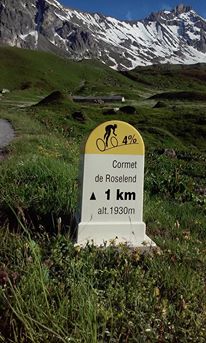
Our itinerary took us over about 16 passes or major climbs, which made for some long days, some short but intense days, and some long and intense days. We had ridden some of these before, but my newfound favorite is the Cormet de Roselend:
roselend

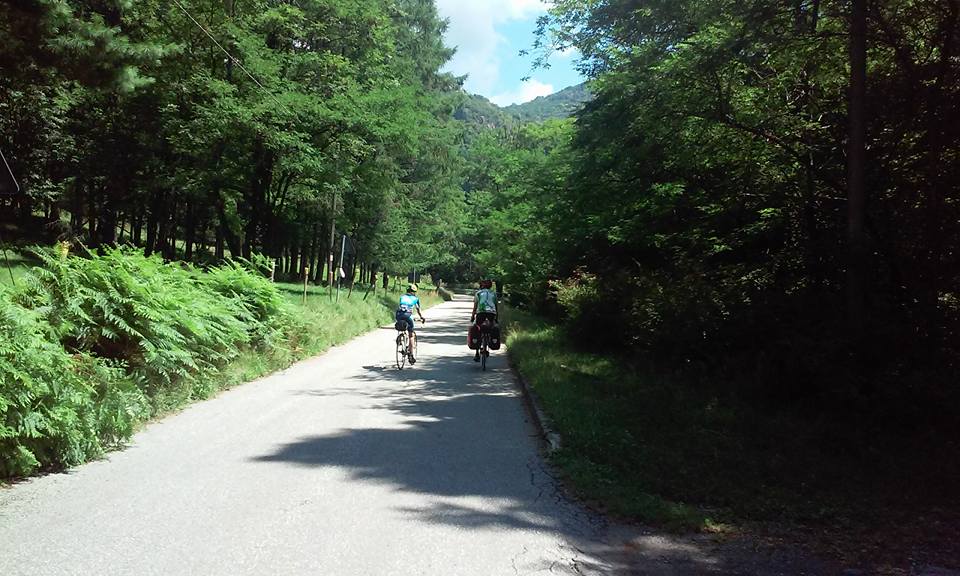
Another highlight was two days winding our way through the foothills of the Piedmont region, from Aosta to Oropa to Lake Orta. This region is really off the beaten path and relatively untrafficked by either cars or bicycles. You might think that the photo below shows a bike path, but in fact it’s a Piedmont-style two way road!
piedmont

As on our previous trips, we stayed in hotels (no camping) and booked most of them in advance so that we could relax during the trip. Not many small hotels in Italy have actual online booking (“send us an inquiry”), but Booking.com has really taken off there, which makes it easier to book some of the out of the way places. New as well for this trip was my smartphone: although I didn’t have cell service in Europe, the phone’s GPS feature still works, and the use of an offline mapping app (Maps.Me) resulted in a dramatic decrease in “where the…are we” stops along the way. Also new is the website Italy Cycling Guide, which is a goldmine of information for independent bike tourers!

For those who want the details, here’s our itinerary. I may do a post about the gear we used on this trip, and here’s my previous post on planning your own bike trip in Italy. If you’d like to do a trip like this and you have specific questions, post them in the comments!

Day 1: Martigny, CH to Chamonix, France, over the Col de Forclaz
Day 2: Chamonix to Bourg Saint Maurice (France), over the Col des Saisies and the Cormet de Roselend. Note that this day could (perhaps should) be split into two days by staying in Beaufort.
Day 3: Bourg Saint Maurice to Aosta (Italy), over the Col du Petit Saint Bernard and Colle San Carlo
Day 4: Aosta to Oropa, via Settimo Vittone. Note that if you take back roads (incredibly beautiful!), this requires a few kilometers on an unpaved road.
Day 5: Oropa to Lake Orta via Rosazza and Bielmonte. Lots of up and down!
Day 6: Day ride between Lake Orta and Lago Maggiore
Day 7: Orta to Cannobio, via the Intrasca valley and Aurona. A classic Giro d’Italia stage with a big climb, then a big plunge down to the lake.
Day 8: Cannobio to Menaggio, beginning with the ferry to Luino.
Day 9: Day ride to the Madonna del Ghisallo shrine and the Muro di Sormano
Day 10: Menaggio to Chiavenna via the Valtellina bike path
Day 11: Chiavenna to Pontresina (Switzerland) over the Maloja Pass
Day 12: Pontresina to Tirano (Italy) over the Bernina Pass
Day 13: Tirano to Ponte di Legno, over the Mortirolo Pass
Day 14: Ponte di Legno to Bormio, over the Gavia Pass
Day 15: Rest day in Bormio
Day 16: Bormio to Merano, over the Stelvio Pass
Day 17: Merano to Bolzano
Day 18: Day ride up Passo Nigra
Day 19: Bolzano to Trento, then train to Milan
pizza

Written by Corinne McKay · Categorized: Off topic · Tagged: bicycling Italy, bike touring Italy, Italy bike trip

  • « Go to Previous Page
  • Page 1
  • Interim pages omitted …
  • Page 108
  • Page 109
  • Page 110
  • Page 111
  • Page 112
  • Interim pages omitted …
  • Page 245
  • Go to Next Page »

Primary Sidebar

Subscribe to the Training for Translators mailing list!

Getting Started as a Freelance Interpreter: Available now in print and electronic editions

Learn from our blog:

  • Survey results: The state of freelance translation in 2026
  • Focus on the clients who can afford you
  • Upcoming direct client marketing class
  • Travel: Cycling Quebec’s Tomifobia Nature Trail
  • Travel: Cycling Burlington, Vermont’s Causeway Bike Trail
  • When part of your business falls off a cliff
  • Upcoming free webinar: Honest brand communications through purpose, positioning, and personality
  • Training for Translators Plus is here!

Search the Training for Translators blog

Copyright © 2026 · Training For Translators · Log in

This website uses cookies to improve your experience. We'll assume you're OK with this, but you can opt-out if you wish. To view this website's privacy policy, click About>Privacy Policy. Accept Read More
Privacy & Cookies Policy

Privacy Overview

This website uses cookies to improve your experience while you navigate through the website. Out of these, the cookies that are categorized as necessary are stored on your browser as they are essential for the working of basic functionalities of the website. We also use third-party cookies that help us analyze and understand how you use this website. These cookies will be stored in your browser only with your consent. You also have the option to opt-out of these cookies. But opting out of some of these cookies may affect your browsing experience.
Necessary
Always Enabled
Necessary cookies are absolutely essential for the website to function properly. This category only includes cookies that ensures basic functionalities and security features of the website. These cookies do not store any personal information.
Non-necessary
Any cookies that may not be particularly necessary for the website to function and is used specifically to collect user personal data via analytics, ads, other embedded contents are termed as non-necessary cookies. It is mandatory to procure user consent prior to running these cookies on your website.
SAVE & ACCEPT