• Skip to main content
  • Skip to primary sidebar

Training for Translators

Classes for translators and interpreters

  • Start here
  • Blog
  • Classes
    • Coaching for freelancers
    • Subscription
  • Books
    • Translate my books
    • Book Shop
  • About/Contact
    • Privacy Policy
  •  
  • Account

Oct 31 2016
Corinne McKay

Getting Started as a Freelance Translator- starts November 14

I’ll be out of the office for the rest of the week to attend the 57th annual ATA conference.  In the meantime, my next online course, Getting Started as a Freelance Translator is open for registration. I’ve been running this class since about 2006, and a participant in the most recent session commented, “I truly enjoyed Corinne’s class for beginners in the business of freelance translation and especially appreciated her individual feedback. Her practical advice was invaluable and helped improve my confidence and clarify my goals. Getting Started as a Freelance Translator was well worth the investment, and I hope to take other classes with Corinne in the future.”

The course registration fee is $355 ($15 discount for ATA members). This includes 12 online videos that teach you the foundations of running a freelance translation business, 20 daily tasks to get you working on your own foundations, individual feedback on four homework assignments (resume/cover letter, marketing plan, rates/billable hours sheet, and online presence), eight live question and answer sessions with recordings provided if you can’t attend, and a private Google Group for class discussions. Note that this is the last session at this price, and the registration will go up to $380 in January.

I hope to see some of you there (and at the ATA conference!). If you’re a more experienced translator, you might be interested in my other upcoming options. Those are Beyond the Basics of Freelancing (plenty of spots left), or a new four-week accountability and coaching group that I’m starting in January (three spots left, so sign up soon if you’re interested).
Written by Corinne McKay · Categorized: Classes for translators · Tagged: classes for translators, online classes for translators. Getting Started as a Freelance Translator

Oct 28 2016
Corinne McKay

Very basic SEO for your freelance website

SEO for freelancers: how important is it? Many freelancers wonder how important search engine optimization (SEO) is, when it comes to your business website and how much traffic you can expect it to attract. Very important? Not at all important? Somewhere in between? With the caveat that this is a very basic introduction and I’m far from an SEO expert, let’s take a look.

First, yes, SEO is important, *if* you want your freelance website or blog to be actively drawing traffic. That sounds obvious, but some freelancers don’t really care about attracting potential clients to their website; they want it simply as an online brochure, or as something to show to clients who are already interested in them. But if you *do* want to actively attract potential clients to your website, SEO is really, really important. Many sources estimate that more than 50%, and perhaps as much as 75% of website traffic is the result of what’s called organic search, meaning that someone Googles “translate German patent,” and finds your web page about German patent translation.

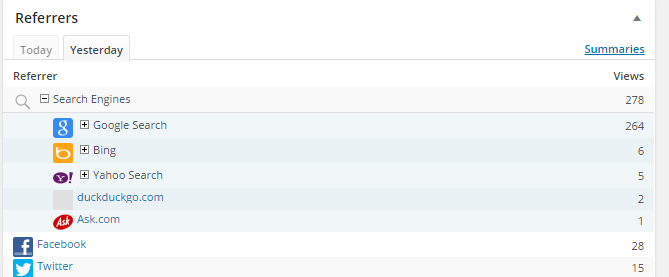
As an example, yesterday my blog got 681 views. Of those, 361 came from “referrers,” meaning an incoming link to my blog. Of those 361, 278 were from search engines, with Google accounting for 264. And that approximate percentage seems fairly constant: the day before yesterday, my site had 912 views, with 484 coming from referrers, of which 309 were Google. So, yes, it’s important.

Referrers to my blog

If you know little or nothing about SEO, start by learning. Search Engine Watch has a fairly technical but very comprehensive list of 22 factors that may affect your site’s search engine ranking. Here’s a less technical explanation for freelance writers, from Daily Writing Tips.

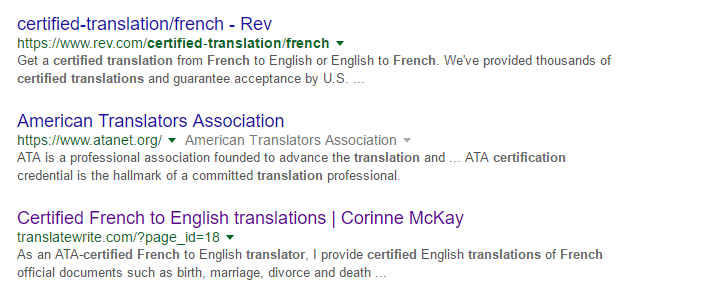
The foundational concept of SEO for freelancers is keywords: meaning that your site needs to include terms that people enter into Google when they need someone like you. As an example, if you Google “certified French translator,” my business website is the third result.
SEO for freelancers: site ranks #3 on Google
Not surprisingly, an average day in the office brings at least one inquiry from someone who found my website and needs a certified translation. I enjoy this kind of work, so I created a web page specifically for it, for SEO purposes. So, step one of SEO is to make sure that your site includes relevant keywords.

Equally importantly, SEO does not mean writing in a contrived, infomercial-esque style. “Keyword stuffing” (repeating your keywords ad nauseum) can actually hurt your search engine rankings, and helpful, relevant content that a lot of other people link to will definitely help. SEO-friendly writing is a specific (and very marketable) skill; just Google “SEO copywriting course” and you’ll enter a whole universe of learning how to write for SEO.

So that’s the content-related part: get your relevant keywords in there, largely by thinking about what your potential clients are Googling. My unscientific dabbling in SEO also makes me think that a series of web pages dedicated to just one service you provide (i.e. patent translation, literary translation, website localization, conference interpreting) will rank higher than a general “Services” page listing everything you do.

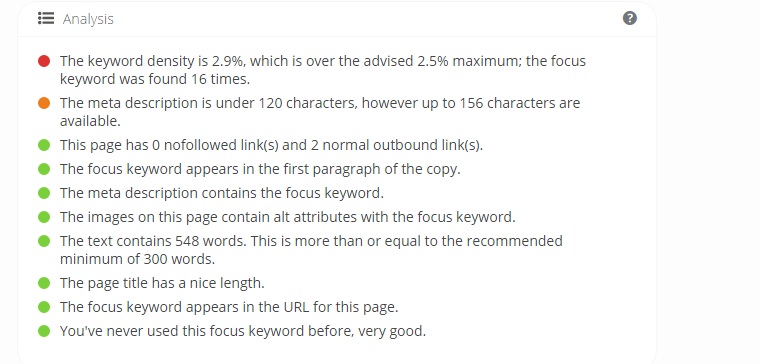
On the technical side, you should do a couple of things. Make sure your site is fast, which is mostly determined by your hosting provider, and make sure it works well across devices, meaning that it looks good and is usable on a regular computer and on mobile devices. Then, at least install a basic SEO plugin so that you have some idea how your pages or posts will rank on Google. I use Yoast SEO (a WordPress plugin) and I’m very happy with it for my purposes. Most helpfully, Yoast gives you real-time feedback while you’re writing. For example, here’s this post’s Yoast SEO analysis as of this very moment:
Yoast SEO screenshot

You don’t want to be enslaved by this analysis; for example Yoast thinks that I’m actually using my focus keyword, “SEO,” *too much* in this post, which could cause Google to classify it as spam. But the real-time analysis can be extremely helpful, for example by prompting you to add some images or links to your post, or to add alt tags (the text that displays if the photo doesn’t load) to the images. Again, if you don’t much care about incoming website traffic, don’t let this keep you up at night. But if you do care, it’s worth paying attention to.

I’m sure that many readers know much more than I do about SEO, so feel free to chime in with your own tips too! One question I am often asked: is it worth hiring an SEO expert to work on your site? Not sure, and I’ve never done it. Thoughts from readers?

Written by Corinne McKay · Categorized: Technology · Tagged: SEO for freelancers, website SEO

Oct 25 2016
Corinne McKay

Tips for ATA57 attendees

With the 57th annual ATA conference coming up next week, I’m excited to report that we expect over 1,800 attendees (this will probably be our second-largest conference ever, after the 50th anniversary conference in NYC), the exhibit hall is sold out, and many of our Advanced Skills and Training Day sessions are sold out as well. If you’re attending ATA57, here are a few resources and tips that might be helpful:

If you are attending your first ATA conference, definitely check out our first-time attendees page. There you’ll find three things you should take advantage of: Jill Sommer’s free webinar on how to make the most of your conference, information about the Buddies Welcome Newbies program, and the ATA Newbies listserve. I also recommend The Savvy Newcomer, ATA’s blog for newcomers to the profession. All of these resources should help you navigate the conference a little more successfully than I did as a newbie in 2004, when I knew so few people, and was so afraid to talk to anyone, that I spent one evening going to the movies alone. Don’t do that…get in there and make the most of your investment in attending the conference.

Also, remember this: the “for newbies” events don’t just save you from ending up in the wrong room at the wrong time at the conference. They allow you to connect with other first-timers, who may be great contacts for you. One question I get from tons of freelancers is, “How do I find a translation partner/editor/someone I really click with to share projects/someone who works in my specializations but in another language/someone who works in my language, but in different specializations?” Attending the newbies events at the conference can be a great way to do that.

Greek translator Catherine Christaki wrote a great blog post on learning from your mistakes to make each conference better. This post is from 2011, but it’s still a must-read for those attending the conference. Catherine is admirably honest about her newbie mistakes (bringing printed copies of her six-page resume, not following up with people she met at the conference), and offers some great suggestions for how to learn from your own mistakes as well.

To round things out, here’s an excellent post from The Muse, on how to make the most of professional conference in general. They offer some common sense but often-overlooked advice, like putting away your phone and actually talking to people, connecting with speakers on Twitter after the conference, and “paying it forward,” by sharing the knowledge you gained at the conference.

A few closing tips from me, based on 12 ATA conferences:

  • Bring plenty of business cards and don’t be afraid to hand them out. If you are actively looking for agency clients, make sure to attend the Job Fair on Thursday evening, bring paper resumes, and have a complete profile in the ATA57 app.
  • Do not work during the conference. You’re making a big investment of time and money to be there, and a lot of what you’re investing in is connections. If you just want information, there are lots of webinars you can take advantage of. You’re coming to an in-person conference to take advantage of the fact that it’s in person, so be there in person.
  • Please, please, please do your session evaluations in the ATA57 app. Even if you use the app *only* for that purpose, please use it for session evaluations. When you use the paper evaluation forms, an ATA staffer or temp has to enter every single one (including deciphering your handwriting…) into the evaluation database. It’s slow, and expensive, and there’s the potential for human error or indecipherable handwriting. The app avoids all of that, and your ratings are instantly populated into the database.
  • Remember that this year the sessions are not being recorded. Do not go to Alcatraz and plan on listening to the recording later. Be there! If you’re interested in multiple sessions during one time slot, pair up with someone, take notes and exchange them afterward.
  • Along the lines of “be there,” be mindful of your phone and social media habits while you’re at the conference. First, you’re making a big investment in being there, so be there. Second, respect the presenters’ intellectual property. Never photograph slides or record the presentation without the speaker’s permission; it’s fine to ask whether the speaker can make the slides available afterward (I’m planning to post mine on my blog), but some speakers will not, and that’s their prerogative. Then take really good notes.
  • Even big-name speakers really appreciate knowing that you loved their presentation. You may think, “they’ve heard it a million times,” but it still means a lot when someone takes the time to write an e-mail saying something specific about a presentation. I make a point of e-mailing at least three or four speakers whose presentations I particularly liked.
  • Lastly: shoes. You cannot network effectively with blisters. Bring at least two pairs of good shoes that allow you to be on your feet all day. I’m a big fan of Lifestride and Crocs (their dress shoes, not the rubber clogs for a conference…) because they’re cute, comfortable, and vegan, but whatever your shoe preference, just don’t risk limping around San Francisco in pain.

And with that, on to ATA57, and I’ll see you there!

Written by Corinne McKay · Categorized: Professional associations, Professional development · Tagged: ATA conference, ATA57, translation conferences

Oct 21 2016
Corinne McKay

Can you give us a quote and a turnaround time?

“Can you give us a quote and a turnaround time?” As freelancers, we hear or read those words a lot: a client, or prospective client, has a document that they need translated, and they want to know about how long it’s going to take, and about how much it’s going to cost. So, when you’re on the receiving end of that request, what’s the best way to proceed? Let’s look at a few options.

You could pick up the phone. If you have a confident but non-pushy phone manner, a phone call makes an immediate personal connection. “Just wanted to touch base about your document and ask you a few questions that will help me get a better sense of what you’re looking for. What’s the purpose of the translation? What’s the deadline?” On the plus side, you’re making the effort to make this personal connection, and you’re getting a better sense of what the client is actually looking for (which may be different from what they think or say that they’re looking for). On the minus side, the potential client might view the call as mildly invasive (if they’re thinking “just tell me how long it’s going to take and how much it’s going to cost”). You also need to make sure that you don’t sound awkward or overly salesy on the phone.

You could give them a brief and direct answer. It’s going to cost X, and it’s going to take X business days from your go-ahead. On the plus side, this is easy for the client to digest and respects the client’s time. On the minus side, there is no engagement here: the interaction is purely transactional (price and speed), and in a sense, encourages the client to select a translator based simply on those transactional factors. As an aside, *never* give a hard deadline (“next Tuesday”), because you don’t know when the client is going to respond. Always frame it as “X days from your go-ahead.”

You could give them a less brief, but still direct answer. In my unscientific tests, I think that most clients respond better to multiple pricing options, even if the “options” are a bit of a stretch. For example if a client asks for a quote for a 10,000 word document, I’ll often say, “My normally turnaround time for 10,000 words is five business days, and the cost would be X. However I could potentially translate this in four business days, for which the cost would be X. And if you’re not on a tight deadline and you have eight business days, the cost would be X.” I think that simply seeing multiple options makes the client feel that you’re flexible (even if the prices are not wildly different), and avoids a “take it or leave it” feeling.

You could give a ballpark answer. It’s generally accepted in the negotiating world that the first person to say an actual number (“it’s going to cost…”) is at a disadvantage. Because if you quote less than what the client was willing to pay, you’ve left money on the table. This is tricky: while it’s certainly possible to ask the client, “What’s your budget?” or “If you work with translators now, what are you paying them?,” it’s generally the service-provider who is expected to say a number first. I like the “what’s your budget” approach in theory, but I’d be very turned off if I wanted to hire a new accountant, asked about her/his rates, and was then asked, “What were you planning on paying to get your taxes done?” It’s a little odd.

Leave a little wiggle room if you want to. When I give a quote to a new client who looks promising (meaning that I’m very interested in their work), I always include phrasing such as, “If this is outside your budget, just let me know and we can talk further.” I’m not saying, “If this is too expensive, just say the word and I’ll charge less.” I’m just saying that we can talk about it. Maybe I can negotiate a longer deadline; or maybe I can ask about their budget and suggest what I could do for that amount of money. You’re not required to leave wiggle room, but it’s an option.

Readers, any other thoughts on requests for quotes?

Written by Corinne McKay · Categorized: Clients, Money, Rates · Tagged: quotes, quoting a translation project, translation quotes

Oct 13 2016
Corinne McKay

LinkedIn connections: what’s your strategy?

One of my goals for this quarter is to make better use of LinkedIn; I feel like it’s an underutilized tool for freelancers, and I want to explore its usefulness for my own purposes and for some students who’ve asked me about it. But here’s a fundamental question about your LinkedIn presence: how do you decide whose connection requests to accept or ignore?

Back in the day (let’s say before 2014 or so), my rule for LinkedIn connection requests was fairly rigid and fairly straightforward: if I don’t know you, and you don’t write a personal message saying how you know me, I don’t accept your request. My feeling was that there was little value in being connected to complete strangers on LinkedIn. Then, things changed in a few ways. Most problematically, LinkedIn now makes it harder to send a personal message (in place of the standard “I’d like to add you to my professional network on LinkedIn”), even if you want to. For example if you simply click on a connection that LinkedIn suggests, your connection request is automatically sent; you have to first click through to the person’s profile if you want to send a personal message along with your request.

As a result, I’ve relaxed my strategy over the years. I now accept most requests from people who already have a number of shared connections with me, and who work in the T&I industry in some capacity. On the positive side, I actually enjoy the status updates feature of the LinkedIn home page (where you can see what your connections have recently posted), and the updates are a lot more interesting when you have a lot of connections. The downside is that I’ve now amassed over 1,500 LinkedIn connections, many (or even most) of them to people who I know nothing about, except that they seem to be translators or interpreters and sent me a connection request. This gets problematic when I get an introduction request from someone else (“Can you refer me to this person?”), or a request for information about one of my connections (“What’s this person like to work with?”).

So, I feel like I’m in a bit of LinkedIn limbo: I don’t see the appeal of the LION (LinkedIn open networker) strategy, but I also feel that the days of restricting one’s LinkedIn network only to people with whom one has a personal connection are probably over. Any other thoughts on the pluses and minuses of this?

Written by Corinne McKay · Categorized: Social networking, Technology · Tagged: LinkedIn, LinkedIn connection strategy

  • « Go to Previous Page
  • Page 1
  • Interim pages omitted …
  • Page 105
  • Page 106
  • Page 107
  • Page 108
  • Page 109
  • Interim pages omitted …
  • Page 245
  • Go to Next Page »

Primary Sidebar

Subscribe to the Training for Translators mailing list!

Getting Started as a Freelance Interpreter: Available now in print and electronic editions

Learn from our blog:

  • Survey results: The state of freelance translation in 2026
  • Focus on the clients who can afford you
  • Upcoming direct client marketing class
  • Travel: Cycling Quebec’s Tomifobia Nature Trail
  • Travel: Cycling Burlington, Vermont’s Causeway Bike Trail
  • When part of your business falls off a cliff
  • Upcoming free webinar: Honest brand communications through purpose, positioning, and personality
  • Training for Translators Plus is here!

Search the Training for Translators blog

Copyright © 2026 · Training For Translators · Log in

This website uses cookies to improve your experience. We'll assume you're OK with this, but you can opt-out if you wish. To view this website's privacy policy, click About>Privacy Policy. Accept Read More
Privacy & Cookies Policy

Privacy Overview

This website uses cookies to improve your experience while you navigate through the website. Out of these, the cookies that are categorized as necessary are stored on your browser as they are essential for the working of basic functionalities of the website. We also use third-party cookies that help us analyze and understand how you use this website. These cookies will be stored in your browser only with your consent. You also have the option to opt-out of these cookies. But opting out of some of these cookies may affect your browsing experience.
Necessary
Always Enabled
Necessary cookies are absolutely essential for the website to function properly. This category only includes cookies that ensures basic functionalities and security features of the website. These cookies do not store any personal information.
Non-necessary
Any cookies that may not be particularly necessary for the website to function and is used specifically to collect user personal data via analytics, ads, other embedded contents are termed as non-necessary cookies. It is mandatory to procure user consent prior to running these cookies on your website.
SAVE & ACCEPT