• Skip to main content
  • Skip to primary sidebar

Training for Translators

Classes for translators and interpreters

  • Start here
  • Blog
  • Classes
    • Coaching for freelancers
    • Subscription
  • Books
    • Translate my books
    • Book Shop
  • About/Contact
    • Privacy Policy
  •  
  • Account

Dec 09 2016
Corinne McKay

Work/life balance tip: you need some slow, non-word hobbies

As someone who lives in a “lifestyle town” (a term I only recently learned, connoting a place where people move for the quality of life), I love talking to other people about what they do when they’re not working. Some people work all the time. Some people’s hobbies are pretty standard: movies, eating out. Some people have really esoteric hobbies: Buddhist archery, or food sculpture. Here’s some advice from me: when you work in a fast-paced, deadline-driven, word-centered job, you need some non-work interests that are a) slow, and b) wordless. This will help preserve your sanity and avoid burnout. Both are important if you want to stick with freelancing for the foreseeable future!

Slow hobbies have really exploded in popularity, at least in the US. Slow hobbies–knitting, weaving, embroidery, crocheting and so on–are now kind of a hipster thing, instead of a granny thing. I’m an avid knitter, and when I would knit back in college in the 90s, knitting was largely seen as a nursing home pastime. Whereas now when I visit the fancy knitting store in Boulder, I’m sometimes the oldest person in there (at age 45), or the only one without purple highlights in my hair. Knitting has progressed from toilet paper covers to bikinis, and cell phone covers, and even craftivism, a newly-coined term for political activism through crafting. My daughter and I volunteer at our local animal shelter (another slow hobby!) with a woman who runs crafting retreats as a job. Her theory, which I’m inclined to believe, is that as the rest of life gets faster, people want to spend their free time doing something slower. For us translators, I definitely recommend it!

Here’s the thing: in our jobs, one of the main questions we deal with is, “How fast can this be done?” We get that message from clients. We wonder it about learning a new piece of software, or setting up a website. How fast can I finish this? The content management system Squarespace even uses the slogan, “Create your own website in minutes!” There’s lots of “in minutes” out there. By contrast, here’s a sock I just finished knitting. I’d estimate that it took me about 8 or 10 hours:

sock
So, no “minutes” here: 8 or 10 hours of hanging out and knitting. Personally I find that knitting helps me relax and focus. By nature I’m an antsy, impatient person; I talk too fast, I read too fast, and I’m always eager to move on to the next thing. So when I get together with friends and want to just sit and talk (or even on conference calls), I often knit at the same time. Knitting has the added bonus of occupying your hands, so that you physically cannot check your phone or browse a mindless website. Like this (photo from Cris Silva at Colorado Translators Association coffee time!)
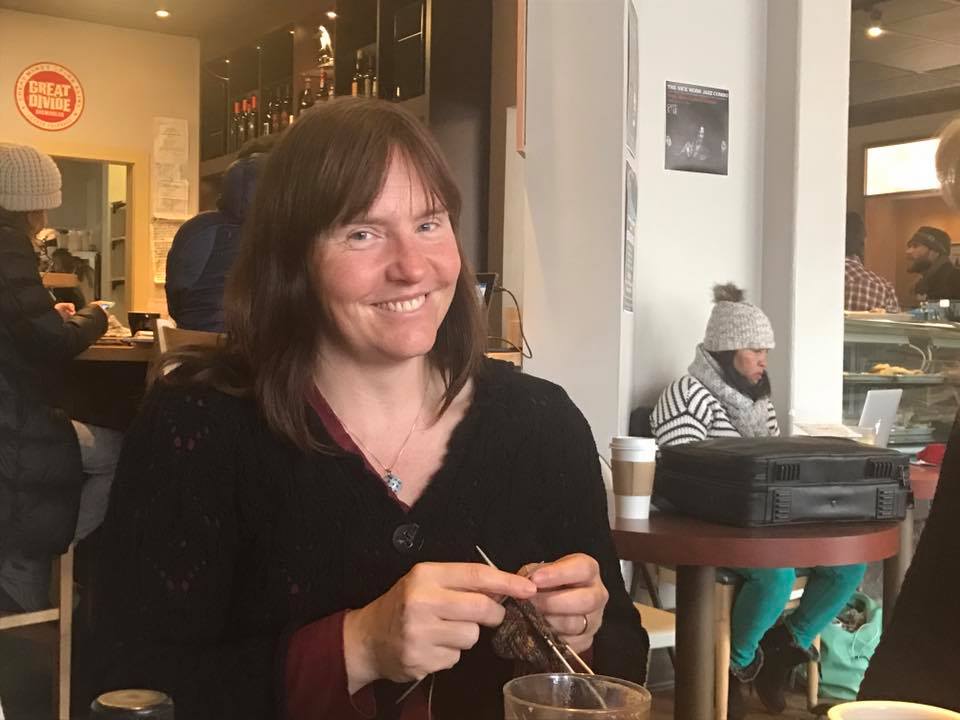
knitting

Playing the lute is an even slower hobby for me. After three years, I’m not the worst lute player you’ve ever heard, but I’ve barely (even with daily practice) progressed beyond what most people would consider the beginner level. On a good day, maybe advanced beginner. But slow progress is there. My rolled chords are starting to sound a little more like rolled chords than like arpeggios (string musicians will get that one!), and I play in a little group that brings me a lot of joy. And to me, the fact that learning to play an instrument is not an “in minutes” process is part of that joy: the joy of creating something that can’t be created in minutes, but rather takes hours/years of dedication to create.

And a word about wordless: at least for me, sometimes at the end of the day I’ve just had it with words. I love my job, but I rarely read an entire book unless we’re on vacation. I read the New Yorker in bed sometimes, but I also think it’s important to give your brain a break from words and use it in a different way. Music, sports, art, crafting, are all great ways to do that.

If you need some added inspiration, here’s a dragonfly pendant that my daughter and I crafted for her bike team Secret Santa. It’s strung on an eye pin, and the ‘wings’ are a link from a broken bike chain, combined with two wood beads for the head and body, and seaglass beads for the tail. Dab some super glue on the chain links so that they remain in flying position!

dragonfly

Written by Corinne McKay · Categorized: Work/life balance · Tagged: slow hobbies, work/life balance

Dec 05 2016
Corinne McKay

Reader asks: “Is this whole freelance thing worth it?”

“Is this whole freelance thing worth it?” It’s a somewhat pessimistic question, but one that I hear with some frequency from readers and students. Corollaries include “I worry about machine translation putting us out of business.” “I’m 57 and only plan on working for another 8-10 years.” “I’m working too hard for the amount of money I’m making.” “I thought I wouldn’t need to market this much.” “Between self-employment tax and paying my own benefits, I have to charge so much more than I thought.”

I’ve been there, grasshopper. When I started freelancing in 2002, I had the “is this worth it” conversation with myself about three times a day. Fourteen years in, here’s my take on some of these concerns.

On the negative side, just to get it out of the way:

  • I don’t lose sleep over machine translation. When computers are writing great books, I’ll worry. In terms of the effect on my business right now, I don’t worry. And for the record, I’m not an MT hater. I use Google Translate myself (when is that museum in Italy open and closed?). But I do think that at some point, we’ll feel MT eating into the lower end of the translation market. And inevitably, that will have some disruptive effect on the rest of the industry. Again, this is not keeping me awake, but I think we’ll feel it at some point.
  • Freelancing is really, really not for everyone. And if it’s not for you, it’s OK. It’s not a defect. You can have a salaried job and still be smart, and driven, and even entrepreneurial.
  • As independent work becomes more of a viable career option, more people are doing it. That causes its own disruptions. When I started freelancing in the early aughts, “I’m a freelancer” was about half a step above “I’m basically unemployed and don’t want to say it.” But in 2016, that’s not the case. Lots more people see freelancing as perhaps more stable than traditional employment. As compared with my early freelance days, I see more competition at the high end of the market, and more of a struggle to make a living at the low end. Personally I think that most “word professions” have followed a similar trajectory. Freelance writers deal with this too: lots more people pitching to the high-end clients, and “are you serious???” rates at the low end.
  • You probably have to earn more than you think. If you want to be a “forever” freelancer, you need a similar level of financial security to someone with a traditional job. That means a few things. It means you’re re-investing in your business (conferences, courses, computer upgrades, memberships). It means you’re saving for retirement. You have a rainy day fund so that you won’t be destitute if you can’t work for a few months. You can take enough time off to recharge and enjoy life. You’re not in perpetual overtime mode to make ends meet. And in order to do that, you’re looking at a pretty big number.
  • Freelancing is a (freaking) lot of work. Let’s say we rank people in most salaried jobs on a scale of 1-10. Some companies will only retain the 9s and 10s, but a lot of companies out there are doing the opposite. They’re only getting rid of the 1s and 2s. They’re promoting the 9s and 10s, and everyone else (3-8) is warming the chair and drawing a salary. In the freelance world, your tail is on the line every single day that you go to work. If you’re not a 9 or a 10, clients may just move on and find someone else. Being the director of marketing, IT person, customer service rep, accountant, bookkeeper, office cleaner, general admin person, AND doing the actual translation work puts a lot on your plate.
  • You will never be able to stop marketing. Unless, I guess, you work for big agencies that will always need you, and you never raise your rates. Otherwise, you always need to replenish the client pipeline. This year I lost a big direct client (literally) overnight, because they hired an employee who took over the translation work. Agencies will go out of business, or shift their own focus. If you cannot make yourself market, freelancing isn’t the right job.

But on the other hand (phew…I was waiting for this point, because I love my job and I want you to love it too!):

  • Pretty much any index you read will rank translation and interpreting as in-demand, fast-growing careers. The US Bureau of Labor Statistics predicts a 29% increase in the demand for translators and interpreters through 2024. If my own teenage daughter wanted to become a translator or interpreter, I would wholeheartedly encourage her. Overall, I feel very positive about our industry and our job prospects.
  • Translation is a just plain awesome job if you love languages, writing, and learning new things. Translation has made me realize that I could never do a boring job. I can do a hard job, or a stressful job, or a job that requires ongoing professional development. But to me, boredom at work is death. Translation is a good job if you share that sentiment.
  • Your income potential may be higher than at a salaried job. For example, there are few to no in-house jobs for French to English translators here in Colorado. And I have just about zero desire to move to a major city. But by freelancing, I can run a thriving business from basically anywhere. When people comment that, “it must be hard to make ends meet when you’re self-employed,” I actually see the complete opposite side of that coin.
  • The freelance quality of life is an enormous factor. Don’t ignore it. This depends on your situation. Some people don’t mind, and even enjoy, the 9-5 culture. But I’ll use my own example: what would it take for me to accept an in-house job? Well, it would have to replace my freelance income (perhaps not in terms of cash, but including benefits and other compensation). It would have to let me leave work in time to be home when my kid gets home, so that I can take her to her after-school activities. I’ll make up the hours at other times, but I need a break at 3:00. It would have to let me reshuffle work when other members of my family (husband, parents) need me. It would have to give me 6 weeks of complete vacation (no paying work), plus another 2-3 weeks of “paid vacation,” when I’m working part-time from another location. And realistically, those factors are very, very unlikely to happen. At least not without a significant hit to my career advancement potential. So for those reasons alone, freelancing is very, very worth it for me.

    I’ll also say: the classic work/life balance example is kids. People who want to be home with their kids, or be home when their kids get home, etc. But as my own daughter gets older, I can see that the work/life factor doesn’t end there. For example now that I have a shred of free time, I’ve gotten into playing the lute. Then I found two (very patient) retired women who were willing to incorporate me into a little music group. We play together one morning a week, which I could never do with a salaried job. So, I also think it’s time to broaden the work/life focus beyond kids, and into “having a life outside work.”

Readers, thoughts on this? Advice on how to assess the “is it worth it?” factor for newbies?

Written by Corinne McKay · Categorized: Freelancing, Getting started as a translator · Tagged: Freelancing, starting as a freelance translator

Dec 01 2016
Corinne McKay

This blog, by the numbers

Here’s a short post inspired by a question from a reader, who asked, “You seem open to ‘ask me anything’ types of questions, and I wonder if you could give us some statistics about your blog. How much traffic does it get? How many people are on your e-mail list? Do you make any money directly from the blog? How many posts have you written, and are you thinking about doing anything different with it in the future?” As this reader observed, I’m pretty open to AMA questions, so here goes, for those who are thinking of starting a blog, or who like to geek out on these things.

I published Thoughts on Translation’s first post on February 2, 2008 (that’s officially 100 years ago in Internet time). The first post was called how to succeed as a freelance translator, and two people commented on it: my friend and blogging mentor Beth Hayden, (who taught me how to start the blog in the first place), and my friend and colleague Judy Jenner. The blog now includes 702 posts, and 6,482 comments.  So, back of the envelope, that’s about two posts per week, and about 10 comments on each post. It won the 2016 ProZ.com community choice award for the best blog about translation.

Traffic: about 20,000-25,000 views a month. On a day when I post something new (usually Mondays), traffic goes up to about 1,200 or 1,300 views, and if I haven’t posted for a while, it goes down to 600 or 700, but in general it’s about 1,000 views a day.

Subscriptions: 3,169 people subscribe to the blog directly, and I have 2,485 people on my e-mail list.

Monetization: I don’t make any money from the blog itself. I’m not a huge fan of affiliate deals in general (“my unbiased opinion” and “I got something for free in exchange for this opinion” don’t really jive in my mind), and I find ads distracting on an informational-content site. However, this blog is the primary way that I market my online classes for translators. I started them out of a feeling that if I struggled with the business aspects of being a translator, other people probably did too, and the classes really took off. After over 10 years of teaching it, every session of Getting Started as a Freelance translator still fills up, and my classes for experienced translators have done well too and are a lot of fun to teach. In reality they’re limited only by the time I have to put into creating them. So that’s a big monetization factor that has grown to about 50% of my income. There is definitely a cost to running a good blog; I pay about $25 a month for robust hosting, and I paid a bit over $2,000 for the recent redesign to update the look of the site and add an automated course registration system.

Plans for the future: Mainly I just want to keep doing what I’m doing, but I’m also planning on adding a podcast version of some posts (just me reading the post, not an interview format), and I’ll probably add sponsors to that. I guess I have semi-conflicted feelings about monetization: I find website ads kind of tacky, but I’m OK with podcast sponsorships. Call me weird.

Is a blog worth it: Absolutely! Definitely not! It depends on your perspective. For me, absolutely, because about half of my income comes from writing, teaching, and consulting for other translators. But lots of translators are disappointed when they start blogging and don’t get any translation clients from it; this seems obvious if you’re writing a blog that only other translators would be interested in reading, but it happens a lot. Blog for your clients, whoever they are. If you want to get work from international marketing companies, then blog for them, not for other translators.

So, there you have it. Any other questions, just leave them in the comments and I’ll answer if I can!

Written by Corinne McKay · Categorized: Blogging

Nov 29 2016
Corinne McKay

Why don’t more translation agencies…

I wonder a couple of things about translation agencies. And when I say “I wonder…,” I mean that honestly. Not as in “most agencies do it this way, and that’s clearly the wrong way.” As in “I honestly wonder.” Here we go:

Why don’t more agencies have in-house translators?

The knee jerk answer to this is cost and flexibility. When agencies use freelancers, they pay only for the services they need, when they need them. No benefits, no office overhead, no providing computers and software, no caffeine-addicted translators draining the coffee pot all day, and so on.

But here’s the other side of the coin: I’m guessing that most mid-sized agencies, and certainly all large agencies, have enough work to keep at least a few in-house translators busy full-time in their most commonly requested languages. And then, the agency has a few advantages:

  • Those translators can work for the same clients all the time, which the agency can’t guarantee when it uses freelancers.
  • Those translators are on salary, so the agency can charge a markup for rush projects without paying more to have them translated.
  • Confidential projects are never sent outside the office.
  • It’s easier to monitor the quality of a translator’s work when they’re right there in your office.
  • A small team of translators would get used to working together, which would probably raise the quality of their translations.
  • The agency could cut its administrative overhead significantly. Instead of having to find an available freelancer, negotiate a rate and deadline, deal with snafus like the project being late or the translator having a computer crash, the project could just be assigned to one of the in-house translators with no back and forth.

Why don’t more agencies specialize?

One of the first pieces of advice given to any beginning freelancer is: specialize. Become the expert. Don’t try to be all things to all clients. Yet, the vast majority of agencies do not specialize *at all*, and even use “translating all subjects, all languages” as one of their selling points. Just Google that and you’ll see what I mean.

There are exceptions: I work with a couple of agencies that only do one subject area, and I can think of a handful of agencies that only do one language. But again, that’s the exception. It seems to me that by specializing, agencies could reap many of the benefits that specialized freelancers do:

  • Become the go-to agency for their language or specialization.
  • Fish in a smaller pond when it comes to marketing.
  • Get to know one subject area really well, thus producing better translations.
  • Know who to market to, rather than anyone on Earth who needs a translation.

Agency owners? People with insights into this? Any thoughts here?

Written by Corinne McKay · Categorized: Clients · Tagged: translation agencies

Nov 28 2016
Corinne McKay

January coaching group: three spots left

In response to requests from a few former students, I’m going to be offering a one-month intensive coaching and accountability group in January. The group is limited to 10 people and three spots are still open.

This group ($530/$515 for ATA members) is for freelancers who want one-on-one mentoring (everyone will get two one-hour phone sessions with me), plus the structure of a group for accountability. You’ll pick a business goal–find one new direct client, find better agency clients, start a client-facing blog, etc. Then you’ll pick daily steps that you’re going to take toward that goal, and you’ll have to log in every single weekday and report on what you did. We’ll also do eight live question and answer sessions for the whole group, and I’ll send you a daily e-mail with marketing tips. Various students had asked about this option over the years (“I know what I need to do, I just have to sit down and force myself to do it”), so I think this group will be a good start to 2017 if you have some new goals in mind.

Here’s the full description and registration form if you’d like to join us!

Written by Corinne McKay · Categorized: Announcements, Classes for translators · Tagged: classes for translators, online classes for translators

  • « Go to Previous Page
  • Page 1
  • Interim pages omitted …
  • Page 103
  • Page 104
  • Page 105
  • Page 106
  • Page 107
  • Interim pages omitted …
  • Page 245
  • Go to Next Page »

Primary Sidebar

Subscribe to the Training for Translators mailing list!

Getting Started as a Freelance Interpreter: Available now in print and electronic editions

Learn from our blog:

  • Survey results: The state of freelance translation in 2026
  • Focus on the clients who can afford you
  • Upcoming direct client marketing class
  • Travel: Cycling Quebec’s Tomifobia Nature Trail
  • Travel: Cycling Burlington, Vermont’s Causeway Bike Trail
  • When part of your business falls off a cliff
  • Upcoming free webinar: Honest brand communications through purpose, positioning, and personality
  • Training for Translators Plus is here!

Search the Training for Translators blog

Copyright © 2026 · Training For Translators · Log in

This website uses cookies to improve your experience. We'll assume you're OK with this, but you can opt-out if you wish. To view this website's privacy policy, click About>Privacy Policy. Accept Read More
Privacy & Cookies Policy

Privacy Overview

This website uses cookies to improve your experience while you navigate through the website. Out of these, the cookies that are categorized as necessary are stored on your browser as they are essential for the working of basic functionalities of the website. We also use third-party cookies that help us analyze and understand how you use this website. These cookies will be stored in your browser only with your consent. You also have the option to opt-out of these cookies. But opting out of some of these cookies may affect your browsing experience.
Necessary
Always Enabled
Necessary cookies are absolutely essential for the website to function properly. This category only includes cookies that ensures basic functionalities and security features of the website. These cookies do not store any personal information.
Non-necessary
Any cookies that may not be particularly necessary for the website to function and is used specifically to collect user personal data via analytics, ads, other embedded contents are termed as non-necessary cookies. It is mandatory to procure user consent prior to running these cookies on your website.
SAVE & ACCEPT