• Skip to main content
  • Skip to primary sidebar

Training for Translators

Classes for translators and interpreters

  • Start here
  • Blog
  • Classes
    • Coaching for freelancers
    • Subscription
  • Books
    • Translate my books
    • Book Shop
  • About/Contact
    • Privacy Policy
  •  
  • Account

Feb 21 2017
Corinne McKay

Handwritten notes: a secret business weapon

Here’s an environmentally-incorrect confession: I love paper. I live in a little house, we have one car, I ride my bike to work, I’m a vegetarian, and we don’t have a clothes dryer. But I’m clinging to paper with all I’ve got: the little house is full of paper magazines and books, I take meeting notes on paper, and I love sending and receiving paper cards in the mail. Let’s look at some ways to use handwritten notes as a secret weapon in your freelance business.

Handwritten notes are appealing for obvious reasons:

  • They stand out amid the flood of e-mail that we all receive.
  • They show that you’re willing to take the time to send something truly personal.
  • Who gets anything interesting in the mail anymore? At my house, it’s 98.7% ads and bills. A personal card makes an impression.
  • They are clearly not generated by a spambot. This is sad, but it’s getting hard to differentiate legitimate fan e-mail (“Hey Corinne! I love your blog!”) from fan e-mail that is automatically generated. Handwritten notes circumvent that problem.
  • You can enclose things like a business card in them.
  • You don’t need the person’s e-mail address to send them.
  • They are a gift that doesn’t cost anything, so doesn’t seem like overkill. When someone does a favor for you, and you want to express appreciation but it might seem odd to offer to pay them, a handwritten card can split the difference.
  • They are another way to ping a client without being annoying. Without sending yet another, “Got any work for me yet???” e-mail.

You can use handwritten notes in various situations.

  • I send every client a handwritten note after they pay me for the first project; I think it gives a more personal tone to the relationship and shows them that I appreciate working with them.
  • In the early years of my freelance business, when I was actively looking for agency clients, I made copious use of handwritten notes. If I received any response from the agency, even, “Don’t need you right now but we’ll keep your information on file,” I sent a card. It said something like, “Thank you so much for responding to my inquiry about French to English translation work with your agency. I really appreciate your time, and hope to collaborate with you soon.” Then I popped a business card in it and sent it. Interestingly enough, those business cards kicked around people’s offices for a while, and I received several inquiries years later, still based on those initial cards.
  • I send cards to colleagues who refer me for substantial jobs.
  • I send cards to people who give presentations or classes that I really enjoy.
  • Lately I’ve been experimenting with cards as an actual marketing technique: sending them to prospective clients. This offers the added bonus that you don’t need the person’s e-mail address, only their name and the company’s mailing address.
  • I would definitely recommend handwritten notes if you’re aggressively trying to build up your agency client base. Agencies get so many unsolicited applications, and many of them are spam. Even if the agency doesn’t respond at all, send a card saying, “I recently applied for English to German translation work via your website. I’m looking forward to the next steps in the application process and hope to collaborate with you soon.” Enclose a business card.

Closing tip:

Give some thought to the actual cards. If you live in a distinctive place, that’s a good start. I have a former student from Alaska who sends out “Northern Lights” cards that are very representative of where she lives. If I’m sending the card to someone I know, I might go for something whimsical, like these zoo animals doing yoga. But don’t send an elephant in crow pose to a potential client, unless perhaps you translate for yoga retreat centers! For most prospective clients, go with a high-quality, conservative card and write with a nice pen.

Readers, any other examples of how you use handwritten cards?

Written by Corinne McKay · Categorized: Marketing · Tagged: freelance marketing, handwritten notes, using handwritten notes

Feb 17 2017
Corinne McKay

The LinkedIn “foot in the door” strategy

This is a guest post by Maryam Abdi. Maryam is a registered Somali court interpreter and the owner of Expert Somali Translations, a boutique firm offering Somali > English translations and cultural consulting services to legal and government sectors. She is the creator of Translators Academy where she blogs about marketing, sales and career strategies for aspiring and new freelance translators. Maryam holds a Bachelor’s degree in political science from the University of California, San Diego. She is a recipient of the State Bar of California’s Wiley M. Manuel Award for Pro Bono Legal Services, for her volunteer work as an interpreter and translator for victims of human rights abuses. 

If you’re a freelance translator looking for new clients, the days of bidding on translation job portals and arbitrarily cold-calling translation agencies are over. It’s not a numbers game anymore. Clients these days expect you to spend the time to learn about them before getting in contact. And what’s the best way to do that? The answer is LinkedIn. LinkedIn is nothing short of a goldmine for freelance translators. It’s an incredible tool to learn about prospects, grow your network and find high-quality and well-paying clients. When used correctly, it can create endless work opportunities.

In this blog post, we’re going to dig deep and explore how freelance translators can:

  • Authentically connect with other translators working with their ideal clients
  • Expand their network to get access to translation projects that never get advertised
  • Use the Foot in the Door Strategy to leverage their network and get introductions to “pre-sold” potential clients.

By harnessing the power of LinkedIn, you’ll be well on your way to setting up a well-organized translation sales system that you can maintain in as little as five hours a week.

The step-by-step method to building your high-end LinkedIn network from scratch

Is there a particular translation agency or company you want to work with? But you’re unsure how to go about it? The most effective way to getting in the potential client’s inner circle is to use the Foot in the Door Strategy. It’s a simple, three-step process that you can implement right away on LinkedIn. This is a highly methodical approach that deconstructs the often-confusing prospecting process. It begins with finding other translators who are already working with your ideal clients and translation agencies.

maryam1

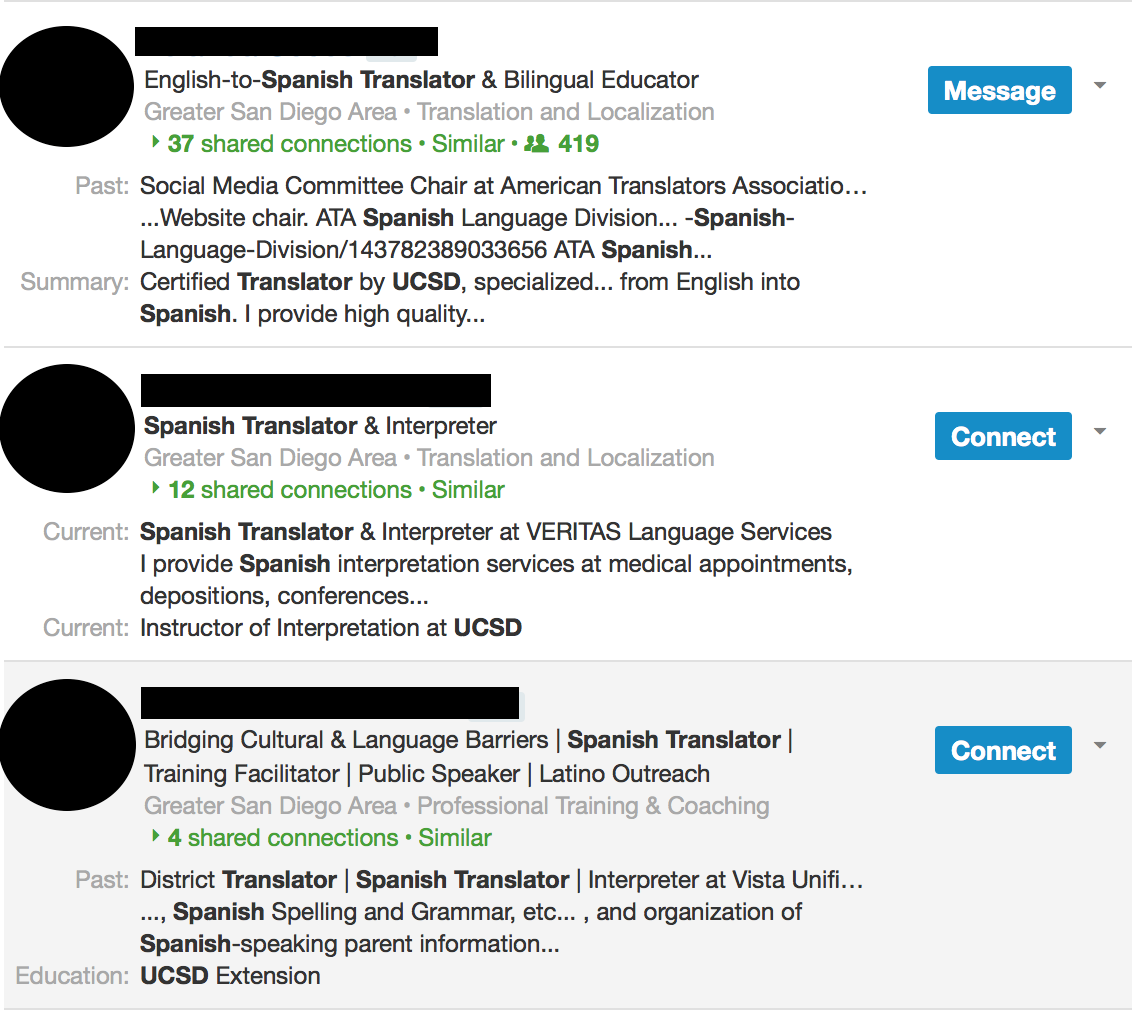
The LinkedIn Advanced People Search tool helps you find the right translators to contact. You can search for translators by their language pairs, specialization and the companies they work with. Here’s the step-by-step process to filling out each field of the Advanced People Search tool:

  • Start with the keywords field and type in the specialization of the translators you want to connect with. If you’re interested in flexible translation positions, this is a great place to enter the keyword “freelance”.
  • To find translators working in similar language pairs as you, enter the preferred languages in the title field. For example, if you’re searching for French <-> English translators you could insert, “French English translator.”
  • Next, enter the name of the agency or potential direct client in the company field. For many translators who don’t populate this field, their search results become limited.
  • In the Advanced People Search tool, you can also filter the results by relationship. A “1st connection” is someone that is already in your network. Assuming you want to find a translator outside of your network, click on the remaining options (2nd connections, Group members and 3rd connections + Everyone else).
  • The next step is to narrow your search by location. Enter your city to find local translators working with your ideal clients.

Once you complete the form, click on the search button to get a list of translators with the information you specified. You can experiment with the Advanced People Search tool to find the specific person you want to contact.


maryam2

After you review the search results, the next step is the “research phase” where you’ll collect information on the translators working with the translation agencies and companies on your prospecting list. Before you contact them, do your homework so you don’t come off impersonal in your approach. Once you’ve found the translators that have a relationship with your ideal clients and you review their profile, now it’s time to find a way to connect with them on LinkedIn.The easiest way to connect with freelance translators working for your ideal clients and agencies is to find a connecting factor. Before you can send them a message you have to demonstrate how you know them. For example, you can connect with a translator who went to the same university or translation programs as you. You could also search by translation association membership or perhaps comb through their profile to see if they have listed their personal email. Either way, you need this information to not only “warm up” your message but to add them to your personal network on LinkedIn. It’s best to reach out to translators who have the same specialization as you or work in complementary language pairs. For example, if you’re a Spanish > English translator find an English > Spanish translator.

Now that I’ve showed you how to find the translators working with your ideal clients, it’s time to authentically contact them with a personalized invitation to connect on LinkedIn. If you’re wondering what to say, you can use the tested word-for-word script below to connect with translators the right way. By using this script you can shave off weeks if not months on your search for new clients.

The word-for-word script to help you find new clients faster

Finding new clients is a lot easier once you leverage the network of your existing clients and colleagues and it all begins with the Foot-in-the-Door Strategy. Here’s a sample message you can use to invite a freelance translator to connect on LinkedIn. Unlike a generic message, this one is personalized and has a high response rate.

maryam_email

Don’t worry about sending this type of message and being met with deaf ears. It’s different from the typical cold emails sent by most freelance translators because:

  • The focus is shifted from you to them and it doesn’t come off as self-serving
  • You’re asking freelance translators to share their story instead of asking for a handout
  • You’re showing you’ve invested some time in getting to know them

This is a much easier way to find new clients without going to random networking events, cold-calling or running expensive advertisements in trade journals.

Building a relationship and requesting an introduction

Once your connection request on LinkedIn is accepted, it’s time to ask for the translator’s insight on the company you’re interested in. You can conduct your informational interview over email, by phone, or even in person if the fellow translator is in the same city as you. During your interview, ask open-ended questions about their experience working with the translation agency or company, the type of projects they work on, and their likes and dislikes about the client you’d like to work with. It’s very important to vet companies and agencies to make sure they’re a good fit for you and your translation services. When it comes to clients, quality is better than quantity. Naturally, the conversation will bounce back to you. In most cases, the translator will ask about your experience. Use this as an opportunity to express your interest in working with the agency or company and ask for an introduction.

However, it doesn’t end there. The point is to make it as simple as possible to get a warm introduction. Just like you, they’re very busy professionals and crafting an email to refer you will be one more thing on their to do list. Make sure to do the “heavy lifting” for them and offer to write the introduction message for them.

Lather, rinse, repeat

It’s often said your network is your net worth and I couldn’t agree more. Freelancing is a business built on relationships. Having the right network of translators will give you access to the well-paying translation projects that never get advertised. If you want to stay top-of-mind when the opportunity arises, stay in touch with translators in your network. Make sure to follow up with the translator after your talk or meeting. Send them a message genuinely thanking them for their time. If they gave you suggestions, tell them you’ll apply the strategies and keep them in the loop with your results. Remember, you also want to nurture your network. You have to give in order to receive and that involves referring your colleagues and presenting them with opportunities to tap into your clientele as well.

The Foot in the Door Strategy isn’t something you only do when you’re in desperate need of clients. Similar to exercising, it’s something you should do consistently in order to see results. Building a network is not easy, but the potential payoff is huge. With time you’ll be able to build the confidence and credibility to approach fellow translators and colleagues on LinkedIn. Eventually, you’ll get faster, more creative and self-assured the more you use the Foot in the Door Strategy.

Now I want to hear from you. Tell me about your experience using LinkedIn to find new clients by sharing your thoughts in the comments below.

Written by Corinne McKay · Categorized: Guest posts, Marketing, Uncategorized · Tagged: finding clients on LinkedIn, LinkedIn, marketing on LinkedIn, Maryam Abdi

Feb 14 2017
Corinne McKay

Preview: Getting Started as a Freelance Translator

The next session of my online course Getting Started as a Freelance Translator starts March 6, and registration is open now. This class tends to fill up early and is limited to 20 people, so now is a good time to sign up if you’re interested. It’s aimed at beginning translators who want nuts and bolts information about how to launch and run a successful translation business, plus one-on-one feedback on marketing materials, deciding how much to charge, etc.

Throughout the four-week session, you’ll work through four sets of online videos, four homework assignments with individual feedback, and eight live question and answer sessions for the whole group. Here’s a preview of one of the course videos, on creating a basic agency marketing campaign. A recent student called this course “one of the finest resources out there for any translator,” and I’d love to see some of you in this session! Registration is $380/$355 for ATA members.

Written by Corinne McKay · Categorized: Classes for translators · Tagged: getting started as a freelance translator, online classes for translators, online translation classes

Feb 10 2017
Corinne McKay

A lucrative sideline: editing for non-native speakers

This is a guest post by Karen Tkaczyk, a fellow French to English freelance translator. Karen is a specialized scientific translator, and over the years she has also built up expertise in editing English articles written by non-native speakers. Since this is something many of my students and readers ask me about, I asked Karen to tell us more about this. You can follow her on Twitter (@ChemXlator) or Facebook

One Translator’s Sideline: Editing Non-Native English Scientific Writing

“The manuscript is poorly written and has too many grammatical and syntax errors. The results are promising, but the paper needs thorough revision to make it suitable for publication in The Journal of Astounding Scientific Developments.” Enter the native English-speaking editor.

Editing texts written in English for publication by scientists who have another language as their mother tongue is a relatively common sideline for freelance translators. The measure of success is the article being published after we have worked on it. Even better, the author sends subsequent manuscripts before submission to avoid the painful step of criticism or rejection. We become a trusted partner.

Editing agencies and scientific publishing houses that offer editing services also feature prominently in this market, but I’ve largely stuck to the more lucrative private clients. Another source of much work is graduate students who need editors for long theses but really can’t afford them. I suspect that could be a great stepping stone into this niche, if you want experience, but that it wouldn’t pay the bills.

So in my experience, an academic scientist is writing in English, which is not their native language. As well as journal articles, they send grant proposals, résumés, and accompanying documents. All of that is going through multiple drafts in the run-up to submission deadlines.

This work is a natural fit for me because I have training in a hard science and translate scientific texts as the bulk of my practice. I work mainly with chemistry and texts related to the chemical industry. I have received non-native editing work on and off throughout the 12 years I’ve been a freelance translator. The work has come to me from my ProZ.com profile , from professors I’ve met at chemistry networking events, and from word-of-mouth from translation colleagues who live in France and give my name to academics there. In 2016 non-native editing made up a little over 10% of my billable income. I have never actively marketed myself for this work – it really is something that has just come my way.

What sets this work apart from bilingual editing or from editing texts written by native speakers?

Obviously there are some parallels with other editing work, such as correcting typos and inconsistencies, but it diverges due to stronger source language interference. For instance, these texts may include homonym errors. On the other hand, you can nearly always assume that the technical terminology will be flawless. You might have to adjust hyphenation but you are unlikely to be spending any time researching technical concepts. Another factor is that you might not be familiar with the author’s native language, so you might not read between the lines the way you can when you know the “other” language.

One other thing that sets this apart from translation work is that you’re pretty consistently interacting with the authors. Of course that may be the case in normal translation or editing work but I find that even with my direct clients I am usually working with a contact in the same company rather than the author directly. Here the academic is asking me to quote, sending the files, sending me updated files because they added a paragraph, asking what I think of the article, resending it at 3 a.m, and then submitting it to the journal.

Pricing

The typical market pricing method is per hour, by volume, often assuming 1,000 words per hour. I’ve seen agencies offer per word rates too. Having gained experience and developed an efficient process, I work quickly, so a per hour rate penalizes me. I prefer to quote a flat fee now, and customers never quibble. They don’t need to know how long we spent on it. They need to value what we achieve. When you quote, do remember to include time for back and forth and redrafts, especially until you get to know your customer.

To estimate how long the job will take, we have to agree on degrees of editing. These categories work for me:

• Copy editing (formatting, grammar, punctuation)
• Language editing (style, semantics)
• Substantive editing (flow/content improvements)
• Developmental edits and ghost writing

I always do the first two of these, and have never done the fourth. I make substantive edits for some of my customers.

The occasional need to justify changes, AKA buttering up the client

You have to be willing to invest in relationships to do this sort of work successfully. Once you know your customer, normal amounts of tact work, but at the beginning, I find being gentle and complimentary useful. Massage these authors’ egos a little. Diplomacy is especially useful if you are ripping apart their logic or filling the margins chock-full with edits. So I might sandwich the edits with a few compliments where I can come up with them.

• “I particularly enjoyed the conclusion. I thought it summarized your results very well.”
• “What exciting results. I hope you agree that the abstract conveys your main point more effectively now.”

Sometimes people will love you and graciously take your advice. But you also need to be prepared for the occasional defensive response. So you need to know your stuff, and have ammunition for justifying changes. For me that’s as simple as referring to my preferred style guide and a few straightforward references about scientific writing usage, when I am challenged. Another typical response is insisting that you revert an edited term to use something that reads as non-native, or a calque of some sort (Often “Eurospeak” jargon). I give them my opinion, in writing, so that I can point out that they ignored my advice if the article comes back rejected, and then they decide.

Other value that I can add includes occasional comments for suggested obvious improvements that are not within the scope of the job. Mentioning that “This reference is not listed in the Bibliography” can be a plus.

I enjoy editing as part of my translation practice. It adds variety and helps me think about target-language writing more “purely” than when I translate and might be affected by a source text, so I think it builds up my skills. Once in a while, the authors even credit me in the acknowledgements, so my name makes it into The Journal of Astounding Scientific Developments, or this week’s equivalent: that’s my small reward.

Written by Corinne McKay · Categorized: Editing, Guest posts · Tagged: editing for non-native speakers, freelance editing, Karen Tkaczyk, translation editing

Feb 07 2017
Corinne McKay

Really short marketing e-mails: don’t overthink it

Many freelance translators are overthinkers. Wanting to get it just right turns into lots of obsessing over 37 ways the idea could go wrong, soliciting the opinions of 93 colleagues, burning the project to the ground and starting from scratch, etc. Overthinking gets in the way of lots of things, but most of all it hinders effective marketing. Why? Because one of the keys to effective marketing is simply to market. Many freelancers are failing at marketing. Not (not) because they market in ineffective ways, but because they don’t market at all.

Here’s one way around the overthinking trap. Note that I said “one way.” Not “the best way” or “the only way,” but one way. Write really short marketing e-mails that leave very little room for overthinking. Like this:

“Dear Mr. Lewis, I am a German to English medical translator and recently came across your website while researching medical device companies. Would you be the right person to speak to about offering my translation services?”

“Dear Ms. Thomas, I am an Italian to English medical translator and recently came across your agency’s website. I live in the San Diego area and enjoy working with local agencies. Are you currently recruiting translators in my language and specialization?”

“Dear Ms. Phillips, I am an English to Spanish translator specializing in education. I’m interested in offering my translation services to your textbook company. Would you be the right person to speak to about that?”

These e-mails are not:

  • warm
  • intended to create a connection with the recipient
  • intended to show that you researched the potential client, other than their basic line of business

However, they have a few advantages:

  • They’re short, to the point, and they respect the recipient’s time. When you write a) a long e-mail, to b) someone you don’t know, and you’re c) trying to sell something, the chances of the recipient reading to the end are near zero. This kind of e-mail avoids that problem.
  • They take very little time to write, but they show that you know something about the potential client; they’re much better than a “Dear Sir or Madam” e-mail.
  • They don’t demand an extensive response from the recipient. Again, a “can you please give me your take on my life story” e-mail will almost certainly be deleted by anyone who doesn’t know you. But this type of e-mail invites the recipient to respond in a similarly concise way. “Sure!” “Try contacting the marketing department at…” or “We have someone right now, but I’ll save your contact info” would all be acceptable responses, and all take about 30 seconds to write.

So again, this is not an artisanal approach to marketing. It’s kind of the antithesis of the free sample translation pitch, where you’re investing a lot of time before you even contact the client. But if you just need to do something to avoid overthinking your marketing efforts, you could try this.

Written by Corinne McKay · Categorized: Marketing · Tagged: one-line marketing e-mails, short marketing e-mails

  • « Go to Previous Page
  • Page 1
  • Interim pages omitted …
  • Page 100
  • Page 101
  • Page 102
  • Page 103
  • Page 104
  • Interim pages omitted …
  • Page 245
  • Go to Next Page »

Primary Sidebar

Subscribe to the Training for Translators mailing list!

Getting Started as a Freelance Interpreter: Available now in print and electronic editions

Learn from our blog:

  • Survey results: The state of freelance translation in 2026
  • Focus on the clients who can afford you
  • Upcoming direct client marketing class
  • Travel: Cycling Quebec’s Tomifobia Nature Trail
  • Travel: Cycling Burlington, Vermont’s Causeway Bike Trail
  • When part of your business falls off a cliff
  • Upcoming free webinar: Honest brand communications through purpose, positioning, and personality
  • Training for Translators Plus is here!

Search the Training for Translators blog

Copyright © 2026 · Training For Translators · Log in

This website uses cookies to improve your experience. We'll assume you're OK with this, but you can opt-out if you wish. To view this website's privacy policy, click About>Privacy Policy. Accept Read More
Privacy & Cookies Policy

Privacy Overview

This website uses cookies to improve your experience while you navigate through the website. Out of these, the cookies that are categorized as necessary are stored on your browser as they are essential for the working of basic functionalities of the website. We also use third-party cookies that help us analyze and understand how you use this website. These cookies will be stored in your browser only with your consent. You also have the option to opt-out of these cookies. But opting out of some of these cookies may affect your browsing experience.
Necessary
Always Enabled
Necessary cookies are absolutely essential for the website to function properly. This category only includes cookies that ensures basic functionalities and security features of the website. These cookies do not store any personal information.
Non-necessary
Any cookies that may not be particularly necessary for the website to function and is used specifically to collect user personal data via analytics, ads, other embedded contents are termed as non-necessary cookies. It is mandatory to procure user consent prior to running these cookies on your website.
SAVE & ACCEPT