• Skip to main content
  • Skip to primary sidebar

Training for Translators

Classes for translators and interpreters

  • Start here
  • Blog
  • Classes
    • Coaching for freelancers
    • Subscription
  • Books
    • Translate my books
    • Book Shop
  • About/Contact
    • Privacy Policy
  •  
  • Account

Dec 20 2017
Corinne McKay

Winter class discounts end December 31

I’m offering four online courses for translators this winter, and discounted registration rates for them end on December 31. After that, registration for my full-length courses increases from $380 to $410, so it’s a good time to sign up and put the expense on your 2017 accounting! ATA members can use coupon code ATA for $15 off these prices, and past students can use coupon code ALUM for $15 off as well (those can be combined: just apply both of them).

A student in my Marketing to Direct Clients class recently left this comment on the end-of-course survey:

“If you are a translator looking to take your business to the next level, I cannot recommend Corinne’s courses more highly! I was impressed by how generously Corinne shared her knowledge and expertise with her students and I truly appreciated her positive and down-to-earth approach. The pace of both courses was just right, and the assignments were relevant and interesting. Corinne’s individual feedback on my homework was priceless! I also appreciated being able to ask her anything and everything during the class calls.”

Here’s the lineup for January-April, and note that the quick-start session of Getting Started is open only through December 31.

Special: quick-start session of Getting Started as a Freelance Translator, my flagship course for beginners. For beginning and aspiring translators who want to learn the basics in a quick-start format. Includes self-paced video lessons and a one-hour individual consulting session with me. $195 ($180 for ATA members), registration open through December 31, 2017.

Breaking Into the Book Translation Market, for translators who want to translate fiction or non-fiction books, for traditional publishers or for self-published authors. Next session begins January 15, 2018. $380 ($365 for ATA members) through December 31, 2017; $410/$395 after that. Note that this session is already filling up; sign up soon if you want to participate.

Beyond the Basics of Freelancing, for mid-career freelance translators who want to enjoy their work more, earn more money, and avoid career stagnation. Next session begins February 19, 2018. $380 ($365 for ATA members) through December 31, 2017; $410/$395 after that.

Marketing to Direct Clients, for translators who want to identify, contact, and work with direct clients. Next session begins April 2, 2018. $380 ($365 for ATA members) through December 31, 2017; $410/$395 after that.

Thank you for another year of great discussions about the language professions (believe it or not, Thoughts on Translation will turn ten in February!), and I wish all of you a wonderful 2018.

Written by Corinne McKay · Categorized: Classes for translators · Tagged: classes for translators, online courses for translators, online translation courses, translation classes

Dec 14 2017
Corinne McKay

Survey: online translation technique classes

Based upon requests from readers and students, I’m in the early stages of developing some language-specific translation technique classes (i.e. “Become a better translator: German to English”) to be offered in 2018. If you are interested in this type of course, please take a short survey that I’ve prepared. This will help me assess the demand for these types of classes, and understand what people would like to get out of them. The survey is just five multiple choice questions and then a comment box, and doesn’t require any personal information from you. Thank you!

Written by Corinne McKay · Categorized: Classes for translators · Tagged: online translation classes, online translation courses, translation classes, translation courses

Dec 07 2017
Corinne McKay

Quick take: Learning a language with Duolingo

Since many translators are compulsive language learners–in addition to our working languages, it seems that we’re always trying to learn new ones–I thought I’d give a brief overview of my experience studying Italian with Duolingo, a free online language-learning site. If other readers have used Duolingo, I’d be interested in hearing your impressions!

The basics: Duolingo promotes itself as “the world’s most popular way to learn a language.” It’s free, and you can do the lessons on Duolingo’s website or via their app. They currently offer 23 languages (the ones you’d expect, plus surprises like Esperanto and Welsh) and their primary hook is that you study the language in very small increments–each lesson takes about five minutes to complete. Duolingo is also very gamified–whether you like that kind of thing or not. You earn badges and “lingots” (virtual jewels that can be redeemed for various bonuses on the site), and you can follow friends who also study on Duolingo. Like many other web-based learning platforms, Duolingo offers a paid version that is ad-free and allows you to download the lessons for offline use. The paid upgrades range from $5.99 to $9.99 a month, depending on how many months you pay for at once.

My purpose: I started Duolingo’s Italian course about six months ago, with the goal of being able to hold a basic conversation in Italian. I don’t aspire to translate from Italian. My family has done three bike trips in Italy, and one of my (many) big dreams is to someday do some sort of music program in Italy to further my studies on the lute (what can I say…it keeps me out of trouble). I’ve done the “Italian for Dummies” CDs, and of course the full-immersion experience when we’re there is helpful. But my goal is pretty basic: be able to have simple conversations in Italian. According to Duolingo, I’m now 40% fluent in Italian–more on this later.

The pluses: Duolingo has a lot to recommend it. It’s free, it’s fun, and it’s a pretty painless way to learn the basics of a new language. The lessons are very straightforward and well-designed, and I’ll admit that Duolingo’s gimmicks work on me (like a charm!). I really try to make good use of the little pockets of time in the day (waiting for a conference call, waiting for my daughter at guitar lessons, and so on), so as soon as Duolingo e-mails me, “Got 5 minutes? Do a lesson!” I’m on it. Duolingo offers lots of ways to reinforce what you’re learning: you can mouse over a word to hear it pronounced, or to display the equivalent in English.

The minuses: If you’re trying to learn a language for real (or somewhat for real), Duolingo also has a few downsides. First, the lessons seem to get less varied and creative as you progress up the ladder. Initially, the Italian course involved a wide variety of activities: translating from Italian to English and English to Italian in writing; sight-translating written English sentences into spoken Italian (with pronunciation analysis), matching pictures with the Italian nouns for them, and so on. But as I’ve made progress, the exercises are almost exclusively translating written Italian sentences into English. Which, if you translate French for a living and studied a little Spanish, isn’t that difficult, even if you would have no clue how to produce that sentence in Italian. It’s just not that hard to guess that the Italian verb “lavorare” means “to work,” even if you couldn’t use that verb in a sentence. So in that sense, Duolingo helps you develop passive comprehension skills more than active speaking skills.

Additionally, Duolingo’s “You are X percent fluent in…” assessment gives you a very inflated sense of your abilities, depending on how you look at it. As mentioned above, Duolingo classifies me as 40% fluent in Italian. If, by that, they mean that there’s a 40% chance that I understand an utterance in Italian, or that I’m 40% of the way to a very basic knowledge of Italian…OK. But I’m betting that many people who do Duolingo’s courses interpret that percentage as “I’m 40% of the way to speaking this language perfectly,” which is far from the case. Based on my experience, there is no way that someone who started from 0% fluent and reached 100% fluent exclusively by using Duolingo would be able to work as a translator from that language, for example.

Still, I like the fact that Duolingo really emphasizes consistent, daily practice, and that the lessons are of a length that you can absorb without feeling like your head is going to explode. I’d encourage other translators to use Duolingo to build conversational fluency; it’s free, and fun, and very engaging to use.

Written by Corinne McKay · Categorized: Language learning · Tagged: Duolingo, language learning, learning a language

Nov 30 2017
Corinne McKay

New podcast: the basics of direct client marketing

In this episode of Speaking of Translation, Eve and Corinne discuss the basics of marketing your freelance translation services to direct clients. We offer tips on deciding who to market to, beginner-friendly direct client marketing techniques, and what factors to consider before you start marketing to direct clients. Links mentioned in this episode:

  • Eve’s book: Maintaining Your Second Language
  • Corinne’s new e-book (print version also available): Finding and Marketing to Translation Agencies
  • Ed Gandia’s e-book on warm e-mail marketing
  • Tess Whitty’s podcast Marketing Tips for Translators
  • C.J. Hayden’s book, workbook, and courses Get Clients Now

And if you enjoy Speaking of Translation, you can subscribe to the podcast in iTunes (or even leave us a review!)

Click the audio player link to listen online

http://traffic.libsyn.com/speakingoftranslation/SoT_direct.mp3

Right-click the link below to download the MP3.
Chrome/Firefox: Choose “Save Link As”
Internet Explorer: Choose “Save target as”
Safari: Choose “Download Linked File”
The basics of direct client marketing

Written by Corinne McKay · Categorized: Direct clients, Marketing · Tagged: direct client marketing, marketing to direct clients

Nov 28 2017
Corinne McKay

Completely off-topic: Make a chocolate salami as a holiday treat

I took last week off to mountain bike in the Utah desert with my family (it was stellar, thanks for asking!), so I thought I’d ease back in to real life with an OT post. I like to cook, and I also like to combine creativity and cooking. Past off-topic posts on this theme have included:

  • How to make Halloween sugar skulls
  • How to make chocolate truffles for yourself or as a gift
  • How to make this really incredible whole-grain walnut bread that, to my knowledge, is found only in certain bakeries in Switzerland

When we got back from vacation, I felt like doing some experimental holiday cooking, ahead of the real holiday cooking season where people outside my immediate family will be eating the results. Ever since we spent the summer of 2016 in Northern Italy, I’ve been lusting after chocolate salami. If you’ve never heard those two words used together, it’s a bit of a mindset shift. The thing looks very similar to a meat salami, but is actually a sweet confection. More fabulously, Italians eat this with breakfast–where has that idea been all my life?? No wonder Italians are so much less stressed-out than Americans.

In many of the hotels where we stayed on our bike tour, slices of chocolate salami appeared on the breakfast buffet. My family likes to joke that the evolution of one’s metabolism on a long-distance bike trip is:

  • First, dessert after dinner every night
  • Then, dessert before and after dinner
  • Then, all of the above, plus dessert after lunch (i.e. get a sandwich from a bakery for lunch, and add a pastry)
  • Then, all of the above, plus dessert after breakfast, in the form of chocolate salami

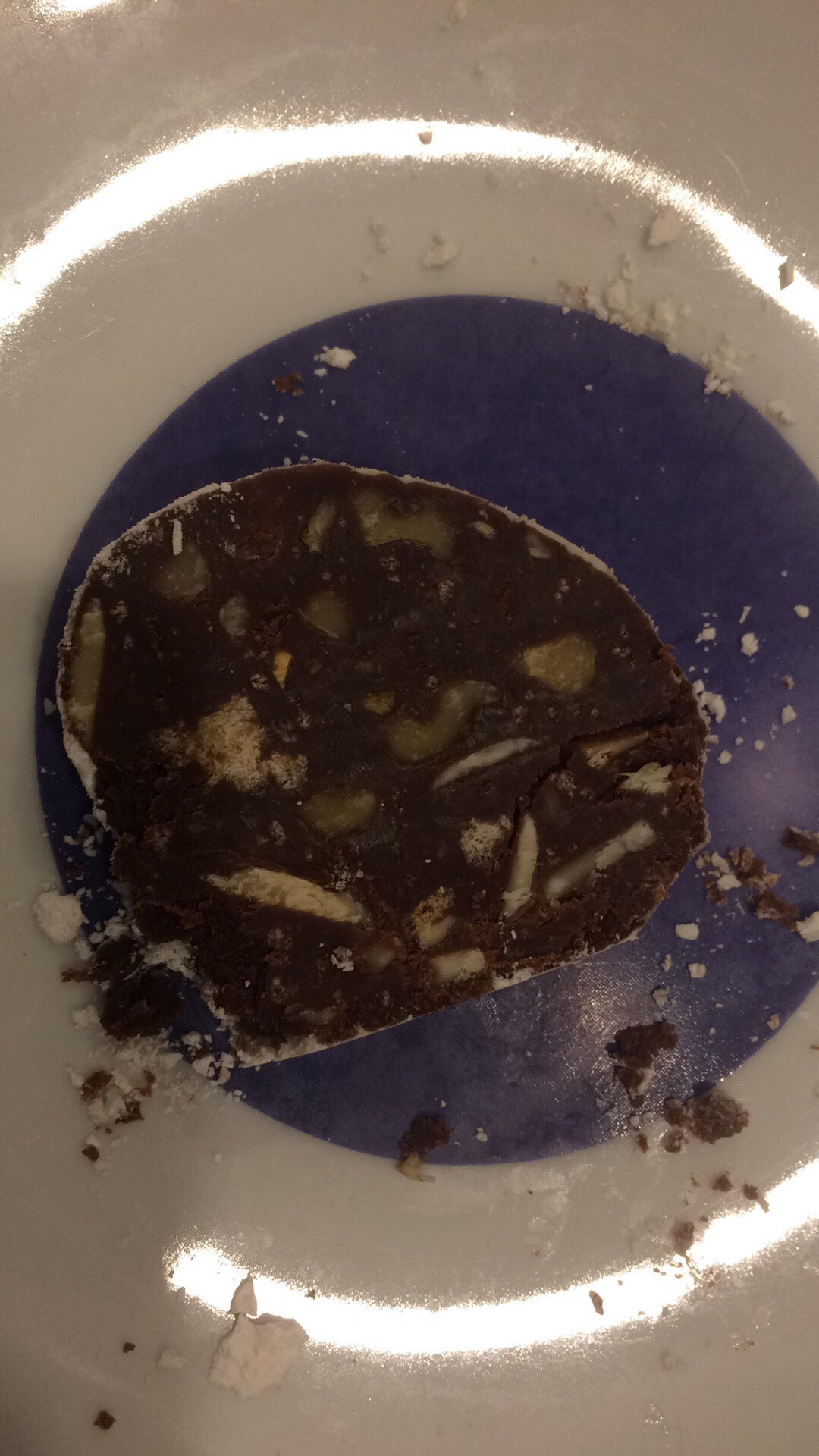
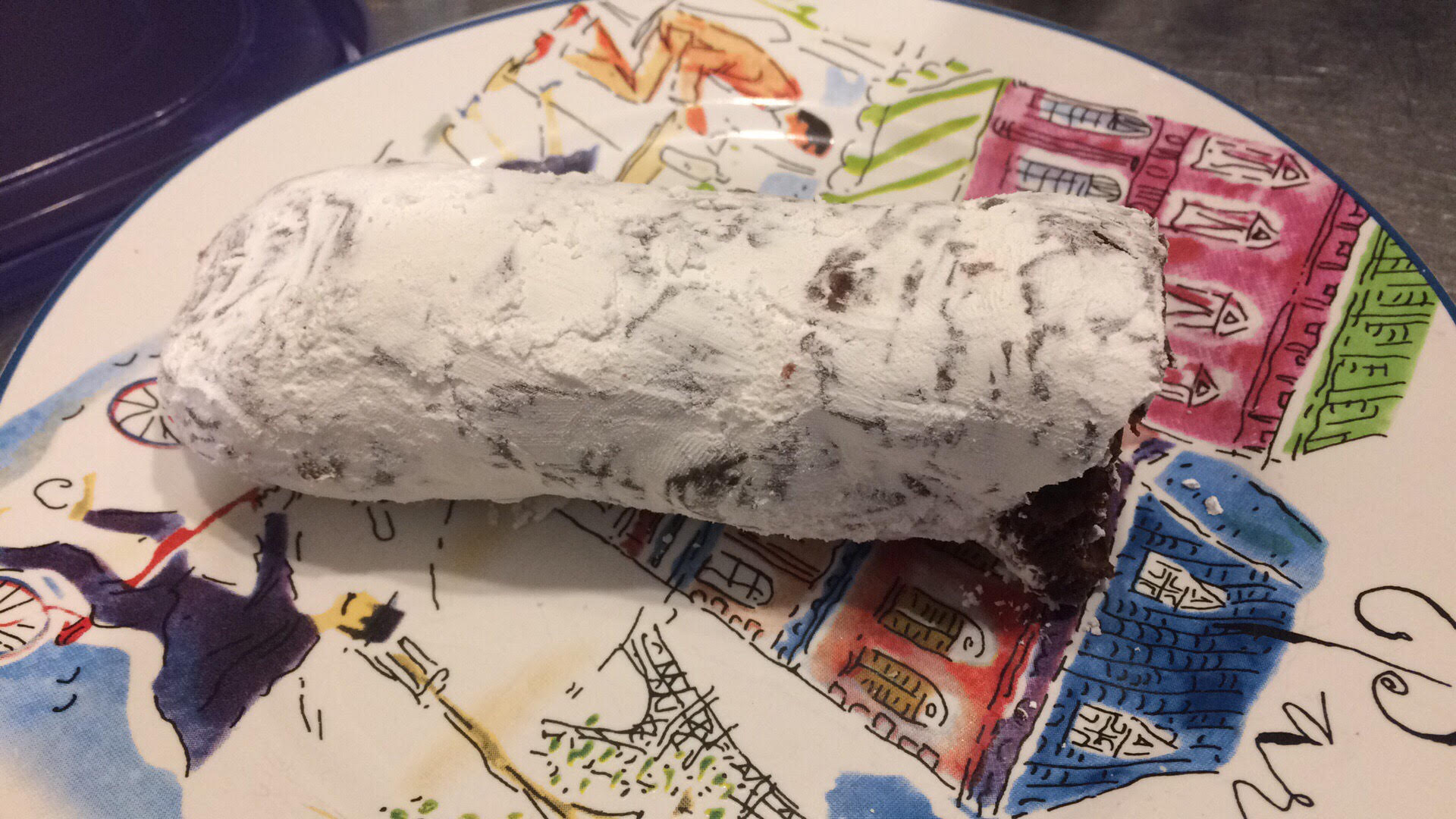
So I decided it was time to learn to make chocolate salami myself. If you’ve ever made truffles or anything truffle-like, it’s really not so hard. The matrix is like truffle filling, with chopped nuts and crushed biscotti as the “fat blobs” that appear in a meat sausage. You make the filling, allow it to cool until it is moldable, roll it into a log, and then dust the thing with powdered sugar to simulate the aged sausage casing. I used this Food Network recipe by Giada de Laurentiis and didn’t modify it at all. The result was quite pleasing, even for a beta version.

I had trouble getting the log perfectly round; first the matrix wasn’t chilled enough and mushed all over, then it was a little too hard and ended up a bit ridgy and oval rather than round. But for a first try, I was happy with the result. Here are some photos, and I apologize to every Italian chocolate sausage-maker for posing this one on a plate that says “Paris.”

salami2

salami1

salami3

Written by Corinne McKay · Categorized: Off topic · Tagged: chocolate salami

  • « Go to Previous Page
  • Page 1
  • Interim pages omitted …
  • Page 90
  • Page 91
  • Page 92
  • Page 93
  • Page 94
  • Interim pages omitted …
  • Page 245
  • Go to Next Page »

Primary Sidebar

Subscribe to the Training for Translators mailing list!

Getting Started as a Freelance Interpreter: Available now in print and electronic editions

Learn from our blog:

  • Survey results: The state of freelance translation in 2026
  • Focus on the clients who can afford you
  • Upcoming direct client marketing class
  • Travel: Cycling Quebec’s Tomifobia Nature Trail
  • Travel: Cycling Burlington, Vermont’s Causeway Bike Trail
  • When part of your business falls off a cliff
  • Upcoming free webinar: Honest brand communications through purpose, positioning, and personality
  • Training for Translators Plus is here!

Search the Training for Translators blog

Copyright © 2026 · Training For Translators · Log in

This website uses cookies to improve your experience. We'll assume you're OK with this, but you can opt-out if you wish. To view this website's privacy policy, click About>Privacy Policy. Accept Read More
Privacy & Cookies Policy

Privacy Overview

This website uses cookies to improve your experience while you navigate through the website. Out of these, the cookies that are categorized as necessary are stored on your browser as they are essential for the working of basic functionalities of the website. We also use third-party cookies that help us analyze and understand how you use this website. These cookies will be stored in your browser only with your consent. You also have the option to opt-out of these cookies. But opting out of some of these cookies may affect your browsing experience.
Necessary
Always Enabled
Necessary cookies are absolutely essential for the website to function properly. This category only includes cookies that ensures basic functionalities and security features of the website. These cookies do not store any personal information.
Non-necessary
Any cookies that may not be particularly necessary for the website to function and is used specifically to collect user personal data via analytics, ads, other embedded contents are termed as non-necessary cookies. It is mandatory to procure user consent prior to running these cookies on your website.
SAVE & ACCEPT